. 2010 May 5;11(5):402-11.
doi: 10.1016/j.cmet.2010.03.012.

Resistance to high-fat diet-induced obesity and insulin resistance in mice with very long-chain acyl-CoA dehydrogenase deficiency

Affiliations

Resistance to high-fat diet-induced obesity and insulin resistance in mice with very long-chain acyl-CoA dehydrogenase deficiency

Dongyan Zhang et al. Cell Metab. .

Erratum in

  • Cell Metab. 2010 Jul 4;12(1):103

Abstract

Mitochondrial fatty acid oxidation provides an important energy source for cellular metabolism, and decreased mitochondrial fatty acid oxidation has been implicated in the pathogenesis of type 2 diabetes. Paradoxically, mice with an inherited deficiency of the mitochondrial fatty acid oxidation enzyme, very long-chain acyl-CoA dehydrogenase (VLCAD), were protected from high-fat diet-induced obesity and liver and muscle insulin resistance. This was associated with reduced intracellular diacylglycerol content and decreased activity of liver protein kinase Cvarepsilon and muscle protein kinase Ctheta. The increased insulin sensitivity in the VLCAD(-/-) mice were protected from diet-induced obesity and insulin resistance due to chronic activation of AMPK and PPARalpha, resulting in increased fatty acid oxidation and decreased intramyocellular and hepatocellular diacylglycerol content.


Figures
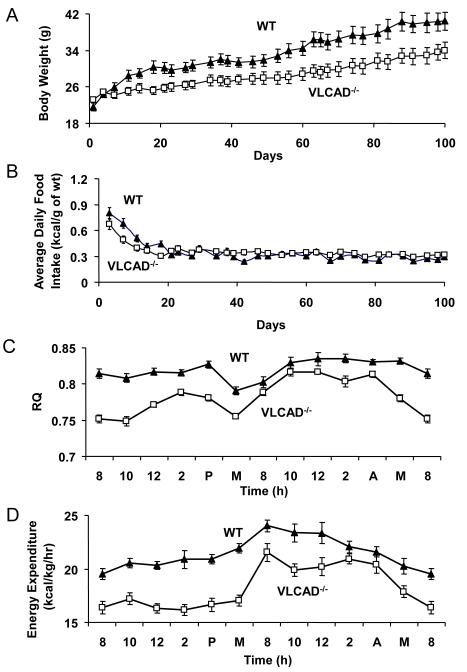
Figure 1
Figure 1
(A) VLCAD−/− mice have significantly lower body weight (P<0.05) than WT mice when fed a high-fat diet ad lib for 100 days. (B) VLCAD−/− mice have significantly lower food intake (P<0.05) as compared to WT mice fed a high-fat diet ad lib for the first two weeks of feeding. (C) VLCAD−/− mice have significantly lower RQ (P<0.001) and (D) lower energy expenditure (P<0.02) as compared to WT controls measured over 24 hours. RQ and energy expenditure measurements were performed on mice pair-fed high-fat diet for 3 months. Both groups n=7. Values are mean ± SEM.
Figure 2
Figure 2
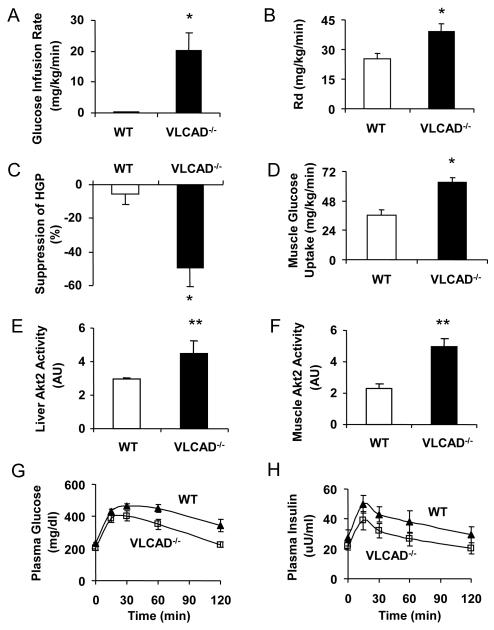
VLCAD−/− mice are resistant to high-fat induced insulin resistance as demonstrated by (A) a significantly higher glucose infusion rate, (B) significantly higher whole body glucose uptake (Rd), (C) significantly higher insulin-mediated suppression of hepatic glucose production (HGP), and (D) a significantly higher skeletal muscle glucose uptake as compared to WT controls pair-fed high fat diet. The downstream effects include significantly increased Akt2 activity in the liver (E) and muscle (F) of VLCAD−/− mice. VLCAD−/− mice also had improved glucose tolerance during IPGTT, as shown by a significantly lower glucose curve (G) as compared to WT, while the insulin curve was also trending lower (H). *, P<0.05. **, P<0.01. Both groups n=7 and were pair-fed the high-fat diet. Values are mean± SEM.
Figure 3
Figure 3
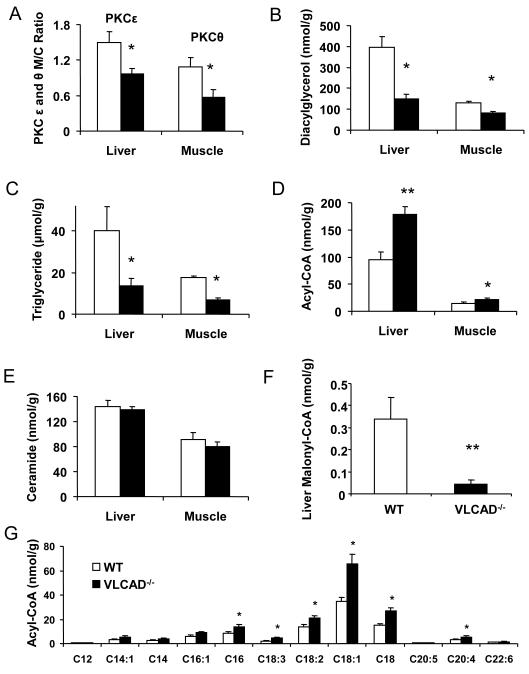
(A) Protein kinase Cε or θ membrane translocation (activation) in liver and muscle of VLCAD−/− mice was significantly decreased as compared to WT controls; (B) diacylglycerol (DAG) and (C) triglyceride (TG) concentrations in liver were significantly lower in the VLCAD−/− mice; (D) VLCAD−/− mice had significantly higher total acyl-CoA concentrations in liver (P< 0.01) and muscle; (E) there were no significant differences in the liver ceramide concentrations; (F) Liver malonyl-CoA significantly lower in VLCAD−/− mice. (G) Liver acyl-CoA profile. Open bars are WT and black filled bars indicate VLCAD−/− mice. *, P<0.05. **, P<0.01. Both groups n=7 and were pair-fed the high-fat diet. Values are mean± SEM.
Figure 4
Figure 4
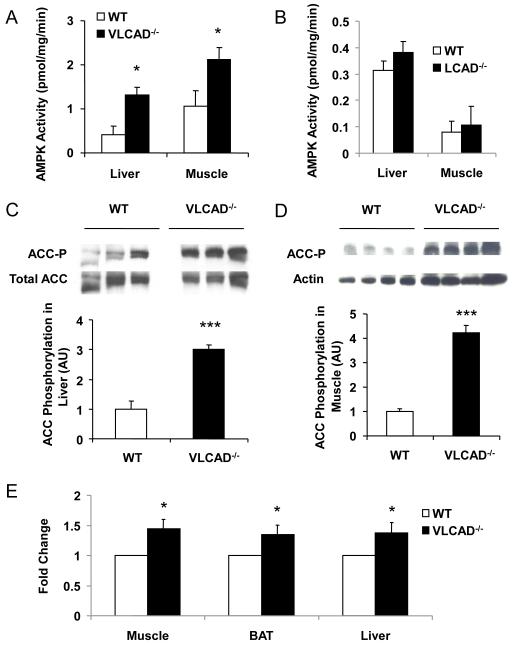
AMPK activity and phospho-acetyl-CoA carboxylase. AMPK activity is significantly elevated in (A) VLCAD−/− liver and skeletal muscle; but not in (B) LCAD−/− liver and skeletal muscle; VLCAD−/− mice have significantly increased phosphorylated (inactivated form) ACC in both (C) liver and (D) skeletal muscle. (E) fatty acid oxidation is significantly increased in VLCAD−/− mouse liver, brown adipose tissue (BAT) and skeletal muscle. *, P<0.05. **, P<0.01. ***, P<0.001. All groups have n=7. Values are mean± SEM.
Figure 5
Figure 5
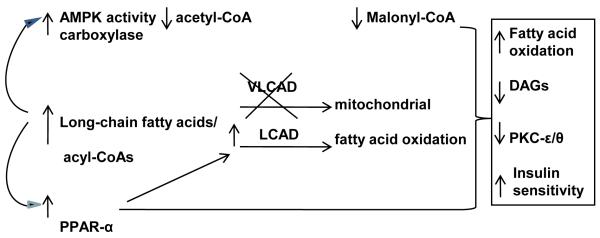
Schematic summary of increased fatty acid oxidation and insulin sensitivity in high fat fed VLCAD−/− mice. We hypothesize that due to the build-up of long-chain fatty acids in the mouse VLCAD deficient state with enzymatic compensation provided by intact LCAD activity, there is a stimulation of fatty acid oxidation via (1) direct activation of AMPK and (2) stimulation of PPAR-α with the collective downstream activation of mitochondrial fatty acid oxidation. The net effect is a resistance in the VLCAD −/− mice to the build-up of DAG and the insulin resistant state found in the high-fat fed WT mice.

References

    1. Alessi DR, Caudwell FB, Andjelkovic M, Hemmings BA, Cohen P. Molecular basis for the substrate specificity of protein kinase B; comparison with MAPKAP kinase-1 and p70 S6 kinase. FEBS Lett. 1996;399:333–338. - PubMed
    1. Clark H, Carling D, Saggerson D. Covalent activation of heart AMP-activated protein kinase in response to physiological concentrations of long-chain fatty acids. Eur J Biochem. 2004;271:2215–2224. - PubMed
    1. Cox KB, Hamm DA, Millington DS, Matern D, Vockley J, Rinaldo P, Pinkert CA, Rhead WJ, Lindsey JR, Wood PA. Gestational, pathologic and biochemical differences between very long-chain acyl-CoA dehydrogenase deficiency and long-chain acyl-CoA dehydrogenase deficiency in the mouse. Hum. Mol. Genet. 2001;10:2069–2077. - PubMed
    1. Cox KB, Liu J, Tian L, Barnes S, Yang Q, Wood PA. Cardiac hypertrophy in mice with long-chain acyl-CoA dehydrogenase or very long-chain acyl-CoA dehydrogenase deficiency. Lab. Invest. 2009;89:1348–1354. - PMC - PubMed
    1. Doh KO, Kim YW, Park SY, Lee SK, Park JS, Kim JY. Interrelation between long-chain fatty acid oxidation rate and carnitine palmitoyltransferase 1 activity with different isoforms in rat tissues. Life Sci. 2005;77:435–43. - PubMed

Publication types

MeSH terms