


Endothelin signalling regulates volume-sensitive Cl- current via NADPH oxidase and mitochondrial reactive oxygen species
- PMID: 20444986
- PMCID: PMC2936123
- DOI: 10.1093/cvr/cvq125
Endothelin signalling regulates volume-sensitive Cl- current via NADPH oxidase and mitochondrial reactive oxygen species
Abstract
Aims: We assessed regulation of volume-sensitive Cl(-) current (I(Cl,swell)) by endothelin-1 (ET-1) and characterized the signalling pathway responsible for its activation in rabbit atrial and ventricular myocytes.
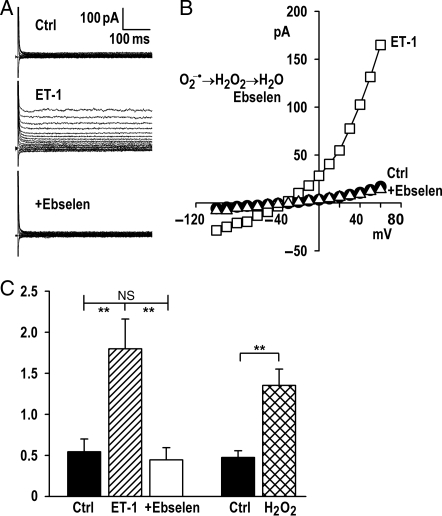
Methods and results: ET-1 elicited I(Cl,swell) under isosmotic conditions. Outwardly rectified Cl(-) current was blocked by the I(Cl,swell)-selective inhibitor DCPIB or osmotic shrinkage and involved ET(A) but not ET(B) receptors. ET-1-induced current was abolished by inhibiting epidermal growth factor receptor (EGFR) kinase or phosphoinositide-3-kinase (PI-3K), indicating that these kinases were downstream. Regarding upstream events, activation of I(Cl,swell) by osmotic swelling or angiotensin II (AngII) was suppressed by ET(A) blockade, whereas AngII AT(1) receptor blockade failed to alter ET-1-induced current. Reactive oxygen species (ROS) produced by NADPH oxidase (NOX) stimulate I(Cl,swell). As expected, blockade of NOX suppressed ET-1-induced I(Cl,swell), but blockade of mitochondrial ROS production with rotenone also suppressed I(Cl,swell). I(Cl,swell) was activated by augmenting complex III ROS production with antimycin A or diazoxide; in this case, I(Cl,swell) was insensitive to NOX inhibitors, indicating that mitochondria were downstream from NOX. ROS generation in HL-1 cardiomyocytes measured by flow cytometry confirmed the electrophysiological findings. ET-1-induced ROS production was inhibited by blocking either NOX or mitochondrial complex I, whereas complex III-induced ROS production was insensitive to NOX blockade.
Conclusion: ET-1-ET(A) signalling activated I(Cl,swell) via EGFR kinase, PI-3K, and NOX ROS production, which triggered mitochondrial ROS production. ET(A) receptors were downstream effectors when I(Cl,swell) was elicited by osmotic swelling or AngII. These data suggest that ET-1-induced ROS-dependent I(Cl,swell) is likely to participate in multiple physiological and pathophysiological processes.
Figures




References
-
- Brunner F, Bras-Silva C, Cerdeira AS, Leite-Moreira AF. Cardiovascular endothelins: essential regulators of cardiovascular homeostasis. Pharmacol Ther. 2006;111:508–531. - PubMed
-
- Ono K, Tsujimoto G, Sakamoto A, Eto K, Masaki T, Ozaki Y, et al. Endothelin-A receptor mediates cardiac inhibition by regulating calcium and potassium currents. Nature. 1994;370:301–304. doi:10.1038/370301a0. - DOI - PubMed
-
- Kiesecker C, Zitron E, Scherer D, Lueck S, Bloehs R, Scholz EP, et al. Regulation of cardiac inwardly rectifying potassium current IK1 and Kir2.x channels by endothelin-1. J Mol Med. 2006;84:46–56. doi:10.1007/s00109-005-0707-8. - DOI - PubMed
-
- Du XY, Sorota S. Cardiac swelling-induced chloride current is enhanced by endothelin. J Cardiovasc Pharmacol. 2000;35:769–776. doi:10.1097/00005344-200005000-00014. - DOI - PubMed
-
- Browe DM, Baumgarten CM. Angiotensin II (AT1) receptors and NADPH oxidase regulate Cl− current elicited by β1 integrin stretch in rabbit ventricular myocytes. J Gen Physiol. 2004;124:273–287. doi:10.1085/jgp.200409040. - DOI - PMC - PubMed
Publication types
MeSH terms
Substances
Grants and funding
LinkOut - more resources
Full Text Sources
Research Materials
Miscellaneous
