


Importance of carbon dioxide physiological forcing to future climate change
- PMID: 20445083
- PMCID: PMC2906877
- DOI: 10.1073/pnas.0913000107
Importance of carbon dioxide physiological forcing to future climate change
Abstract
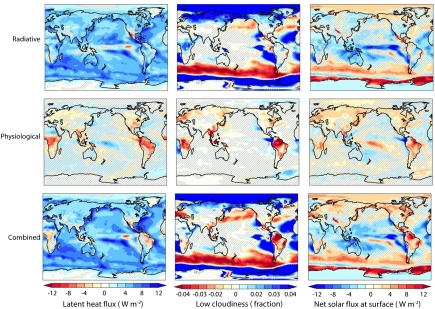
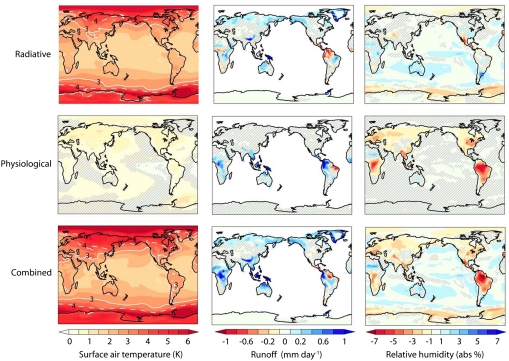
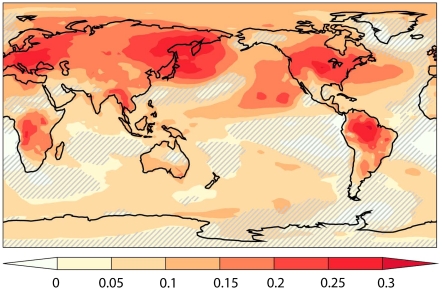
An increase in atmospheric carbon dioxide (CO(2)) concentration influences climate both directly through its radiative effect (i.e., trapping longwave radiation) and indirectly through its physiological effect (i.e., reducing transpiration of land plants). Here we compare the climate response to radiative and physiological effects of increased CO(2) using the National Center for Atmospheric Research (NCAR) coupled Community Land and Community Atmosphere Model. In response to a doubling of CO(2), the radiative effect of CO(2) causes mean surface air temperature over land to increase by 2.86 +/- 0.02 K (+/- 1 standard error), whereas the physiological effects of CO(2) on land plants alone causes air temperature over land to increase by 0.42 +/- 0.02 K. Combined, these two effects cause a land surface warming of 3.33 +/- 0.03 K. The radiative effect of doubling CO(2) increases global runoff by 5.2 +/- 0.6%, primarily by increasing precipitation over the continents. The physiological effect increases runoff by 8.4 +/- 0.6%, primarily by diminishing evapotranspiration from the continents. Combined, these two effects cause a 14.9 +/- 0.7% increase in runoff. Relative humidity remains roughly constant in response to CO(2)-radiative forcing, whereas relative humidity over land decreases in response to CO(2)-physiological forcing as a result of reduced plant transpiration. Our study points to an emerging consensus that the physiological effects of increasing atmospheric CO(2) on land plants will increase global warming beyond that caused by the radiative effects of CO(2).
Conflict of interest statement
The authors declare no conflict of interest.
Figures
References
-
- Field C, Jackson R, Mooney H. Stomatal responses to increased CO2: implications from the plant to the global scale. Plant Cell Environ. 1995;18:1214–1255. doi: . - DOI
-
- Collatz GJ, Ribas-Carbo M, Berry JA. A coupled photosynthesis-stomatal conductance model for leaves of C4 plants. J Plant Physiol. 1992;19:519–538.
-
- Sellers PJ, et al. Comparison of radiative and physiological effects of doubled atmospheric CO2 on climate. Science. 1996;271:1402–1406. doi: . - DOI
-
- Hungate BA, et al. Evapotranspiration and soil water content in a scrub-oak woodland under carbon dioxide enrichment. Glob Change Biol. 2002;8:289–298. doi: . - DOI
MeSH terms
Substances
LinkOut - more resources
Full Text Sources
Medical
Molecular Biology Databases
