Review
. 2010 Aug;45(4):257-65.
doi: 10.3109/10409231003786094.

Dual functions of codons in the genetic code

Affiliations
Review

Dual functions of codons in the genetic code

Alexey V Lobanov et al. Crit Rev Biochem Mol Biol. 2010 Aug.

Abstract

The discovery of the genetic code provided one of the basic foundations of modern molecular biology. Most organisms use the same genetic language, but there are also well-documented variations representing codon reassignments within specific groups of organisms (such as ciliates and yeast) or organelles (such as plastids and mitochondria). In addition, duality in codon function is known in the use of AUG in translation initiation and methionine insertion into internal protein positions as well as in the case of selenocysteine and pyrrolysine insertion (encoded by UGA and UAG, respectively) in competition with translation termination. Ambiguous meaning of CUG in coding for serine and leucine is also known. However, a recent study revealed that codons in any position within the open reading frame can serve a dual function and that a change in codon meaning can be achieved by availability of a specific type of RNA stem-loop structure in the 3'-untranslated region. Thus, duality of codon function is a more widely used feature of the genetic code than previously known, and this observation raises the possibility that additional recoding events and additional novel features have evolved in the genetic code.


Conflict of interest statement

Declaration of interest

The authors report no conflicts of interest. The authors alone are responsible for the content and writing of the paper.

Figures
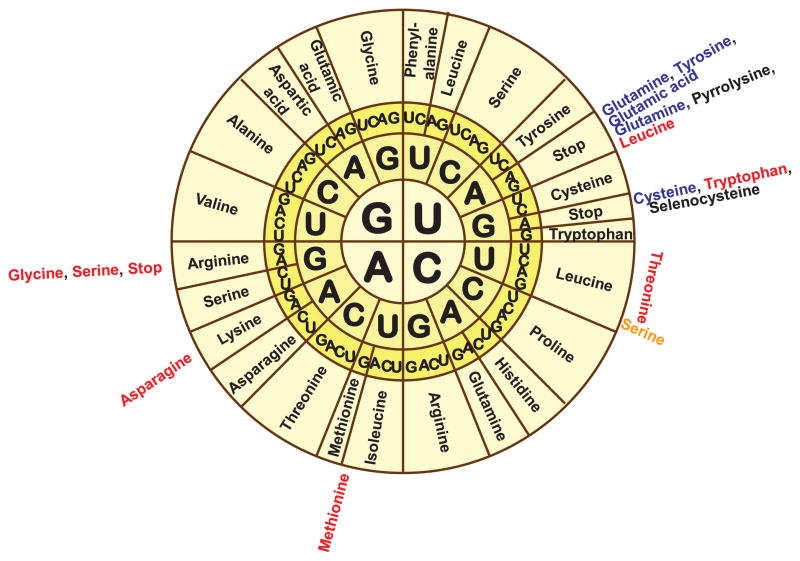
Figure 1
Figure 1. The genetic code and its variations
The figure is available in color in the online publication. The genetic code is shown in the circular form, with known alternative meanings indicated outside the circle. Differences with the standard genetic code are shown as follows: red for mitochondrial, blue for ciliate and Euplotid nuclear code, and orange for the ambiguous yeast nuclear code. Sec and Pyl are shown in black.
Figure 2
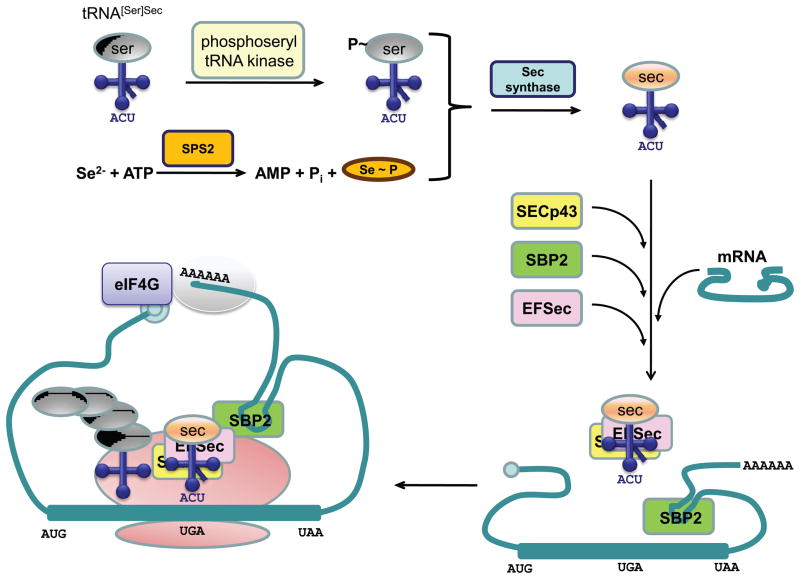
Figure 2. Selenocysteine incorporation machinery
The figure is available in color in the online publication. The mechanism of Sec biosynthesis and incorporation into selenoproteins is shown and discussed in the text. Further discussion and identification of the various components involved in Sec biosynthesis are presented elsewhere (Xu et al, 2007).
Figure 3
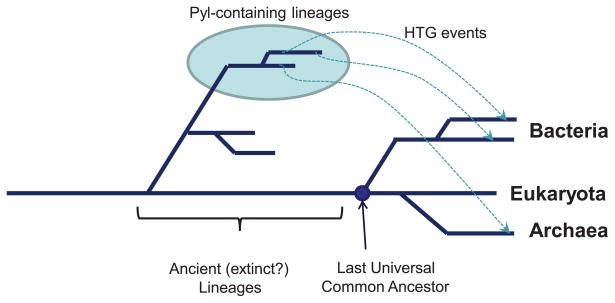
Figure 3. Horizontal gene transfer of the pyrrolysine trait
The figure is available in color in the online publication. The model for a possible horizontal gene transfer of the Pyl trait to archaea and bacteria is shown. Ancient (probably extinct) Pyl users are indicated by a light blue circle, and the last universal common ancestor (LUCA) of eukaryotes, bacteria and archaea is shown in dark blue. Dotted lines show a possible Pyl trait transfer.

References

    1. Ambrogelly A, Gundllapalli S, Herring S, Polycarpo C, Frauer C, Söll D. Pyrrolysine is not hardwired for cotranslational insertion at UAG codons. Proc Natl Acad Sci USA. 2007;104:3141–6. - PMC - PubMed
    1. Berry MJ, Banu L, Harney JW, Larsen PR. Functional characterization of the eukaryotic SECIS elements which direct selenocysteine insertion at UGA codons. EMBO J. 1993;12:3315–22. - PMC - PubMed
    1. Blattner FR, Plunkett G, Bloch CA, Perna NT, Burland V, Riley M, Collado-Vides J, Glasner JD, et al. The Complete Genome Sequence of Escherichia coli K-12. Science. 1997;277:1453–62. - PubMed
    1. Brown CM, Dinesh-Kumar SP, Miller WA. Local and distant sequences are required for efficient readthrough of the barley yellow dwarf virus PAV coat protein gene stop codon. J Virol. 1996;70:5884–5892. - PMC - PubMed
    1. Chambers I, Frampton J, Goldfarb P, Affara N, McBain W, Harrison PR. The structure of the mouse glutathione peroxidase gene: the selenocysteine in the active site is encoded by the 'termination' codon, TGA. EMBO J. 1986;5:1221–7. - PMC - PubMed

Publication types

Substances

LinkOut - more resources