


Angiotensin II and the ERK pathway mediate the induction of myocardin by hypoxia in cultured rat neonatal cardiomyocytes
- PMID: 20446923
- PMCID: PMC2890999
- DOI: 10.1042/CS20100084
Angiotensin II and the ERK pathway mediate the induction of myocardin by hypoxia in cultured rat neonatal cardiomyocytes
Abstract
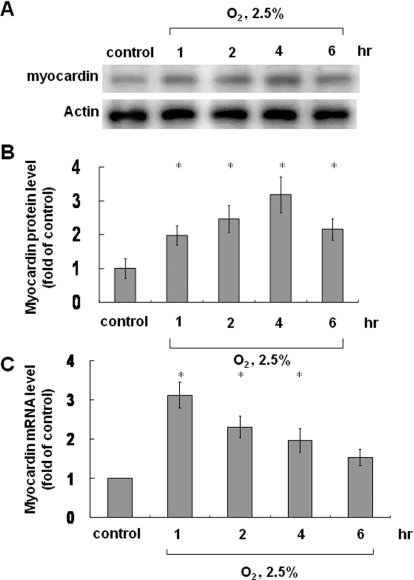
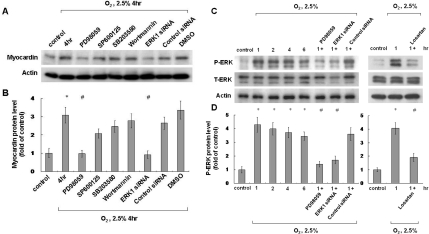
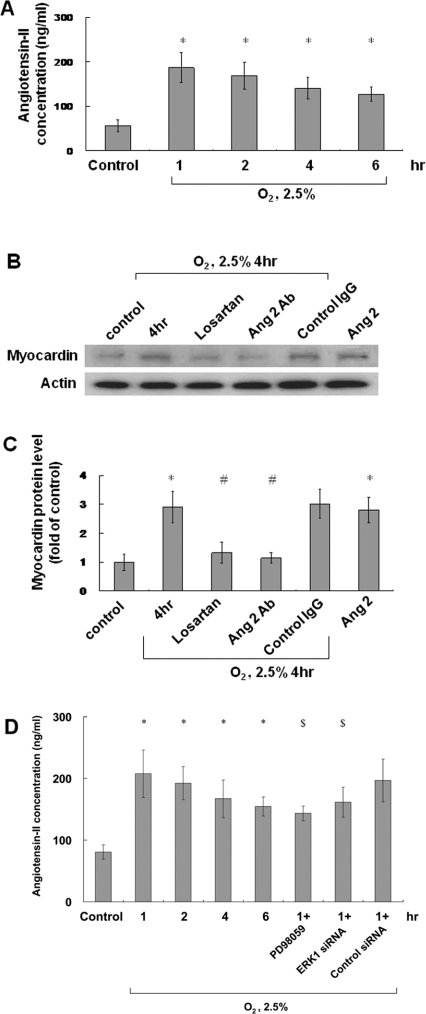
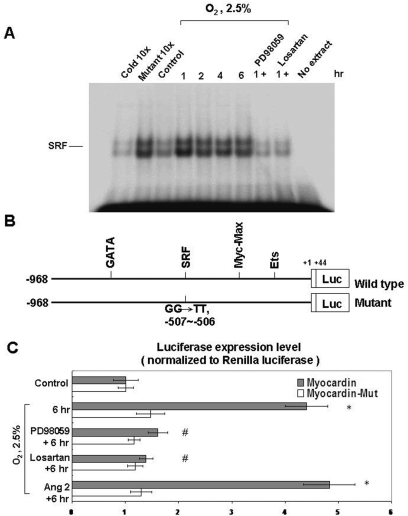
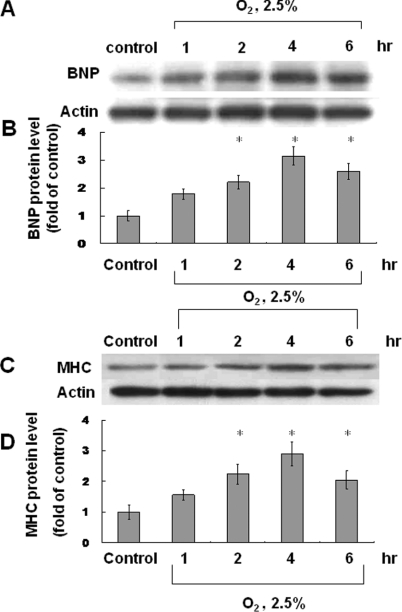
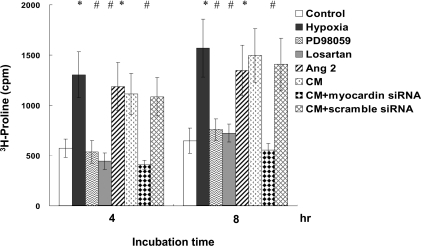
Hypoxic injury to cardiomyocytes is a stress that causes cardiac pathology through cardiac-restricted gene expression. SRF (serum-response factor) and myocardin are important for cardiomyocyte growth and differentiation in response to myocardial injuries. Previous studies have indicated that AngII (angiotensin II) stimulates both myocardin expression and cardiomyocyte hypertrophy. In the present study, we evaluated the expression of myocardin and AngII after hypoxia in regulating gene transcription in neonatal cardiomyocytes. Cultured rat neonatal cardiomyocytes were subjected to hypoxia, and the expression of myocardin and AngII were evaluated. Different signal transduction pathway inhibitors were used to identify the pathway(s) responsible for myocardin expression. An EMSA (electrophoretic mobility-shift assay) was used to identify myocardin/SRF binding, and a luciferase assay was used to identify transcriptional activity of myocardin/SRF in neonatal cardiomyocytes. Both myocardin and AngII expression increased after hypoxia, with AngII appearing at an earlier time point than myocardin. Myocardin expression was stimulated by AngII and ERK (extracellular-signal-regulated kinase) phosphorylation, but was suppressed by an ARB (AngII type 1 receptor blocker), an ERK pathway inhibitor and myocardin siRNA (small interfering RNA). AngII increased both myocardin expression and transcription in neonatal cardiomyocytes. Binding of myocardin/SRF was identified using an EMSA, and a luciferase assay indicated the transcription of myocardin/SRF in neonatal cardiomyocytes. Increased BNP (B-type natriuretic peptide), MHC (myosin heavy chain) and [(3)H]proline incorporation into cardiomyocytes was identified after hypoxia with the presence of myocardin in hypertrophic cardiomyocytes. In conclusion, hypoxia in cardiomyocytes increased myocardin expression, which is mediated by the induction of AngII and the ERK pathway, to cause cardiomyocyte hypertrophy. Myocardial hypertrophy was identified as an increase in transcriptional activities, elevated hypertrophic and cardiomyocyte phenotype markers, and morphological hypertrophic changes in cardiomyocytes.
Figures
References
-
- Miano J. M. Serum response factor: toggling between disparate programs of gene expression. J. Mol. Cell. Cardiol. 2003;35:577–593. - PubMed
-
- Wang D., Chang P. S., Wang Z., Sutherland L., Richardson J. A., Small E., Krieg P. A., Olson E. N. Activation of cardiac gene expression by myocardin, a transcriptional cofactor for serum response factor. Cell. 2001;105:851–862. - PubMed
-
- Zhang X., Azhar G., Zhong Y., Wei J. Y. Identification of a novel serum response factor cofactor in cardiac gene regulation. J. Biol. Chem. 2004;279:55626–55632. - PubMed
-
- Kontaraji J. E., Parthenakis F. I., Patrianakos A. P., Karalis I. K., Vardas P. E. Altered expression of early marker genes in circulating cells of patients with hypertrophic cardiomyopathy. Cardiovasc. Pathol. 2007;16:329–335. - PubMed
MeSH terms
Substances
LinkOut - more resources
Full Text Sources
Research Materials
Miscellaneous
