


HLA-allele matched unrelated donors compared to HLA-matched sibling donors: role of cell source and disease risk category
- PMID: 20447462
- PMCID: PMC2934755
- DOI: 10.1016/j.bbmt.2010.03.024
HLA-allele matched unrelated donors compared to HLA-matched sibling donors: role of cell source and disease risk category
Abstract
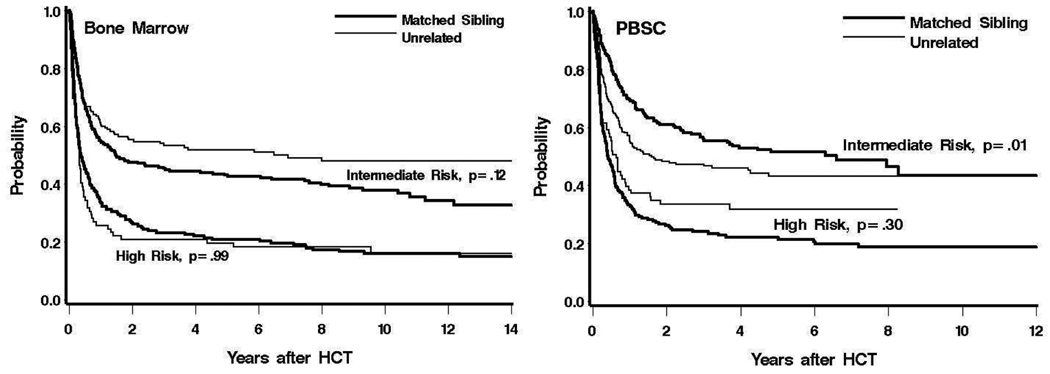
To determine whether the risks of allogeneic transplantation are different when the donor is a fully matched unrelated donor (MUD; based on 10/10 HLA alleles) compared to an HLA-identical sibling, we performed a retrospective analysis of 1448 patients with high-risk or advanced hematologic malignancies given T-replete grafts after myeloablative conditioning. No statistically significant differences were found between recipients of a matched sibling donor (MSD) and 10/10 MUD in survival, disease-free survival (DFS), and nonrelapse mortality (NRM) for patients with high-risk disease or those given bone marrow as a graft source. However, for patients with intermediate-risk disease receiving peripheral blood grafts, we observed higher NRM and lower overall survival (OS) in the 10/10 MUD group compared to the MSD cohort. Graft-versus-host disease (GVHD) was higher in the MUD group compared to the MSD group. These results suggest that if a patient has high-risk disease and an MSD is not available, selection of an HLA-allele-matched MUD may provide similar OS and DFS, and therefore lack of an MSD in and of itself should not preclude such a patient from undergoing transplantation. However, for patients with intermediate-risk disease, transplantation with peripheral blood from a 10/10 MUD is associated with lower survival than an MSD.
Copyright © 2010 American Society for Blood and Marrow Transplantation. Published by Elsevier Inc. All rights reserved.
Conflict of interest statement
Conflict-of-interest disclosure: The authors declare no competing financial interests.
Figures
References
-
- Petersdorf EW, Anasetti C, Martin PJ, et al. Limits of HLA mismatching in unrelated hematopoietic cell transplantation. Blood. 2004;104:2976–2980. - PubMed
-
- Lee SJ, Klein J, Haagenson M, et al. High-resolution donor-recipient HLA matching contributes to the success of unrelated donor marrow transplantation. Blood. 2007;110:4576–4583. - PubMed
-
- Yakoub-Agha I, Mesnil F, Kuentz M, et al. Allogeneic marrow stem-cell transplantation from human leukocyte antigen-identical siblings versus human leukocyte antigen-allelic-matched unrelated donors (10/10) in patients with standard-risk hematologic malignancy: a prospective study from the French Society of Bone Marrow Transplantation and Cell Therapy. J Clin Oncol. 2006;24:5695–5702. - PubMed
-
- Hansen JA, Mickelson EM, Choo SY, et al. Clinical bone marrow transplantation: Donor selection and recipient monitoring. In: Rose NR, De Macario EC, Fahey JL, Friedman H, Penn GM, editors. Manual of Clinical Laboratory Immunology. Washington: American Society for Microbiology; 1992. pp. 850–866.
Publication types
MeSH terms
Substances
Grants and funding
LinkOut - more resources
Full Text Sources
Medical
Research Materials
