


Comment
doi: 10.1038/nm0510-523.
Fibrosis under arrest
- PMID: 20448575
- PMCID: PMC3169997
- DOI: 10.1038/nm0510-523
Item in Clipboard
Comment
Fibrosis under arrest
Nat Med.
2010 May.
Abstract
Approximately 5% of people that are hospitalized for any reason develop acute kidney failure, which, in some cases, progresses to a chronic condition resulting in fibrosis of the kidney and permanent changes in the organ’s function. Two new studies suggest that cell cycle arrest of epithelial cells and epigenetic modifications have key roles in the switch to chronic disease (pages 535–543 and 544–550).
Conflict of interest statement
The author declares no competing financial interests.
Figures
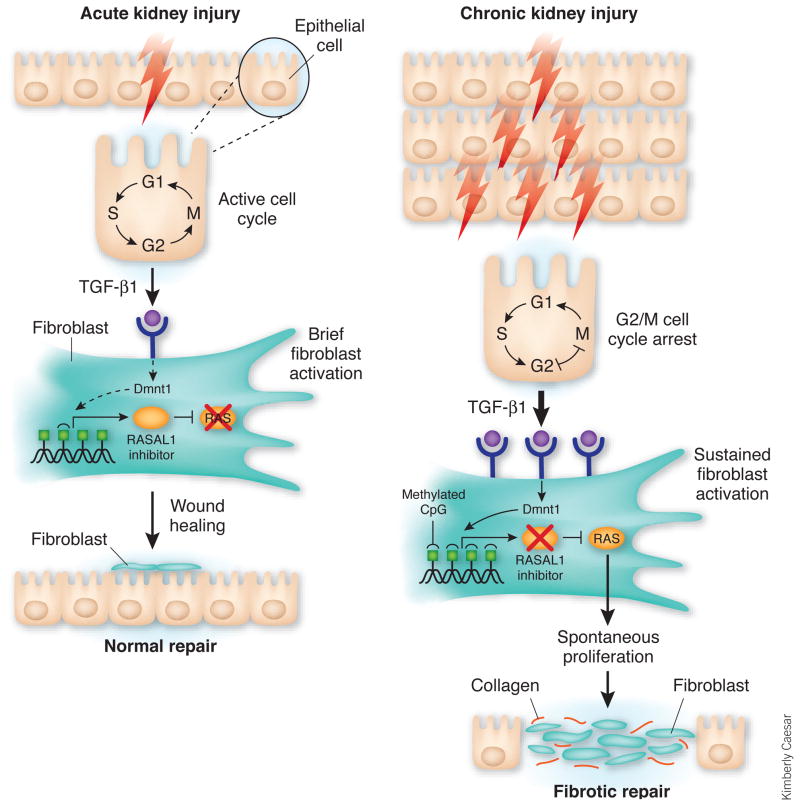
Epithelial cell cycle arrest in G2/M and epigenetic changes in fibroblasts coordinately promote kidney fibrosis. After acute kidney injury, damaged epithelial cells initiate a wound-healing program. When the injury is of short duration (left), epithelial cells located near the lesion secrete modest amounts of TGF-β1, which induces fibroblast proliferation and secretion of extracellular matrix components such as collagen I. Epithelial cells also activate the cell cycle and begin to proliferate. In the absence of TGF-β1 and other profibrotic mediators, fibroblasts quickly return to the resting state, undergo apoptosis or both, whereas epithelial cells expand in number and quickly repair the site of tissue damage. In cases where the kidney injury is persistent or repeated (right), increasing numbers of epithelial cells stall between the G2 and M phases of the cell cycle, which stimulates the production of considerable amounts of TGF-β1. If the cell cycle is reactivated, TGF-β1 production decreases, and normal wound repair commences once again. However, if the epithelial cell cycle is arrested for an extended length of time, TGF-β1 production persists and contributes to downstream epigenetic modifications in fibroblasts that slowly transform these cells into activated myofibroblasts. Myofibroblasts proliferate and secrete collagen in a progressively growth factor–independent manner. Although a variety of genetic modifications take place in fibroblasts at this stage, the gene encoding RASAL1 seems to become hypermethylated by the methytransferase Dnmt1. This epigenetic modification turns down RASAL1 expression leading to persistent Ras activation, perpetual fibroblast proliferation and fibrogenesis in the kidney. Epigenetic changes, such as RASAL1 methylation, are stable modifications that can be inherited through multiple cell divisions. This pathway shows how normal kidney repair mechanisms can quickly transform into pathogenic fibrotic responses.
Comment on
-
Methylation determines fibroblast activation and fibrogenesis in the kidney.Nat Med. 2010 May;16(5):544-50. doi: 10.1038/nm.2135. Epub 2010 Apr 25. Nat Med. 2010. PMID: 20418885 Free PMC article.
-
Epithelial cell cycle arrest in G2/M mediates kidney fibrosis after injury.Nat Med. 2010 May;16(5):535-43, 1p following 143. doi: 10.1038/nm.2144. Epub 2010 May 2. Nat Med. 2010. PMID: 20436483 Free PMC article.
References
Publication types
MeSH terms
Substances
Grants and funding
LinkOut - more resources
Full Text Sources
