Comparative Study
. 2010 Sep 1;268(1-2):2-11.
doi: 10.1016/j.heares.2010.04.014. Epub 2010 May 6.

Murine intracochlear drug delivery: reducing concentration gradients within the cochlea

Affiliations
Comparative Study

Murine intracochlear drug delivery: reducing concentration gradients within the cochlea

David A Borkholder et al. Hear Res. .

Abstract

Direct delivery of compounds to the mammalian inner ear is most commonly achieved by absorption or direct injection through the round window membrane (RWM), or infusion through a basal turn cochleostomy. These methods provide direct access to cochlear structures, but with a strong basal-to-apical concentration gradient consistent with a diffusion-driven distribution. This gradient limits the efficacy of therapeutic approaches for apical structures, and puts constraints on practical therapeutic dose ranges. A surgical approach involving both a basal turn cochleostomy and a posterior semicircular canal canalostomy provides opportunities for facilitated perfusion of cochlear structures to reduce concentration gradients. Infusion of fixed volumes of artificial perilymph (AP) and sodium salicylate were used to evaluate two surgical approaches in the mouse: cochleostomy-only (CO), or cochleostomy-plus-canalostomy (C+C). Cochlear function was evaluated via closed-system distortion product otoacoustic emissions (DPOAE) threshold level measurements from 8 to 49 kHz. AP infusion confirmed no surgical impact to auditory function, while shifts in DPOAE thresholds were measured during infusion of salicylate and AP (washout). Frequency dependent shifts were compared for the CO and C+C approaches. Computer simulations modeling diffusion, volume flow, interscala transport, and clearance mechanisms provided estimates of drug concentration as a function of cochlear position. Simulated concentration profiles were compared to frequency-dependent shifts in measured auditory responses using a cochlear tonotopic map. The impact of flow rate on frequency dependent DPOAE threshold shifts was also evaluated for both surgical approaches. Both the C+C approach and a flow rate increase were found to provide enhanced response for lower frequencies, with evidence suggesting the C+C approach reduces concentration gradients within the cochlea.


Figures

Figure 1
Figure 1
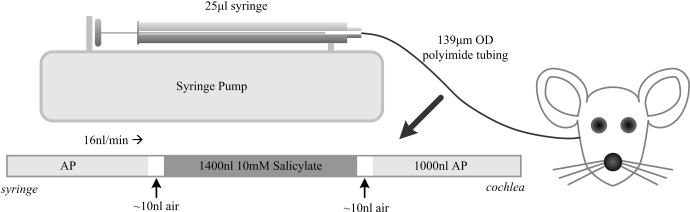
Schematic illustration of the experimental infusion setup. Polyimide microtubing was preloaded with 1000 nL of AP, 1400 nL of SAL, and the washout volume of AP. Fluids were separated by a 10 nL air bubble to prevent mixing of solutions. The setup was attached to a syringe pump to precisely control infusion rate.
Figure 2
Figure 2
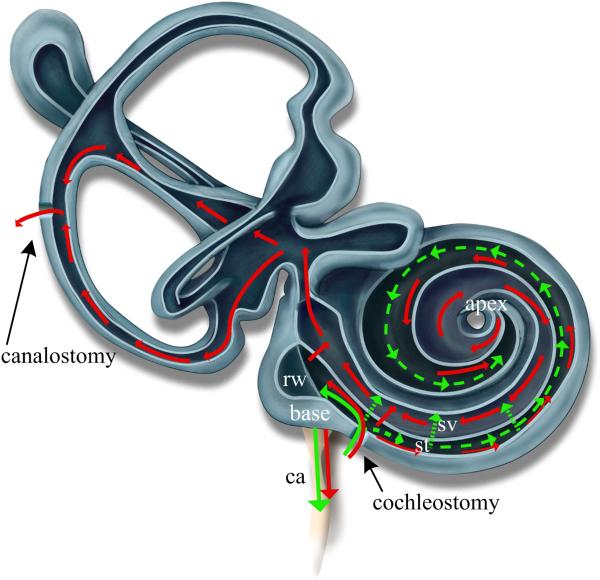
Theoretical flow path within the cochlea and vestibular system for two surgical approaches. Pressure driven flow is depicted with solid lines while dotted lines represent diffusion mechanisms. Cochleostomy-only (Green) results in pressure driven outflow through the cochlear aqueduct (ca) and diffusion driven transport from base to apex and between scala. Cochleostomy-plus-canalostomy (Red) results in pressure driven flow through the cochlear aqueduct, between scala, and from base to apex in scala tympani (st), through the helicotrema, from apex to base in scala vestibuli (sv), and then through the vestibular system. Diffusion mechanisms (not shown) are similar to the CO case. Modeling of these infusion approaches with FluidSim was constrained to a single fluidic exit placed at either the ca or the base of sv..
Figure 3
Figure 3
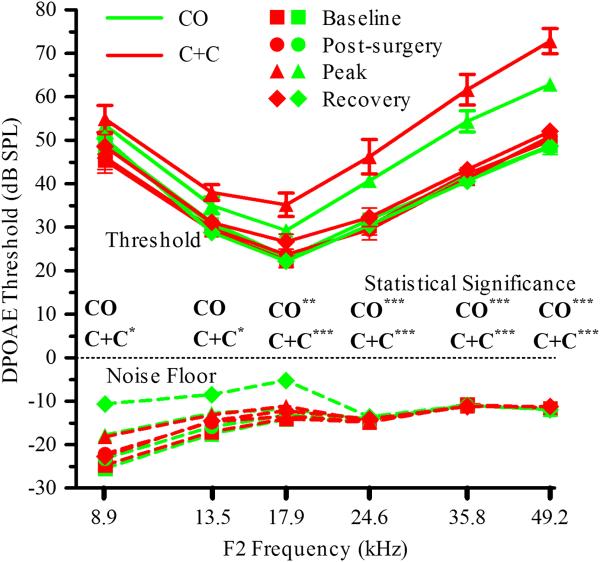
Frequency dependent DPOAE threshold shifts with infusion (16 nl/min) of 1000 nl AP, 1400 nl 10 mM SAL, and ~2000 nl AP. Surgery and infusion of AP resulted in statistically insignificant shifts in DPOAE thresholds while frequency dependent shifts were observed in response to SAL. Statistical comparison of peak threshold shifts to baseline for each frequency and each surgical approach are shown on the figure (* p<0.05, **p<0.01, ***p<0.001). Washout and return of thresholds to baseline values (differences statistically insignificant) suggests no acute damage to auditory function with either surgical approach. Greater shifts at high frequencies are consistent with basal turn infusion. Data are plotted as mean ± SEM (n=8 animals for each approach).
Figure 4
Figure 4
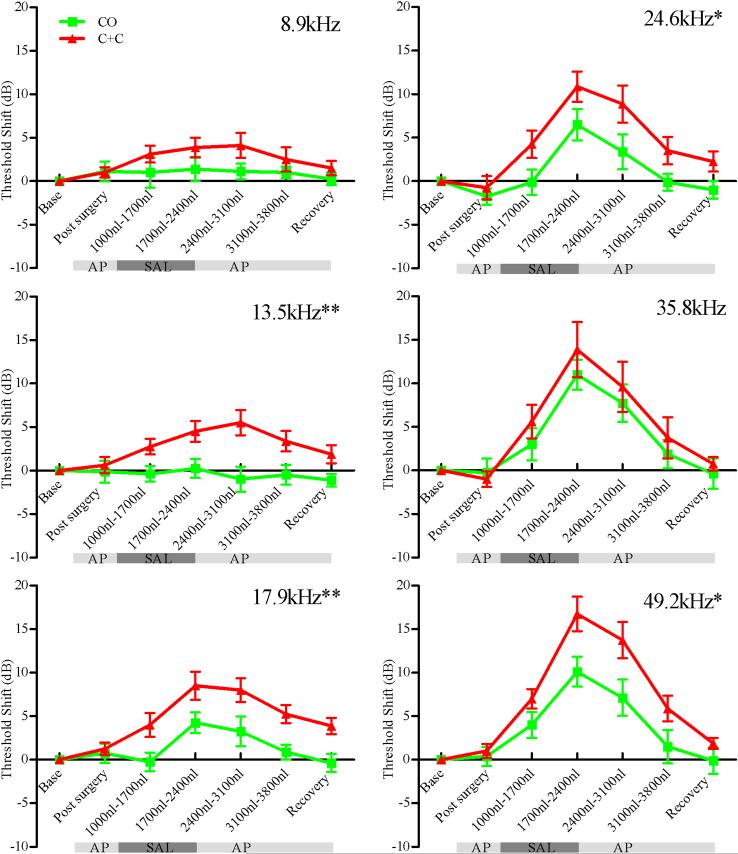
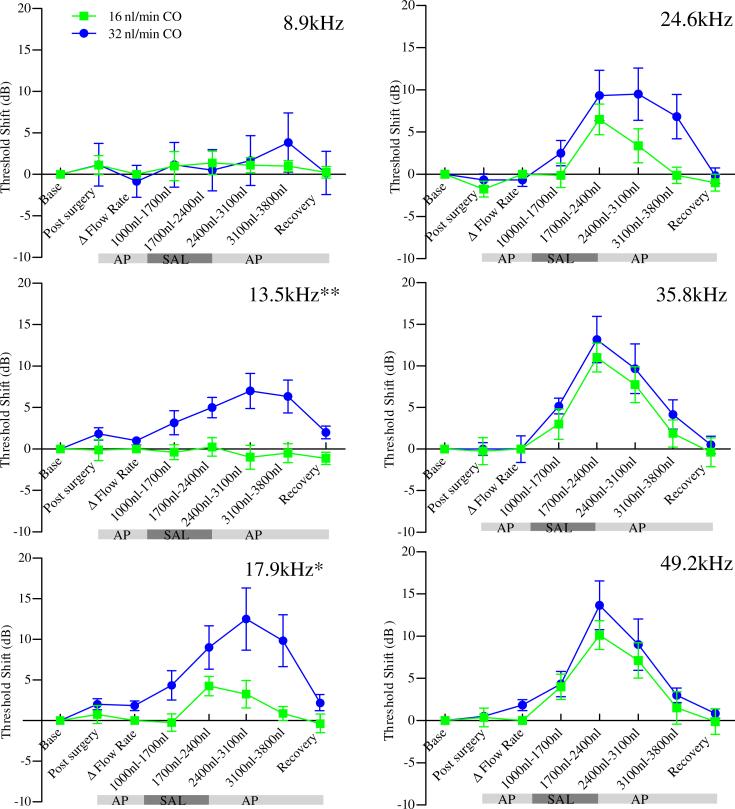
DPOAE threshold shifts versus infused volumes for F2 frequencies 8.9, 13.5, 17.9, 24.6, 35.8 and 49.2 kHz. Green traces are for the CO approach while red traces are for the C+C approach. Statistically significant differences between the methods are observed for 13.5, 17.9, 24.6, and 49.2 kHz demonstrating improved access to apical structures with the C+C approach. Note that the point of infusion is presumed tonotopically close to 35.8 kHz based on similar responses at this frequency. Asterisks on figure indicate statistically significant main effects between methods (* p<0.05, ** p<0.01). Data are plotted as mean ± SEM (n=8 animals for each approach).
Figure 5
Figure 5
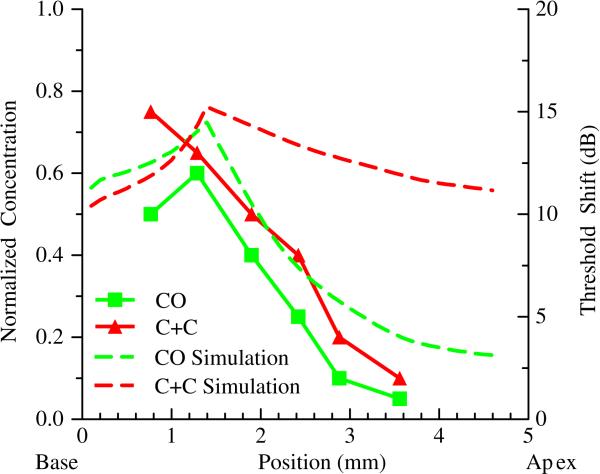
Comparison of simulated concentration gradients to measured DPOAE threshold shifts. Simulated infusion is at 1.3mm. Dotted lines represent normalized drug concentrations in scala tympani following 65 minutes of simulated infusion at 16 nl/min. Data points with solid lines represent in vivo threshold shifts following infusion of 1000nl of SAL. The scale for threshold shift was adjusted to facilitate comparison of trends in threshold and concentration data, and does not suggest a direct correlation between the datasets. The CO data sets are qualitatively similar while the C+C threshold shifts fail to follow the shape of the predicted concentration gradient.
Figure 6
Figure 6
DPOAE threshold shifts versus infused volumes for F2 frequencies 8.9, 13.5, 17.9, 24.6, 35.8 and 49.2 kHz. Flow rates of 16 nl / min (green) and 32 nl/min (blue) were examined for the CO approach. Δ Flow Rate indicates point at which flow was changed from 16 nl/min to 32 nl/min for the higher flow rate experiments. Statistical comparison of peak thresholds to baseline for each frequency: 16nl/min [17.9**, 24.6***, 35.8***, 49.2***], and 32nl/min [13.5**, 17.9***, 24.6***, 35.8***, 49.2***] (* p<0.05, **p<0.01, ***p<0.001). Statistically significant differences between the methods are observed for 13.5 and 17.9 kHz demonstrating higher apical concentrations with the higher flow rate. Asterisks on figure indicate statistically significant main effects between methods (* p<0.05, ** p<0.01). Data are plotted as mean ± SEM (n=8 animals for 16nl/min and n=6 animals for 32nl/min).
Figure 7
Figure 7
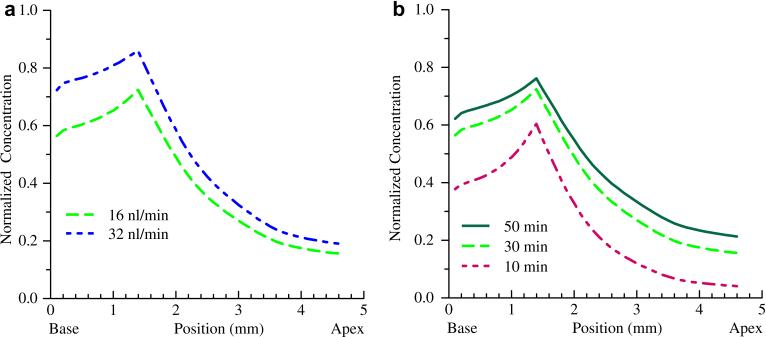
Simulated concentration gradients for the CO infusion at different flow rates and clearance rates. (a) Doubling the flow rate to 32nl / min (blue) results in a predicted increase in concentration consistent with the physiological experiments. (b) Clearance rates have a significant impact on predicted concentrations as shown by the interscala and scala-to-blood communication half-times of 10, 30 and 50 minutes.
Figure 8
Figure 8
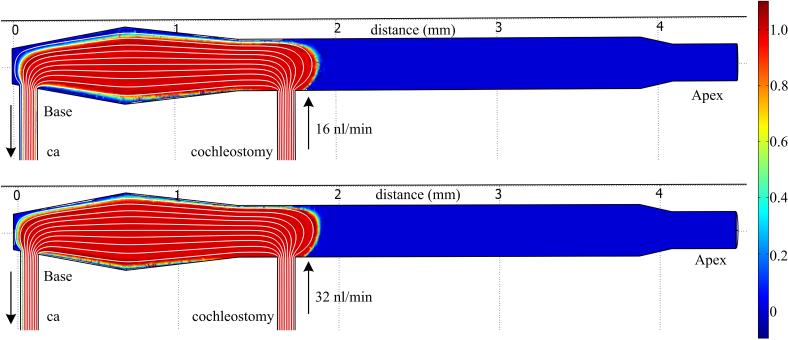
Computation Fluid Dynamics (CFD) analysis of flow in an idealized, linear cochlear model of scala tympani for the CO infusion case for 16 nl/min and 32 nl/min flow rates. Diffusion forces are set to zero to isolate convective transport and allow visualization of flow and mixing mediated spread. Flow is from the cochleostomy to the cochlear aqueduct (ca). (a) The fluid velocity streamlines from the fluid jet, and resulting steady state concentrations (false color) are similar for both flow rates, suggesting the fluid dynamics have minimal impact on distribution in the cochlea. (b) Time evolution of the concentration profile for the 16nl/min flow rate (supplementary information online only).

References

    1. Borkholder DA. State-of-the-art mechanisms of intracochlear drug delivery. Current Opinions in Otolaryngology & Head and Neck Surgery. 2008;16:472–477. 2008. - PMC - PubMed
    1. Brownell WE. Outer hair cell electromotility and otoacoustic emissions. Ear Hear. 1990;11:82–92. - PMC - PubMed
    1. Cazals Y. Auditory sensori-neural alternations induced by salicylate. Progress in Neurobiology. 2000;62:583–631. - PubMed
    1. Chen Z, Kujawa SG, McKenna MJ, Fiering JO, Mescher MJ, Borenstein JT, Leary Swan EE, Sewell WF. Inner ear drug delivery via a reciprocating perfusion system in the guinea pig. J. Controlled Release. 2005;110:1–19. - PMC - PubMed
    1. Chen Z, Mikulec AA, McKenna MJ, et al. A method for intracochlear drug delivery in the mouse. J Neurosci Methods. 2006;150:67–73. - PubMed

Publication types

Substances