. 2010 Oct 1;52(4):1621-32.
doi: 10.1016/j.neuroimage.2010.04.276. Epub 2010 May 7.

Pinning down response inhibition in the brain--conjunction analyses of the Stop-signal task

Affiliations

Pinning down response inhibition in the brain--conjunction analyses of the Stop-signal task

C N Boehler et al. Neuroimage. .

Abstract

Successful behavior requires a finely-tuned interplay of initiating and inhibiting motor programs to react effectively to constantly changing environmental demands. One particularly useful paradigm for investigating inhibitory motor control is the Stop-signal task, where already-initiated responses to Go-stimuli are to be inhibited upon the rapid subsequent presentation of a Stop-stimulus (yielding successful and unsuccessful Stop-trials). Despite the extensive use of this paradigm in functional neuroimaging, there is no consensus on which functional comparison to use to characterize response-inhibition-related brain activity. Here, we utilize conjunction analyses of successful and unsuccessful Stop-trials that are each contrasted against a reference condition. This conjunction approach identifies processes common to both Stop-trial types while excluding processes specific to either, thereby capitalizing on the presence of some response-inhibition-related activity in both conditions. Using this approach on fMRI data from human subjects, we identify a network of brain structures that was linked to both types of Stop-trials, including lateral-inferior frontal and medial frontal cortical areas and the caudate nucleus. In addition, comparisons with a reference condition matched for visual stimulation identified additional activity in the right inferior parietal cortex that may play a role in enhancing the processing of the Stop-stimuli. Finally, differences in stopping efficacy across subjects were associated with variations in activity in the left anterior insula. However, this region was also associated with general task accuracy (which furthermore correlated directly with stopping efficacy), suggesting that it might actually reflect a more general mechanism of performance control that supports response inhibition in a relatively nonspecific way.


Figures

Fig. 1
Fig. 1
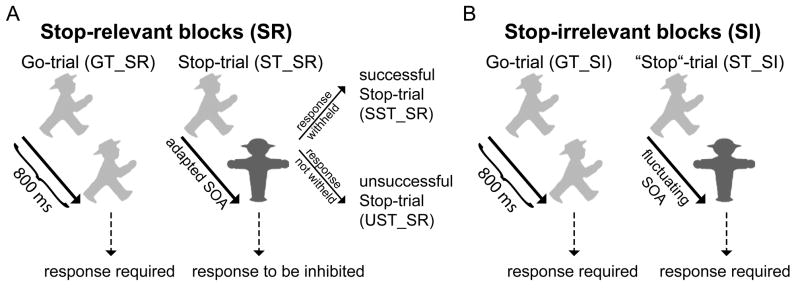
Paradigm. (A) During Stop-relevant (SR) blocks, a choice-reaction stimulus (green German traffic-light symbol oriented to the left or right) was either presented during the entire stimulus duration of 800 ms (Go-trial, GT_SR) or substituted until the end of the stimulus duration by a red Stop-sign (Stop-trial, ST_SR) after a certain variable SOA that was set trial-to-trial by a tracking algorithm. This Stop-sign indicated to withhold the triggered response, thus leading to either a successful (SST_SR) or an unsuccessful Stop-trial (UST_SR). (B) In Stop-irrelevant (SI) blocks the visual stimulation was identical, but the Stop-signs were irrelevant, i.e. responses were required both to Go-trials (GT_SI) and “Stop”-trials (ST_SI).
Fig. 2
Fig. 2
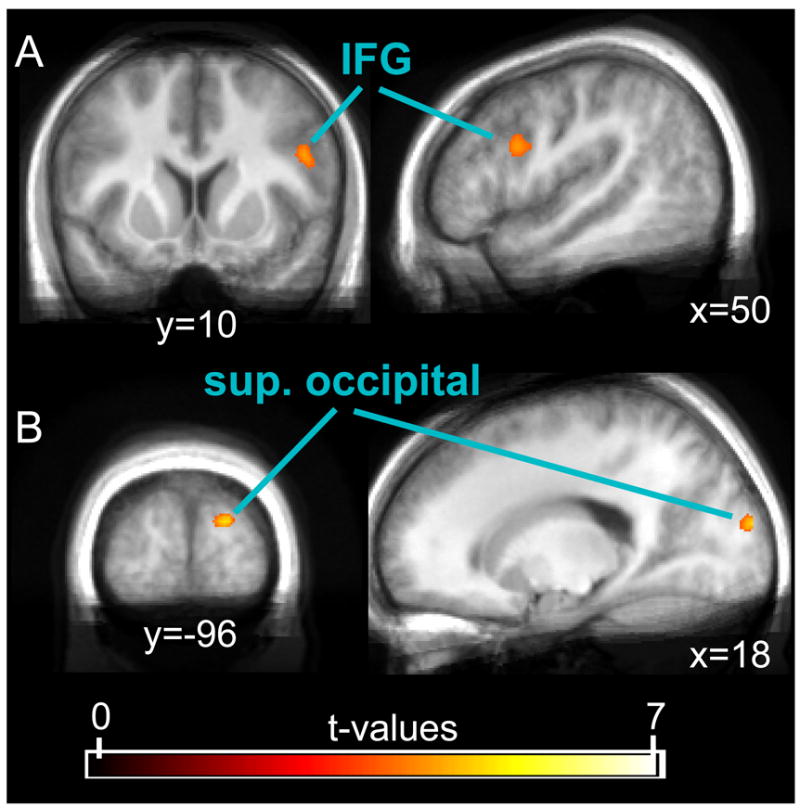
Results of the direct comparison between successful and unsuccessful Stop-trials (SST_SR > UST_SR). This contrast revealed cortical activity in the right IFG (A) and the right superior occipital cortex (B), and subcortical activity in the left caudate nucleus (not shown in figure). The displayed data was thresholded at a t-value of 3.5.
Fig. 3
Fig. 3
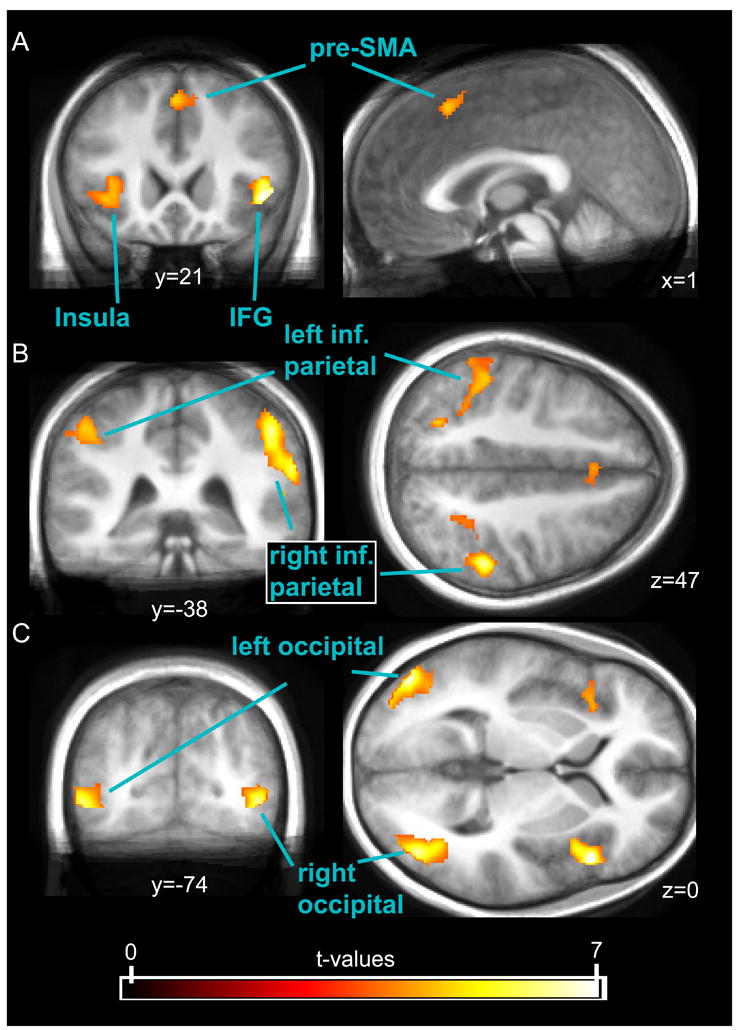
Results of the within-SR-block conjunction (‘SST_SR > GT_SR’ and ‘UST_SR > GT_SR’). This conjunction, that identifies activity common to successful and unsuccessful Stop-trials as compared to Go-trials, among other areas revealed activity in the bilateral IFG/insula (A) and widespread activations in parietal (B) and occipital areas (C). The displayed data was thresholded at a t-value of 3.5.
Fig. 4
Fig. 4
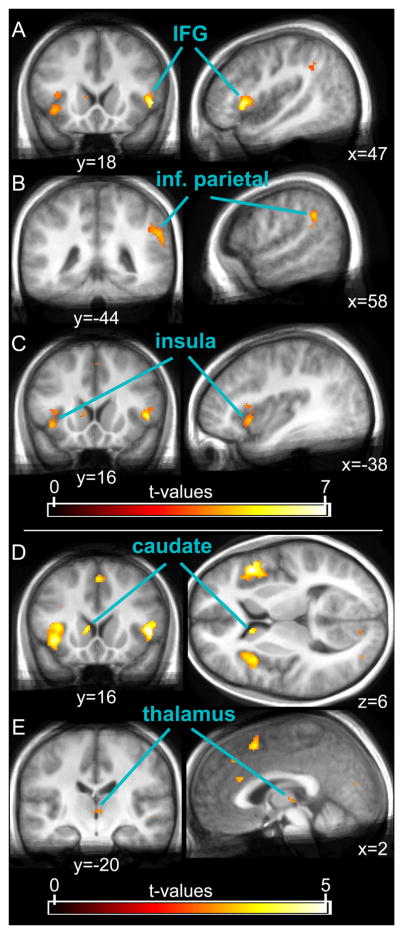
Results of the between-block conjunction (‘SST_SR > ST_SI’ and ‘UST_SR > ST_SI’). This conjunction, which yields activations that are in common between successful and unsuccessful Stop-trials in the Stop-relevant condition relative to “Stop”-trials in the Stop-irrelevant blocks, revealed, among other cortical areas, strong activity in the right IFG (A), right inferior parietal cortex close to the temporo-parietal junction (B), and the left insula (C). Subcortical activations were found in the caudate nucleus (D) and in the thalamus (E; note that the thalamic cluster does not extend very far laterally and ventrally and therefore seems unlikely to contain the STN). The displayed data was thresholded at a t-value of 3.5 in the upper three panels, and at 2.6 in the lower two.
Fig. 5
Fig. 5
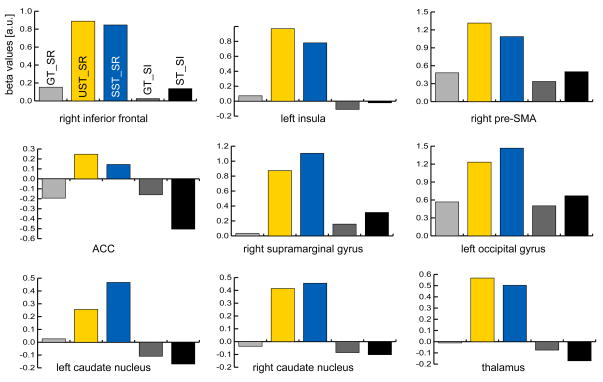
Results of the ROI analysis (beta values averaged across subjects). Parameter estimates were extracted from the activated clusters identified by the between-block conjunction that used Stop-irrelevant “Stop”-trials as the reference condition (see Tab. 5). Activity in none of these ROIs was significantly different between UST (yellow bars) and SST (blue bars).
Fig. 6
Fig. 6
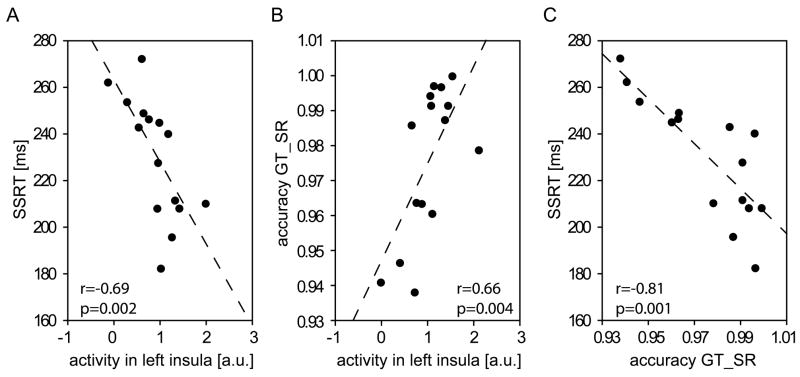
Correlational analyses across subjects. (A) There was a strong negative correlation between SSRT and activity in the left anterior insula (MNI (x,y,z)= −38, 16, −6) during Stop-relevant Stop-trials (as compared to “Stop”-trials from the SI blocks), but also (B) a positive relationship between its activity and accuracy in SR-block Go-trials. (C) A highly significant negative correlation was furthermore found directly between SSRT and SR-block Go-trial accuracy.

References

    1. Alderson RM, Rapport MD, Kofler MJ. Attention-deficit/hyperactivity disorder and behavioral inhibition: a meta-analytic review of the stop-signal paradigm. J Abnorm Child Psychol. 2007;35:745–758. - PubMed
    1. Alderson RM, Rapport MD, Sarver DE, Kofler MJ. ADHD and behavioral inhibition: a re-examination of the stop-signal task. J Abnorm Child Psychol. 2008;36:989–998. - PubMed
    1. Aron AR. Introducing a special issue on stopping action and cognition. Neurosci Biobehav Rev. 2009;33:611–612. - PubMed
    1. Aron AR, Behrens TE, Smith S, Frank MJ, Poldrack RA. Triangulating a cognitive control network using diffusion-weighted magnetic resonance imaging (MRI) and functional MRI. J Neurosci. 2007a;27:3743–3752. - PMC - PubMed
    1. Aron AR, Durston S, Eagle DM, Logan GD, Stinear CM, Stuphorn V. Converging evidence for a fronto-basal-ganglia network for inhibitory control of action and cognition. J Neurosci. 2007b;27:11860–11864. - PMC - PubMed

Publication types

LinkOut - more resources