Review
. 2010 Sep;47(3):461-71.
doi: 10.1016/j.bone.2010.04.611. Epub 2010 May 7.

T cells: critical bone regulators in health and disease

Affiliations
Review

T cells: critical bone regulators in health and disease

Roberto Pacifici. Bone. 2010 Sep.

Abstract

Postmenopausal osteoporosis and hyperparathyroidism are to two common forms of bone loss caused primarily by an expansion of the osteoclastic pool only partially compensated by a stimulation of bone formation. The intimate mechanisms by which estrogen deficiency and excessive production of PTH cause bone loss remain to be determined in part because in vitro studies do not provide the means to adequately reproduce the effects of ovx and PTH overproduction observed in vivo. This article examines the connection between T cells and bone in health and disease and reviews the evidence in favor of the hypothesis that T cells play an unexpected critical role in the mechanism of action of estrogen and PTH in bone.


Figures

Figure 1
Figure 1
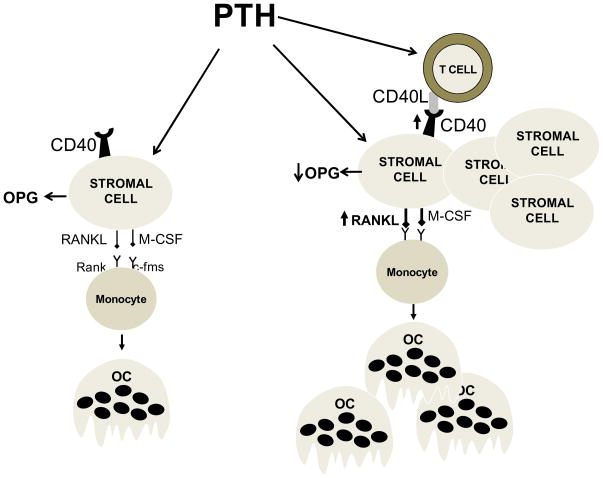
Schematic representation of the role of T cells in the mechanism by which continuous PTH stimulates OC formation. In the absence of T cells (left panel) BM SCs are fewer in number (not shown), and exhibit a blunted capacity to support PTH induced OC formation due to diminished production of RANKL and continuous production of the RANKL decoy receptor OPG. In the presence of T cell expressed CD40L (right panel) the pool of SCs in the BM is 2-fold larger. Furthermore, CD40L/CD40 signaling increases the osteoclastogenic activity of SCs by augmenting the SC production of RANKL and blunting their secretion of OPG. The result is a potentiation of the capacity of PTH to stimulate the formation of OCs.
Figure 2
Figure 2
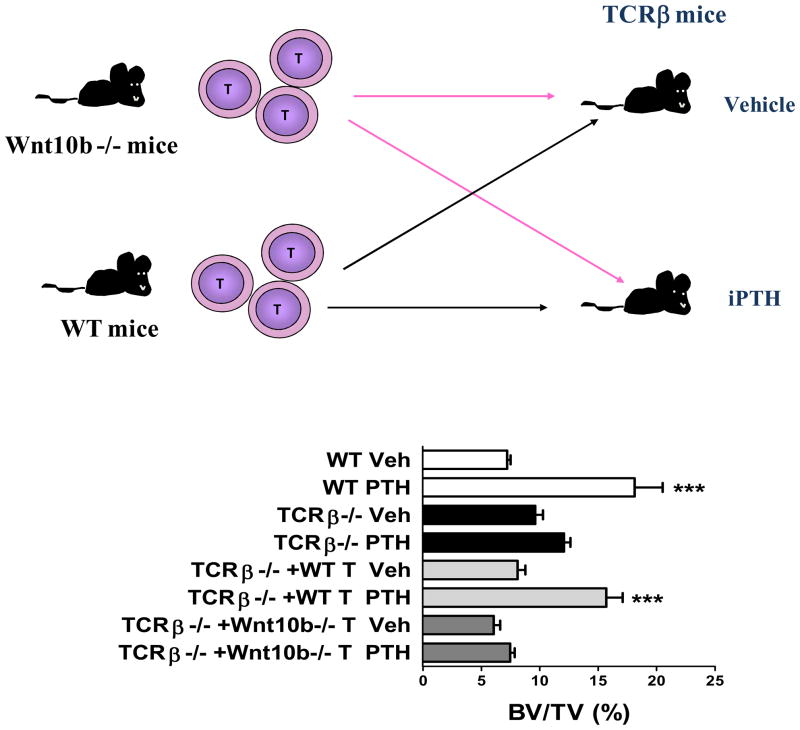
Analysis of the effects of iPTH treatment in WT mice, TCRβ −/− mice, and TCRβ −/− mice subjected to adoptive transfer of T cells derived from WT mice and Wnt10b −/− mice 1 week before initiation of iPTH. The upper panel shows a schematic representation of the experimental design. The bottom panel shows trabecular bone volume (BV/TV) as measured by μCT. *** = p<0.001 compared to the corresponding vehicle treated group.
Figure 3
Figure 3
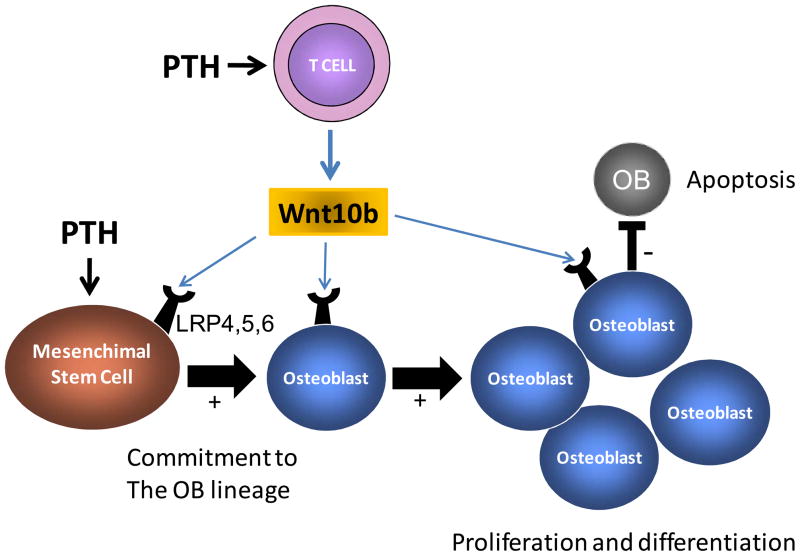
Schematic representation of the role of T cells in the mechanism by which intermittent PTH treatment stimulates bone formation. PTH stimulates T cells to secrete Wnt10b, a Wnt ligand required to activate Wnt signaling in SCs and OBs. In the presence of T cell produced Wnt10b, stimulation of osteoblastic cells by PTH result in the activation of the Wnt signaling pathway. This event leads to increased commitment of mesenchimal stem cells to the osteoblastic lineage, increased osteoblast proliferation and differentiation, and decreased osteoblast apoptosis.
Figure 4
Figure 4
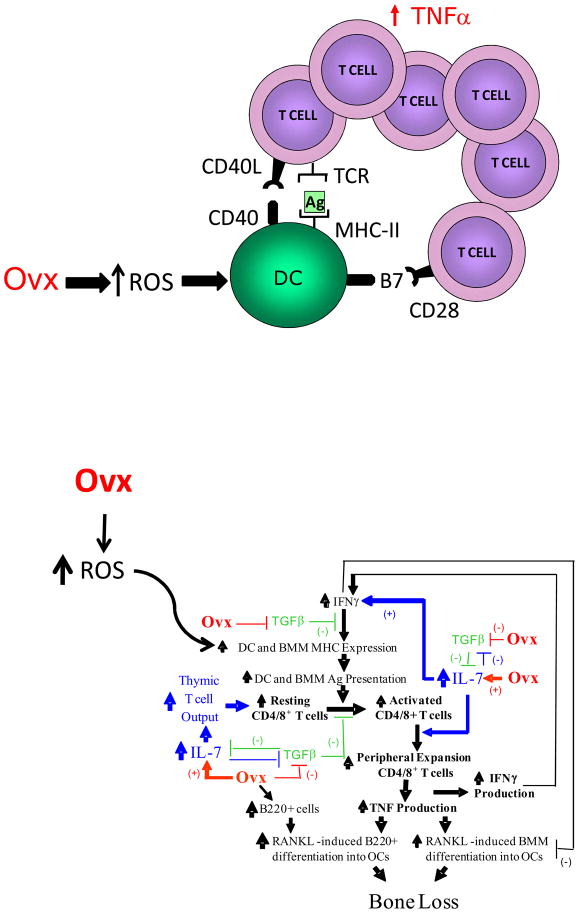
Schematic representation of the mechanism by which ovx increases antigen presentation through ROS. The upper diagram shows that ovx increases the activity of DCs through ROS generation, leading to increased T cell activation, T cell proliferation and secretion of TNF through a mechanism involving the T cell receptor and costimulatory molecules. The bottom diagram shows in detail the cells and the cytokines by which ovx leads to T cell production of TNF and bone loss.

References

    1. Kong YY, Feige U, Sarosi I, Bolon B, Tafuri A, Morony S, Capparelli C, Li J, Elliott R, McCabe S, Wong T, Campagnuolo G, Moran E, Bogoch ER, Van G, Nguyen LT, Ohashi PS, Lacey DL, Fish E, Boyle WJ, Penninger JM. Activated T cells regulate bone loss and joint destruction in adjuvant arthritis through osteoprotegerin ligand. Nature. 1999;402(6759):304–9. - PubMed
    1. Mak TW, Ferrick DA. The gammadelta T-cell bridge: linking innate and acquired immunity. Nat Med. 1998;4(7):764–5. - PubMed
    1. Haas W, Pereira P, Tonegawa S. Gamma/delta cells. Annu Rev Immunol. 1993;11:637–85. - PubMed
    1. Godfrey DI, MacDonald HR, Kronenberg M, Smyth MJ, Van Kaer L. NKT cells: what’s in a name? Nat Rev Immunol. 2004;4(3):231–7. - PubMed
    1. Volpe E, Servant N, Zollinger R, Bogiatzi SI, Hupe P, Barillot E, Soumelis V. A critical function for transforming growth factor-beta, interleukin 23 and proinflammatory cytokines in driving and modulating human T(H)-17 responses. Nat Immunol. 2008;9(6):650–7. - PubMed

MeSH terms