Mouse models of p53 functions
- PMID: 20452944
- PMCID: PMC2845198
- DOI: 10.1101/cshperspect.a001115
Mouse models of p53 functions
Abstract
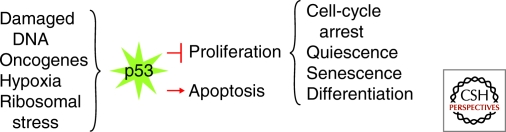
Studies in mice have yielded invaluable insight into our understanding of the p53 pathway. Mouse models with activated p53, no p53, and mutant p53 have queried the role of p53 in development and tumorigenesis. In these models, p53 is activated and stabilized via redundant posttranslational modifications. On activation, p53 initiates two major responses: inhibition of proliferation (via cell-cycle arrest, quiescence, senescence, and differentiation) and induction of apoptosis. Importantly, these responses are cell-type and tumor-type-specific. The analysis of mutant p53 alleles has established a gain-of-function role for p53 mutants in metastasis. The development of additional models that can precisely time the oncogenic events in single cells will provide further insight into the evolution of tumors, the importance of the stroma, and the cooperating events that lead to disruption of the p53 pathway. Ultimately, these models should serve to study the effects of novel drugs on tumor response as well as normal homeostasis.
Figures
References
-
- Appella E, Anderson CW 2001. Post-translational modifications and activation of p53 by genotoxic stresses. Eur J Biochem 268:2764–2772 - PubMed
-
- Armata HL, Garlick DS, Sluss HK 2007. The ataxia telangiectasia-mutated target site Ser18 is required for p53-mediated tumor suppression. Cancer Res 67:11696–11703 - PubMed
-
- Armstrong JF, Kaufman MH, Harrison DJ, Clarke AR 1995. High-frequency developmental abnormalities in p53-deficient mice. Curr Biol 5:931–936 - PubMed
Publication types
MeSH terms
Substances
Grants and funding
LinkOut - more resources
Full Text Sources
Research Materials
Miscellaneous