Review
. 2010 May;2(5):a000984.
doi: 10.1101/cshperspect.a000984. Epub 2009 Dec 9.

Tied up in loops: positive and negative autoregulation of p53

Affiliations
Review

Tied up in loops: positive and negative autoregulation of p53

Xin Lu. Cold Spring Harb Perspect Biol. 2010 May.

Abstract

The tumor suppressor p53 is a master sensor of stress that controls many biological functions, including implantation, cell-fate decisions, metabolism, and aging. In response to a defined stress signal such as gamma radiation, the response of p53 is heterogeneous in vivo. Like a complex barcode, the ability of p53 to function as a central hub that integrates defined stress signals into decisive cellular responses, in a time- and cell-type dependent manner, is facilitated by the extraordinary complexity of its regulation. Key components of this barcode are the autoregulation loops, which positively or negatively regulate p53's activities. Thus, this article focuses on reviewing our current understanding of how autoregulation loops formed between p53 and how its transcriptional targets regulate the activities of p53 at a variety of levels, through mdm2-dependent and -independent pathways. Knowing that a large number of autoregulation loops exist that influence p53's activity, our future challenge is to elucidate which of these play a central role in regulating p53, under which conditions, in response to what stress, and at which particular stage of our lives. Such knowledge may ultimately lead to the development of more effective anticancer therapeutics.


Figures
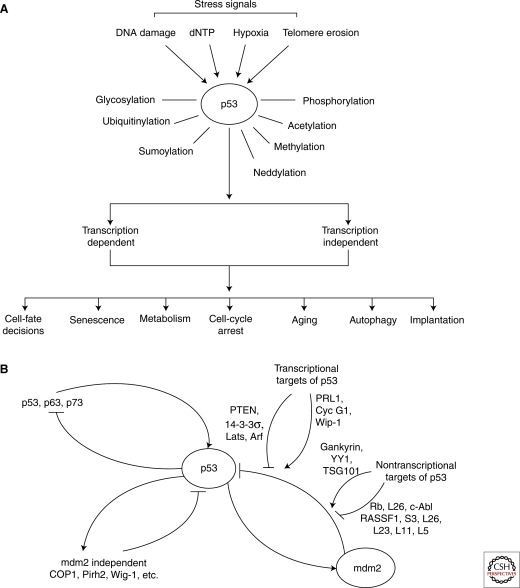
Figure 1.
Figure 1.
The variety of p53’s responses to differing stress signals is partly achieved through a series of autoregulation loops. The complexity of p53’s regulation enables it to dictate a large number of biological outcomes, in response to a variety of different stress signals (A). Key factors in facilitating this complexity of regulation are the mdm2-dependent, mdm2-independent, and p53 family sibling autoregulation loops (B).
Figure 2.
Figure 2.
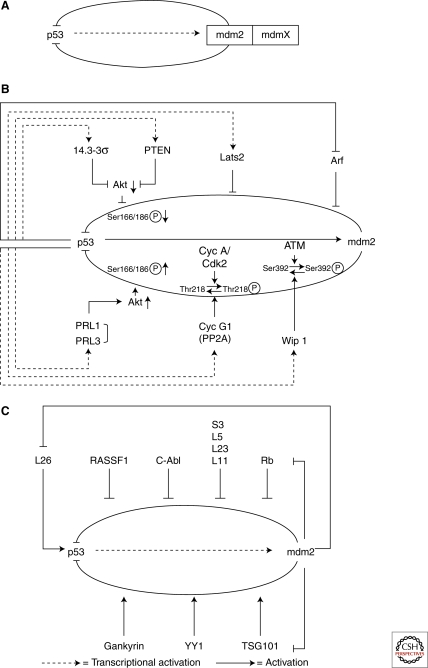
Control of the p53/mdm2 autoregulation loop. The p53/mdm2 autoregulation loop is central to the control of p53’s varied functions. The loop itself can be regulated by both transcriptional (B) and nontranscriptional (C) targets of p53. MdmX may act as a cofactor of mdm2, providing a further level of regulation (A).
Figure 3.
Figure 3.
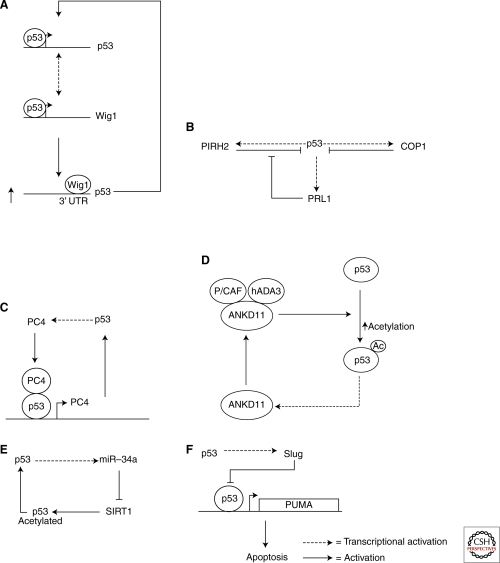
Mdm2-independent autoregulation of p53. A large number of molecules autoregulate p53 independently of mdm2. These include Wig1 (A), PRL1 (B), PC4 (C), ANKD11 (D), miR-34a (E), and Slug (F).
Figure 4.
Figure 4.
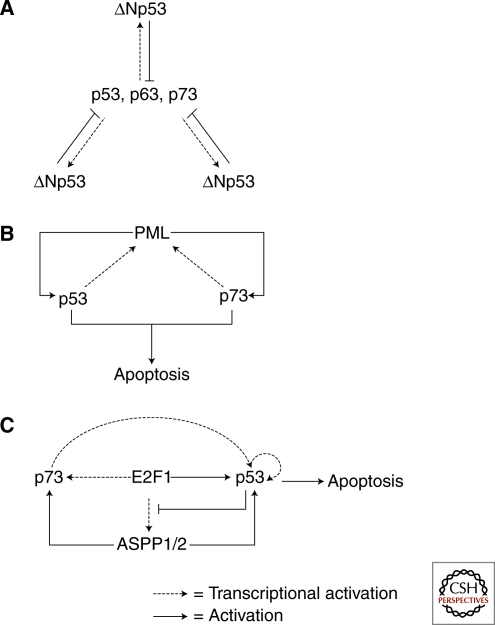
Autoregulation loops formed among the p53 family siblings. The three members of the p53 family form highly conserved negative autoregulation loops (A). In addition, p53 and p73 form a positive autoregulation loop with PML (B), and another with E2F1/ASPP1,2 (C).

References

    1. Aylon Y, Michael D, Shmueli A, Yabuta N, Nojima H, Oren M 2006. A positive feedback loop between the p53 and Lats2 tumor suppressors prevents tetraploidization. Genes Dev 20:2687–2700 - PMC - PubMed
    1. Barak Y, Juven T, Haffner R, Oren M 1993. mdm2 expression is induced by wild type p53 activity. EMBO J 12:461–468 - PMC - PubMed
    1. Bates S, Phillips AC, Clark PA, Stott F, Peters G, Ludwig RL, Vousden KH 1998. p14ARF links the tumour suppressors RB and p53. Nature 395:124–125 - PubMed
    1. Bergamaschi D, Samuels Y, Jin B, Duraisingham S, Crook T, Lu X 2004. ASPP1 and ASPP2: common activators of p53 family members. Mol Cell Biol 24:1341–1350 - PMC - PubMed
    1. Bourdon JC, Fernandes K, Murray-Zmijewski F, Liu G, Diot A, Xirodimas DP, Saville MK, Lane DP 2005. p53 isoforms can regulate p53 transcriptional activity. Genes Dev 19:2122–2137 - PMC - PubMed

Publication types

MeSH terms

Substances