


Quantification of the effect of culturing temperature on salt-induced heat resistance of bacillus species
- PMID: 20453152
- PMCID: PMC2897415
- DOI: 10.1128/AEM.00150-10
Quantification of the effect of culturing temperature on salt-induced heat resistance of bacillus species
Abstract
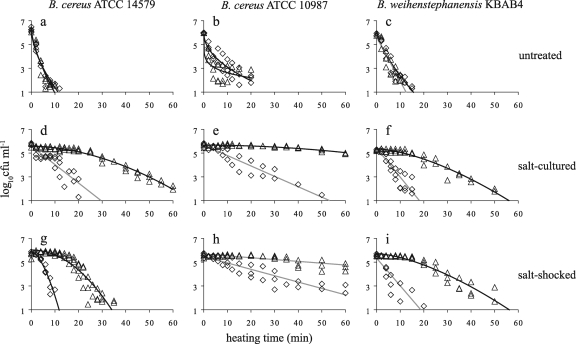
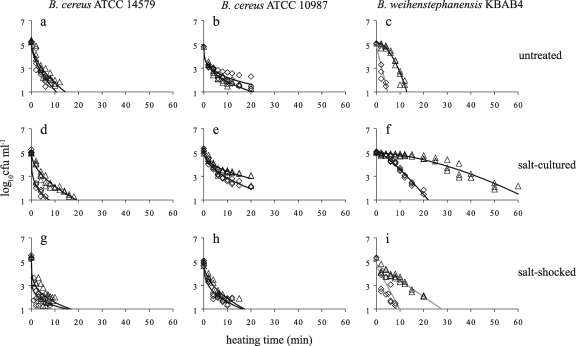
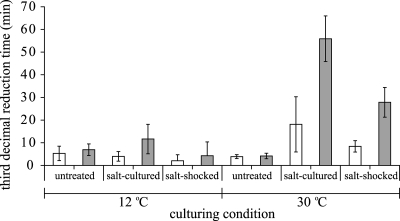
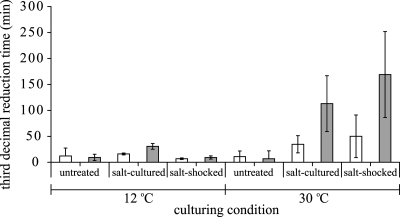
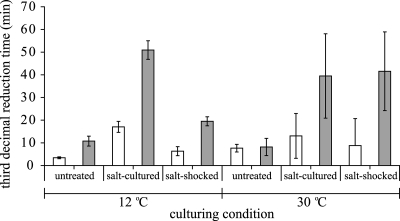
Short- and long-term exposure to mild stress conditions can activate stress adaptation mechanisms in pathogens, resulting in a protective effect toward otherwise lethal stresses. The mesophilic strains Bacillus cereus ATCC 14579 and ATCC 10987 and the psychrotolerant strain B. weihenstephanensis KBAB4 were cultured at 12 degrees C and 30 degrees C until the exponential growth phase (i) in the absence of salt, (ii) in the presence of salt, and (iii) with salt shock after they reached the exponential growth phase and subsequently heat inactivated. Both the first-order model and the Weibull model were fitted to the inactivation kinetics, and statistical indices were calculated to select for each condition the most appropriate model to describe the inactivation data. The third-decimal reduction times (which reflected the times needed to reduce the initial number of microorganisms by three decimal powers) were determined for quantitative comparison. The heat resistance of both mesophilic strains increased when cells were salt cultured and salt shocked at 30 degrees C, whereas these salt-induced effects were not significant for the psychrotolerant strain. In contrast, only the psychrotolerant strain showed salt-induced heat resistance when cells were cultured at 12 degrees C. Therefore, culturing temperature and strain diversity are important aspects to address when adaptive stress responses are quantified. The activated adaptive stress response had an even larger impact on the number of surviving microorganisms when the stress factor (i.e., salt) was still present during inactivation. These factors should be considered when stress-integrated predictive models are developed that can be used in the food industry to balance and optimize processing conditions of minimally processed foods.
Figures
References
-
- Afchain, A. L., F. Carlin, C. Nguyen-The, and I. Albert. 2008. Improving quantitative exposure assessment by considering genetic diversity of B. cereus in cooked, pasteurised and chilled foods. Int. J. Food Microbiol. 128:165-173. - PubMed
-
- Browne, N., and B. C. A. Dowds. 2002. Acid stress in the food pathogen Bacillus cereus. J. Appl. Microbiol. 92:404-414. - PubMed
-
- Browne, N., and B. C. A. Dowds. 2001. Heat and salt stress in the food pathogen Bacillus cereus. J. Appl. Microbiol. 91:1085-1094. - PubMed
-
- Carlin, F., H. Girardin, M. W. Peck, S. C. Stringer, G. C. Barker, A. Martinez, A. Fernandez, P. Fernandez, W. M. Waites, S. Movahedi, F. van Leusden, M. Nauta, R. Moezelaar, M. Del Torre, and S. Litman. 2000. Research on factors allowing a risk assessment of spore-forming pathogenic bacteria in cooked chilled foods containing vegetables: a FAIR collaborative project. Int. J. Food Microbiol. 60:117-135. - PubMed
MeSH terms
Substances
LinkOut - more resources
Full Text Sources
Other Literature Sources
Molecular Biology Databases
