


Predictors of response to treadmill exercise in stroke survivors
- PMID: 20453154
- PMCID: PMC3024239
- DOI: 10.1177/1545968310364059
Predictors of response to treadmill exercise in stroke survivors
Abstract
Background: Aerobic treadmill exercise (T-EX) therapy has been shown to benefit walking and cardiorespiratory fitness in stroke survivors with chronic gait impairment even long after their stroke. The response, however, varies between individuals.
Objective: The purpose of this post hoc analysis of 2 randomized controlled T-EX trials was to identify predictors for therapy response.
Methods: In all, 52 participants received T-EX for 3 (Germany) or 6 (United States) months. Improvements in overground walking velocity (10 m/6-min walk) and fitness (peak VO(2)) were indicators of therapy response. Lesion location and volume were measured on T1-weighted magnetic resonance scans.
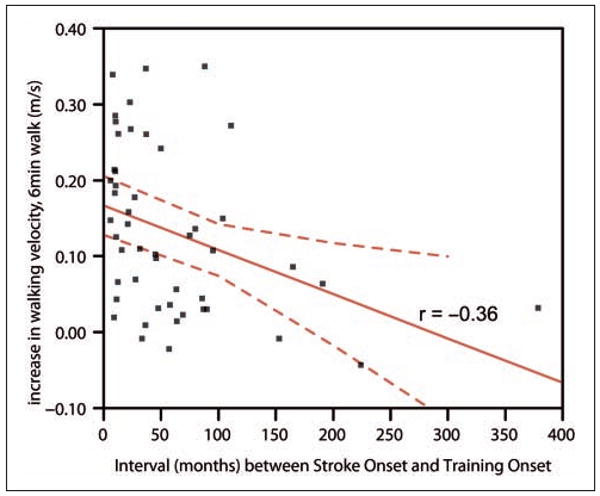
Results: T-EX significantly improved gait and fitness, with gains in 10-m walk tests ranging between +113% and -25% and peak VO(2) between -12% and 88%. Baseline walking impairments or fitness deficits were not predictive of therapy response; 10-m walk velocity improved more in those with subcortical rather than cortical lesions and in patients with smaller lesions. Improvements in 6-minute walk velocity were greater in those with more recent strokes and left-sided lesions. No variable other than training intensity, which was different between trials, predicted fitness gains.
Conclusions: Despite proving overall effectiveness, the response to T-EX varies markedly between individuals. Whereas intensity of aerobic training seems to be an important predictor of gains in cardiovascular fitness, lesion size and location as well as interval between stroke onset and therapy delivery likely affect therapy response. These findings may be used to guide the timing of training and identify subgroups of patients for whom training modalities could be optimized.
Conflict of interest statement
Figures
References
-
- Macko RF, Ivey FM, Forrester LW, et al. Treadmill exercise rehabilitation improves ambulatory function and cardiovascular fitness in patients with chronic stroke: a randomized, controlled trial. Stroke. 2005;36:2206–2211. - PubMed
-
- Dickstein R. Rehabilitation of gait speed after stroke: a critical review of intervention approaches. Neurorehabil Neural Repair. 2008;22:649–660. - PubMed
Publication types
MeSH terms
Grants and funding
LinkOut - more resources
Full Text Sources
Medical
