Review
. 2009:74:225-34.
doi: 10.1101/sqb.2009.74.052. Epub 2010 May 7.

Molecular evolution of piRNA and transposon control pathways in Drosophila

Affiliations
Review

Molecular evolution of piRNA and transposon control pathways in Drosophila

C D Malone et al. Cold Spring Harb Symp Quant Biol. 2009.

Abstract

The mere prevalence and potential mobilization of transposable elements in eukaryotic genomes present challenges at both the organismal and population levels. Not only is transposition able to alter gene function and chromosomal structure, but loss of control over even a single active element in the germline can create an evolutionary dead end. Despite the dangers of coexistence, transposons and their activity have been shown to drive the evolution of gene function, chromosomal organization, and even population dynamics (Kazazian 2004). This implies that organisms have adopted elaborate means to balance both the positive and detrimental consequences of transposon activity. In this chapter, we focus on the fruit fly to explore some of the molecular clues into the long- and short-term adaptation to transposon colonization and persistence within eukaryotic genomes.


Figures
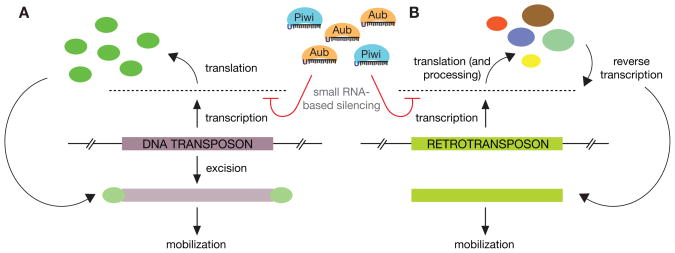
Figure 1
Figure 1
RNA-based targeting of transposable elements. Transposon expression, regardless of type, generates a universal target for the RNAi machinery. (A) DNA transposons are transcribed and then translated to generate a transposase enzyme capable of catalyzing the excision and cis or trans mobilization via this “cut-and-paste” mechanism. The initial transcription of the locus provides a target for silencing. (B) Retrotransposons are transcribed both to be translated (non-LTR retrotransposon proteins are further posttranslationally processed) and also to serve as the substrate for reverse transcriptase to manufacture additional transposon copies. Here, either transcription products or reverse transcription substrate molecules serve as the target of the RNAi machinery.
Figure 2
Figure 2
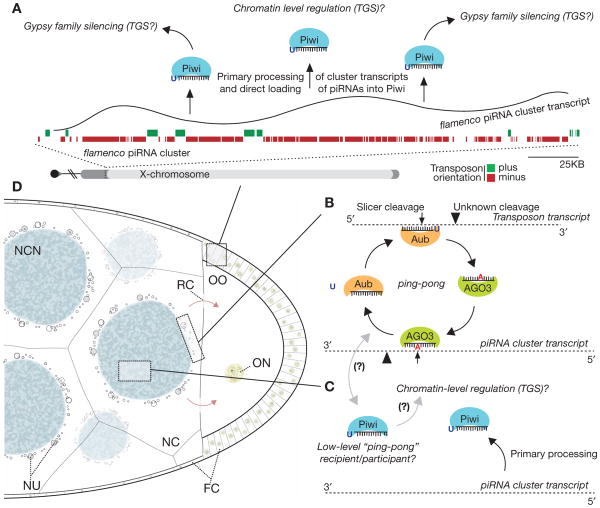
Models of piRNA pathway silencing in distinct tissues of the Drosophila ovary. Germline and somatic cells of the Drosophila ovary use vastly different mechanisms to combat particular transposon threats. (A) In somatic cells of the ovary, flamenco cluster transcription precedes its processing to piRNAs that are directly loaded into the Piwi protein, which targets somatically expressed transposons (gypsy family) for silencing. Given Piwi’s nuclear localization, regulation is likely occurring at the transcriptional level. (TGS) Transcriptional gene silencing. (B) The Aub and AGO3 proteins actively cycle in a germline-specific feed forward amplification loop to generate a potent and abundant pool of silencing-capable piRNAs. (C) Piwi may act similarly in the germline as in the soma. Here, the Piwi protein may directly bind antisense, cluster-derived piRNAs to silence elements by TGS. Additionally, Piwi may serve as a low-level recipient or participant with AGO3 in the ping-pong cycle. (D) Diagram of a mid/late-stage egg chamber of the Drosophila ovary. (NC) Nurse cell (germline); (NCN) nurse cell nucleus; (OO) oocyte; (ON) oocyte nucleus; (NU) nuage; (FC) follicular cell (somatic); (RC) ring canal.
Figure 3
Figure 3
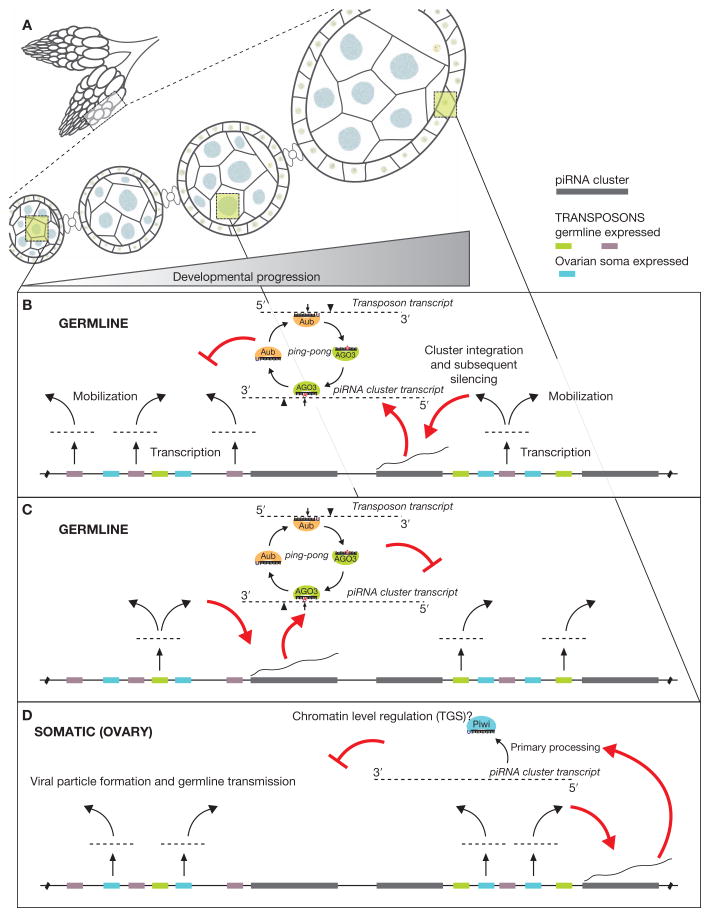
Model for the acquisition of piRNA cluster–based transposon control. Tissue and developmental expression of piRNA clusters could act to combat the diverse expression programs of the myriad transposons in Drosophila. (A) The Drosophila ovary is a complex tissue, representing a full spectrum of oogenesis developmental stages and containing a mixture of both germline and somatic tissues. (B) Germline-expressed transposons (here, purple) eventually mobilize into a coexpressed piRNA cluster (red arrows). This mobilization leads to the entrance of that element into a potent silencing program involving piRNA “ping-pong” and leading to the PTGS (posttranscriptional gene silencing) of active transposon transcripts. (C) Same as B, only now a different set of transposons (green), expressed at a distinct developmental stage, are trapped into the piRNA pathway by a separate, yet coexpressed, piRNA cluster. (D) A somatic expressed cluster (flamenco) captures transposing gypsy family elements, which are transcriptionally active in somatic cells and possess the ability to package into viral particles that infect germline nuclei. However, in this case, transposition into the flameco cluster would need to occur and be selected for within the germline cells.
Figure 4
Figure 4
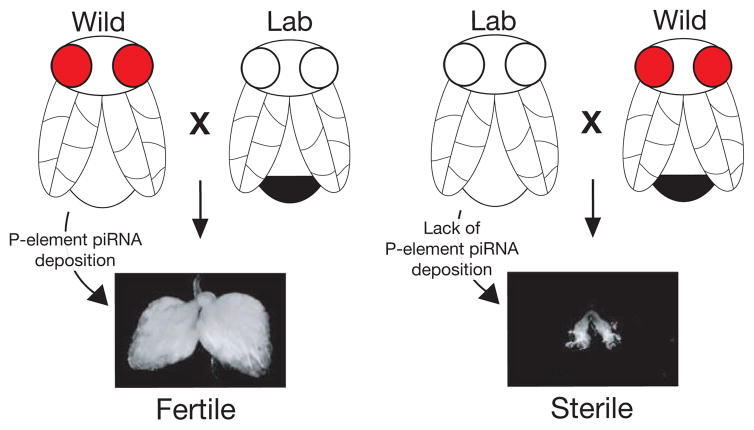
P-element hybrid dysgenesis in Drosophila. Certain crosses between wild (red eyes) and lab-maintained (white eyes) strains of Drosophila melanogaster produce sterile offspring. This sterility is caused by the naïveté and inability of the lab strain to silence a single transposable element (here, the P element) that has colonized the wild strain. Here, piRNAs serve as the epigenetic factor deposited by mothers (light abdomen) to facilitate the silencing of transposons in progeny (males, dark abdomen). A severe defect in ovarian development, including necrosis, accompanies dysgenesis.

References

    1. Aravin AA, Naumova NM, Tulin AV, Vagin VV, Rozovsky YM, Gvozdev VA. Double-stranded RNA-mediated silencing of genomic tandem repeats and transposable elements in the D. melanogaster germline. Curr Biol. 2001;11:1017–1027. - PubMed
    1. Aravin AA, Lagos-Quintana M, Yalcin A, Zavolan M, Marks D, Snyder B, Gaasterland T, Meyer J, Tuschl T. The small RNA profile during Drosophila melanogaster development. Dev Cell. 2003;5:337–350. - PubMed
    1. Aravin A, Gaidatzis D, Pfeffer S, Lagos-Quintana M, Landgraf P, Iovino N, Morris P, Brownstein MJ, Kuramochi-Miyagawa S, Nakano T, et al. A novel class of small RNAs bind to MILI protein in mouse testes. Nature. 2006;442:203–207. - PubMed
    1. Aravin AA, Sachidanandam R, Girard A, Fejes-Toth K, Hannon GJ. Developmentally regulated piRNA clusters implicate MILI in transposon control. Science. 2007;316:744–747. - PubMed
    1. Aravin AA, Sachidanandam R, Bourc’his D, Schaefer C, Pezic D, Toth KF, Hannon GJ. A piRNA pathway primed by individual transposons is linked to de novo DNA methylation in mice. Mol Cell. 2008;31:785–799. - PMC - PubMed

Publication types

Substances

LinkOut - more resources