


Representation and transformation of sensory information in the mouse accessory olfactory system
- PMID: 20453853
- PMCID: PMC2930753
- DOI: 10.1038/nn.2546
Representation and transformation of sensory information in the mouse accessory olfactory system
Abstract
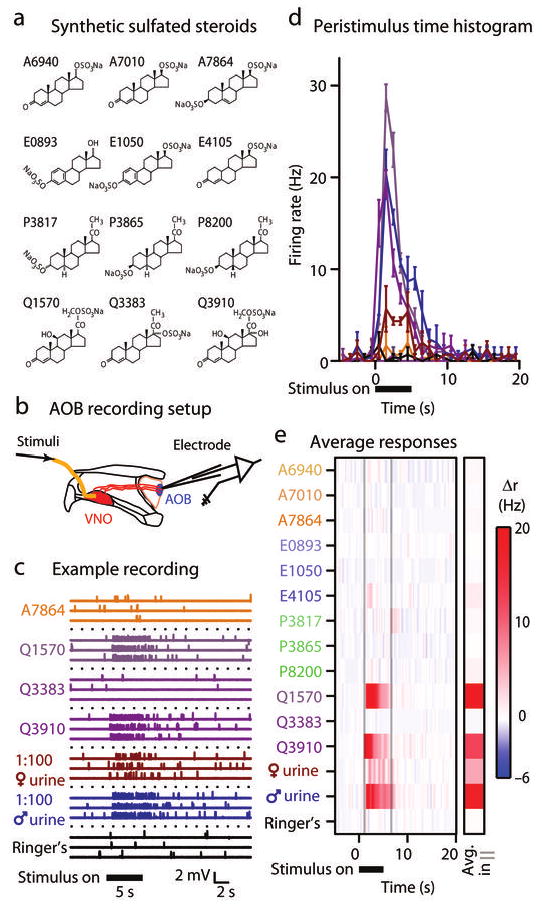
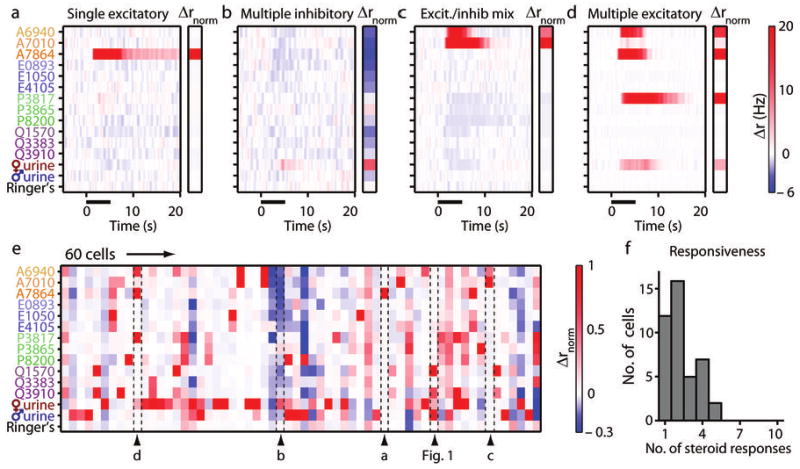
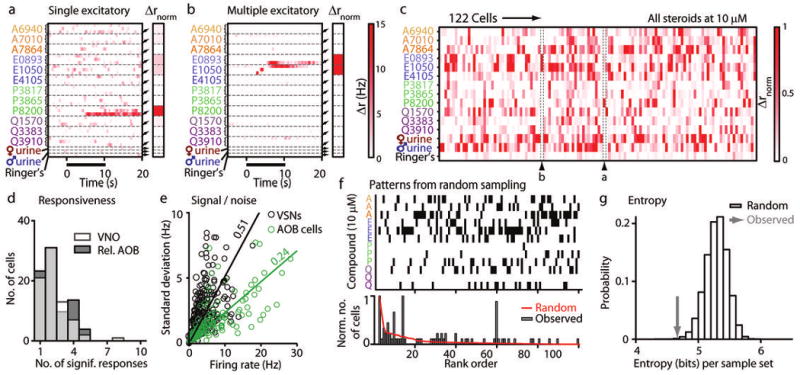
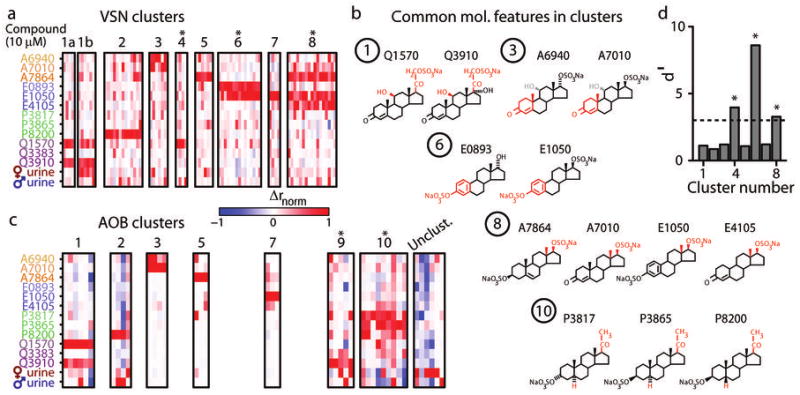
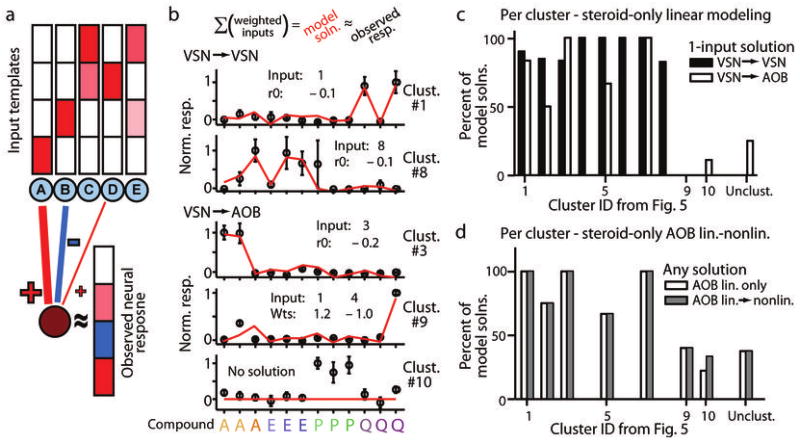
In mice, nonvolatile social cues are detected and analyzed by the accessory olfactory system (AOS). Here we provide a first view of information processing in the AOS with respect to individual chemical cues. 12 sulfated steroids, recently discovered mouse AOS ligands, caused widespread activity among vomeronasal sensory neurons (VSNs), yet VSN responses clustered into a small number of repeated functional patterns or processing streams. Downstream neurons in the accessory olfactory bulb (AOB) responded to these ligands with enhanced signal/noise compared to VSNs. Although the dendritic connectivity of AOB mitral cells suggests the capacity for broad integration, most sulfated steroid responses were well-modeled by linear excitatory drive from just one VSN processing stream. However, a substantial minority demonstrated multi-stream integration. Most VSN excitation patterns were also observed in the AOB, but excitation by estradiol sulfate processing streams was rare, suggesting AOB circuit organization is specific to the biological relevance of sensed cues.
Figures


References
-
- Keller M, Baum MJ, Brock O, Brennan PA, Bakker J. The main and the accessory olfactory systems interact in the control of mate recognition and sexual behavior. Behav Brain Res. 2009;200:268–276. - PubMed
-
- Touhara K, Vosshall LB. Sensing odorants and pheromones with chemosensory receptors. Annu Rev Physiol. 2009;71:307–332. - PubMed
-
- Rodriguez I, Del Punta K, Rothman A, Ishii T, Mombaerts P. Multiple new and isolated families within the mouse superfamily of V1r vomeronasal receptors. Nat Neurosci. 2002;5:134–140. - PubMed
Publication types
MeSH terms
Substances
Grants and funding
LinkOut - more resources
Full Text Sources
