


doi: 10.1038/nchembio.369.
Epub 2010 May 9.
Reprogramming bacteria to seek and destroy an herbicide
Affiliations
- PMID: 20453864
- PMCID: PMC2873063
- DOI: 10.1038/nchembio.369
Item in Clipboard
Reprogramming bacteria to seek and destroy an herbicide
Nat Chem Biol.
2010 Jun.
Retraction in
-
Retraction: Reprogramming bacteria to seek and destroy an herbicide.Nat Chem Biol. 2014 Mar;10(3):239. doi: 10.1038/nchembio0314-239a. Nat Chem Biol. 2014. PMID: 24531072 Free PMC article. No abstract available.
Abstract
A major goal of synthetic biology is to reprogram cells to perform complex tasks. Here we show how a combination of in vitro and in vivo selection rapidly identifies a synthetic riboswitch that activates protein translation in response to the herbicide atrazine. We further demonstrate that this riboswitch can reprogram bacteria to migrate in the presence of atrazine. Finally, we show that incorporating a gene from an atrazine catabolic pathway allows these cells to seek and destroy atrazine.
Figures
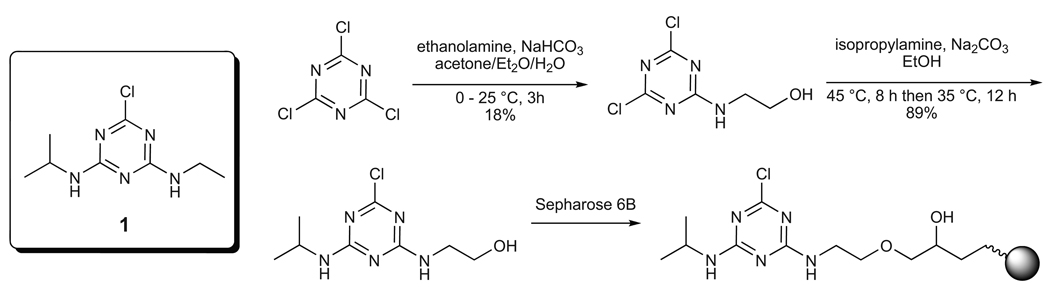
Left: the structure of atrazine (1); right Scheme for the synthesis of an atrazine derivative bound to solid support.
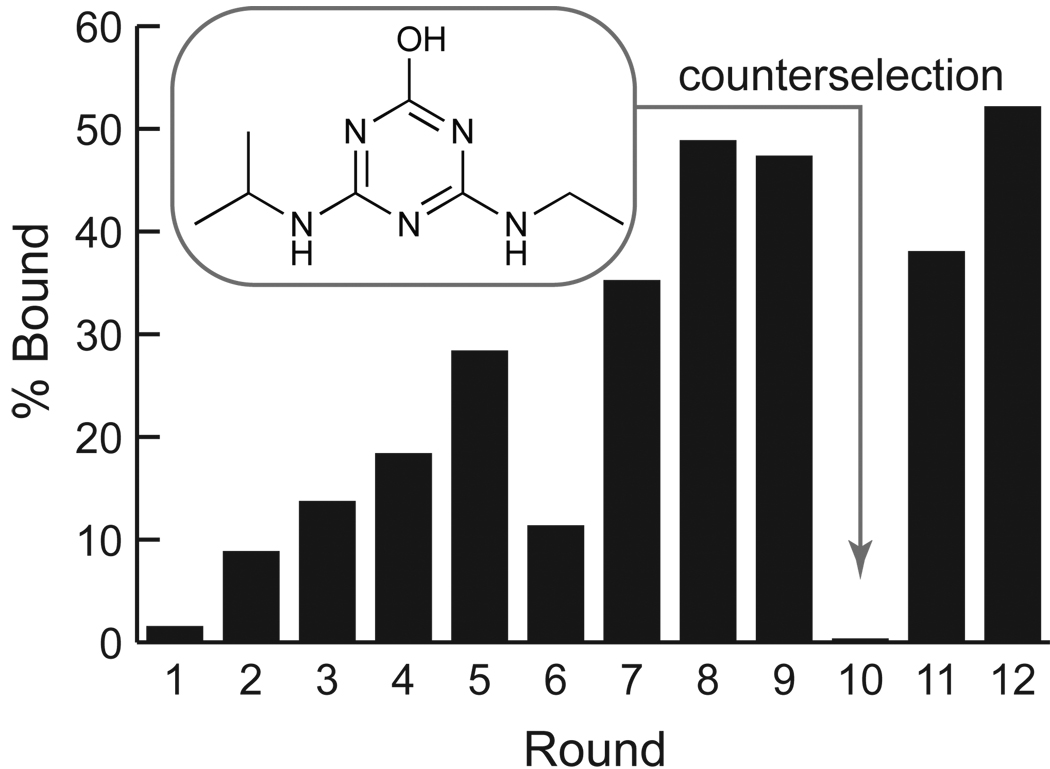
The fraction of the RNA pool bound to the atrazine-derivatized column after each round of SELEX. Counterselection against hydroxyatrazine (1 mM) was performed after round 9.
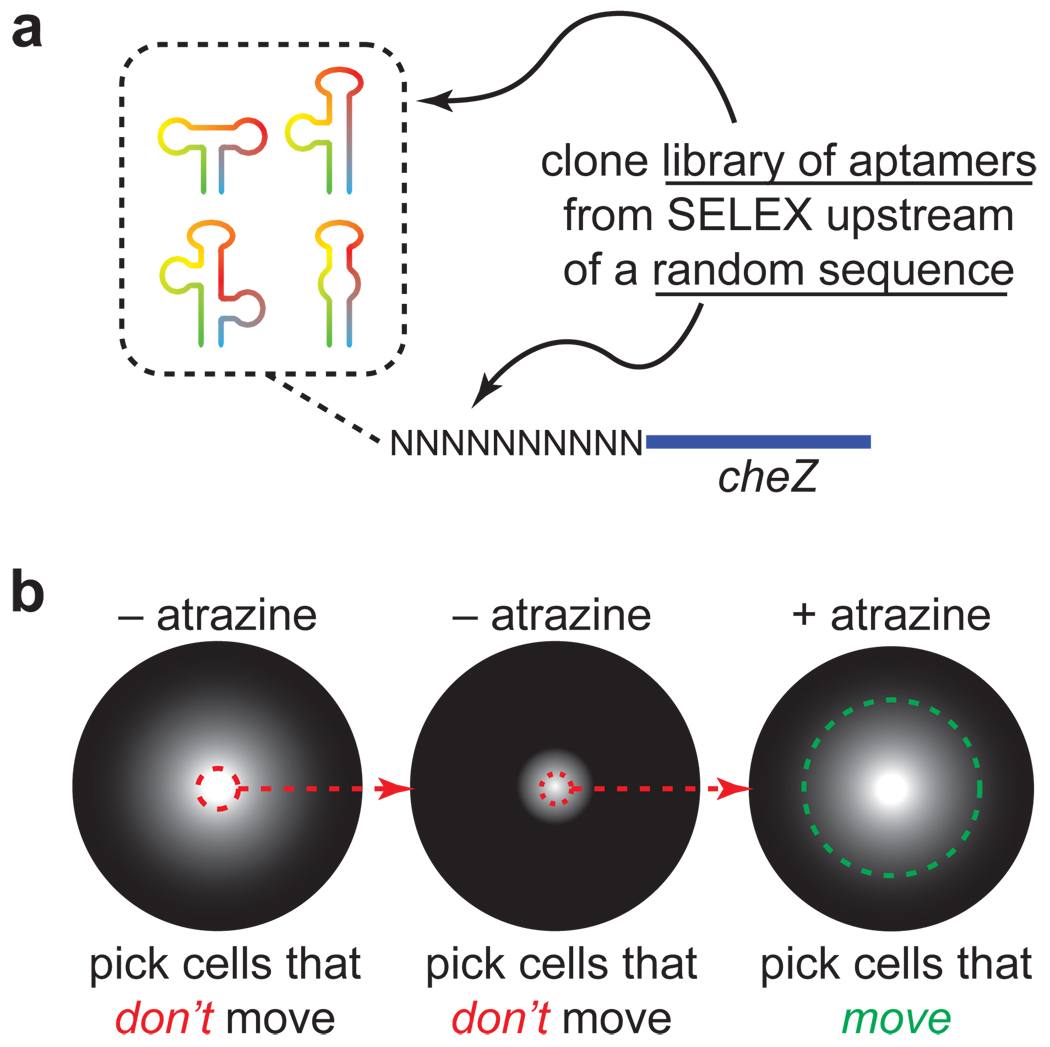
(a) To select riboswitches, a library of atrazine-binding aptamers is cloned upstream of a randomized sequence in the 5'-UTR of the cheZ gene that controls E. coli motility. The randomized sequence can become an expression platform that couples ligand-binding and gene expression. (b) Schematic of selection scheme. The library of sequences is introduced in to a cheZ-deficient strain of E. coli and cells are plated at the center of a Petri dish containing semisolid media without atrazine. Cells that don’t move are selected and the process is repeated. Finally, cells are plated in the presence of atrazine (500 µM) and the cells that migrate are chosen.
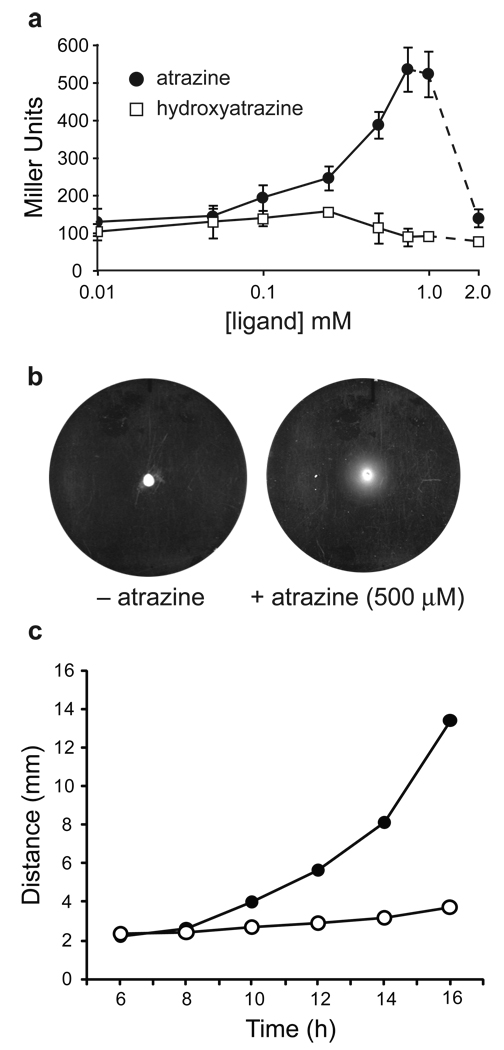
(a) Dose-response relationship for β-galactosidase activity (measured in Miller units) vs. atrazine and hydroxyatrazine concentration. Dashed lines indicate that the compounds began to precipitate from the solution. (b) Motility of riboswitch-containing cells grown for 16 h at 30 °C on semisolid agar in the absence and presence of atrazine (500 µM). The diameter of the plates is 85 mm. (c) Migration radius of reprogrammed cells as a function of time. The cells were inoculated on swarm agar plates either in the presence (filled circles, 500 µM) or absence (open circles) of atrazine. Migration radius was measured using a ruler from images generated at intervals of 2 h, beginning 6 h after inoculation. The uncertainties in measurement are smaller than the symbols.
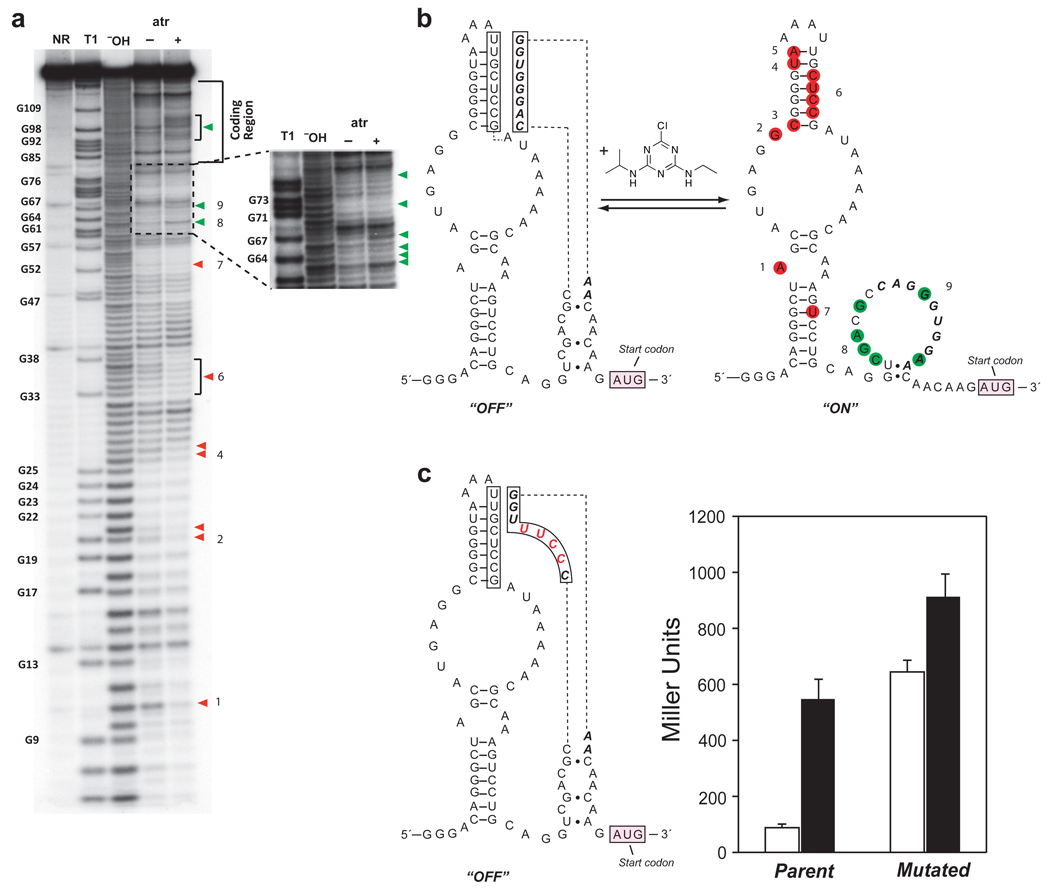
(a) Polyacrylamide gel electrophoresis of RNA products generated by in-line probing of 5´-32P labeled RNA. The full length RNA contained the entire 5'-UTR and the first 56 nucleotides of the coding region. NR, T1, and ¯OH represent no reaction, partial digest with RNase T1 (G-specific cleavage), and partial digest with alkali, respectively. RNA was incubated in the absence (□) or presence (+) of 1 mM atrazine. Product bands corresponding to cleavage after G residues are numbered and marked with filled arrowheads. Red arrowheads mark the nucleotides that react less in the presence of atrazine; green arrowheads mark the positions that react more. The insert corresponds to the N10 region. (b) Proposed mechanism of atrazine-dependent activation. Secondary structures are from mFold, and the structure probing data in a. In the absence of atrazine (“off” state), the N10 region forms a pseudoknot with part of the N40 region, sequestering the RBS. In the presence of atrazine (“on” state), the conformation on right is favored. Nucleotides from the pseudoknot structure are boxed, the N10 region is in bold italics, less reactive nucleotides are red and more reactive ones are green. The numbers correspond to the sites as marked a. (c) Sequence, structure, and in vivo β-galactosidase activity of the mutated riboswitch. The mutated nucleotides are shown in red. The in vivo β-galactosidase assay (measured in Miller units) was conducted in E. coli in the absence (white bar) and presence of atrazine (750 µM; black bar).
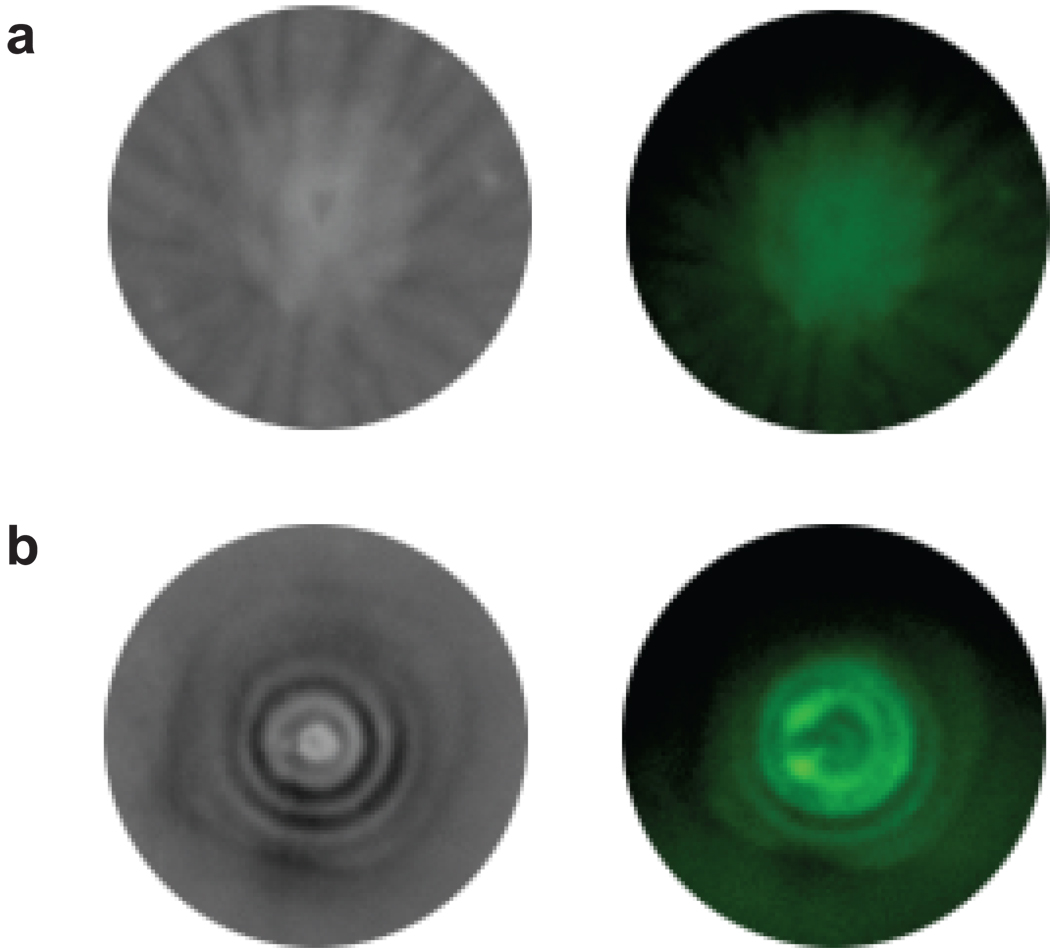
The images on the left were taken under white light whereas images on the right were taken under epi-UV light at 365 nm wavelength using a bandpass filter. (a) Cells containing cheZ under the control of the synthetic riboswitch, but lacking atzA. No atrazine catabolism is observed. (b) Cells containing both cheZ under the control of the synthetic riboswitch and atzA. These cells show concentric circles due to cell motility and atrazine catabolism, which is indicated by the dark circles. White circles are cells fluorescing under UV light.
Comment in
-
Designer bacteria degrades toxin.Nat Chem Biol. 2010 Jun;6(6):398-9. doi: 10.1038/nchembio.378. Nat Chem Biol. 2010. Retraction in: Nat Chem Biol. 2014 Mar;10(3):239. doi: 10.1038/nchembio0314-239b. PMID: 20479747 Retracted. No abstract available.
-
Seek and destroy.Nat Rev Microbiol. 2010 Jul;8(7):465. doi: 10.1038/nrmicro2401. Nat Rev Microbiol. 2010. PMID: 21394954 No abstract available.
References
-
- Parkinson JS, Ames P, Studdert CA. Collaborative signaling by bacterial chemoreceptors. Curr. Opin. Microbiol. 2005;8:116–121. - PubMed
-
- Wadhams GH, Armitage JP. Making sense of it all: bacterial chemotaxis. Nat. Rev. Mol. Cell Biol. 2004;5:1024–1037. - PubMed
-
- Adler J. Chemotaxis in bacteria. Annu. Rev. Biochem. 1975;44:341–356. - PubMed
-
- Derr P, Boder E, Goulian M. Changing the specificity of a bacterial chemoreceptor. J. Mol. Biol. 2006;355:923–932. - PubMed
-
- Matsumura I, Ellington AD. In vitro evolution of beta-glucuronidase into a beta-galactosidase proceeds through non-specific intermediates. J. Mol. Biol. 2001;305:331–339. - PubMed
Publication types
MeSH terms
Substances
Grants and funding
LinkOut - more resources
Full Text Sources
Other Literature Sources
Molecular Biology Databases
Research Materials
