


Role of PAF receptor in proinflammatory cytokine expression in the dorsal root ganglion and tactile allodynia in a rodent model of neuropathic pain
- PMID: 20454616
- PMCID: PMC2862737
- DOI: 10.1371/journal.pone.0010467
Role of PAF receptor in proinflammatory cytokine expression in the dorsal root ganglion and tactile allodynia in a rodent model of neuropathic pain
Abstract
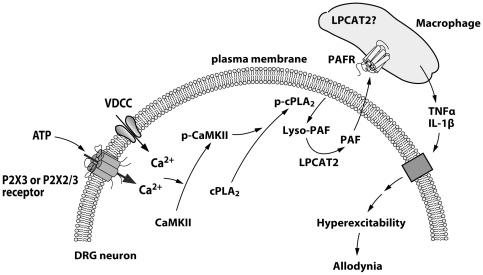
Background: Neuropathic pain is a highly debilitating chronic pain following damage to peripheral sensory neurons and is often resistant to all treatments currently available, including opioids. We have previously shown that peripheral nerve injury induces activation of cytosolic phospholipase A(2) (cPLA(2)) in injured dorsal root ganglion (DRG) neurons that contribute to tactile allodynia, a hallmark of neuropathic pain. However, lipid mediators downstream of cPLA(2) activation to produce tactile allodynia remain to be determined.
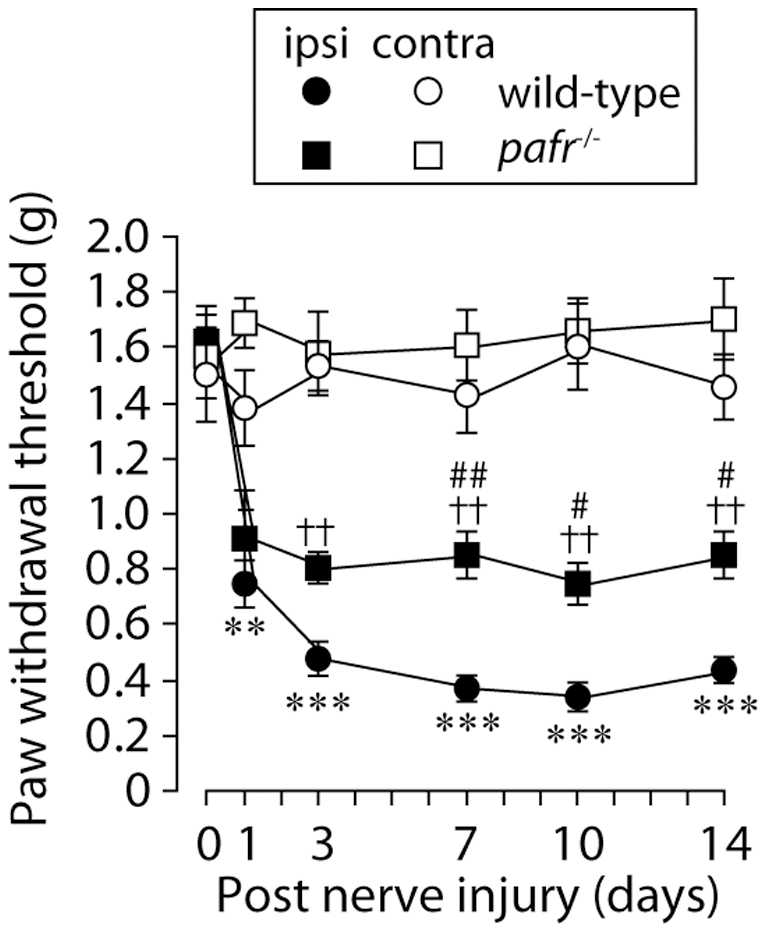
Principal findings: Here we provide evidence that platelet-activating factor (PAF) is a potential candidate. Pharmacological blockade of PAF receptors (PAFRs) reduced the development and expression of tactile allodynia following nerve injury. The expression of PAFR mRNA was increased in the DRG ipsilateral to nerve injury, which was seen mainly in macrophages. Furthermore, mice lacking PAFRs showed a reduction of nerve injury-induced tactile allodynia and, interestingly, a marked suppression of upregulation of tumor necrosis factor alpha (TNFalpha) and interleukin-1beta (IL-1beta) expression in the injured DRG, crucial proinflammatory cytokines involved in pain hypersensitivity. Conversely, a single injection of PAF near the DRG of naïve rats caused a decrease in the paw withdrawal threshold to mechanical stimulation in a dose-dependent manner and an increase in the expression of mRNAs for TNFalpha and IL-1beta, both of which were inhibited by pretreatment with a PAFR antagonist.
Conclusions: Our results indicate that the PAF/PAFR system has an important role in production of TNFalpha and IL-1beta in the DRG and tactile allodynia following peripheral nerve injury and suggest that blocking PAFRs may be a viable therapeutic strategy for treating neuropathic pain.
Conflict of interest statement
Figures





References
-
- Woolf CJ, Mannion RJ. Neuropathic pain: aetiology, symptoms, mechanisms, and management. Lancet. 1999;353:1959–1964. - PubMed
-
- Woolf CJ, Salter MW. Neuronal plasticity: increasing the gain in pain. Science. 2000;288:1765–1769. - PubMed
-
- Scholz J, Woolf CJ. Can we conquer pain? Nat Neurosci. 2002;5(Suppl):1062–1067. - PubMed
-
- Shimizu T, Ohto T, Kita Y. Cytosolic phospholipase A2: biochemical properties and physiological roles. IUBMB Life. 2006;58:328–333. - PubMed
-
- Tsuda M, Hasegawa S, Inoue K. P2X receptors-mediated cytosolic phospholipase A2 activation in primary afferent sensory neurons contributes to neuropathic pain. J Neurochem. 2007;103:1408–1416. - PubMed
Publication types
MeSH terms
Substances
LinkOut - more resources
Full Text Sources
Other Literature Sources
Medical
Molecular Biology Databases
