


Depression and osteoporosis: a research synthesis with meta-analysis
- PMID: 20455194
- PMCID: PMC3120042
- DOI: 10.1055/s-0030-1252020
Depression and osteoporosis: a research synthesis with meta-analysis
Abstract
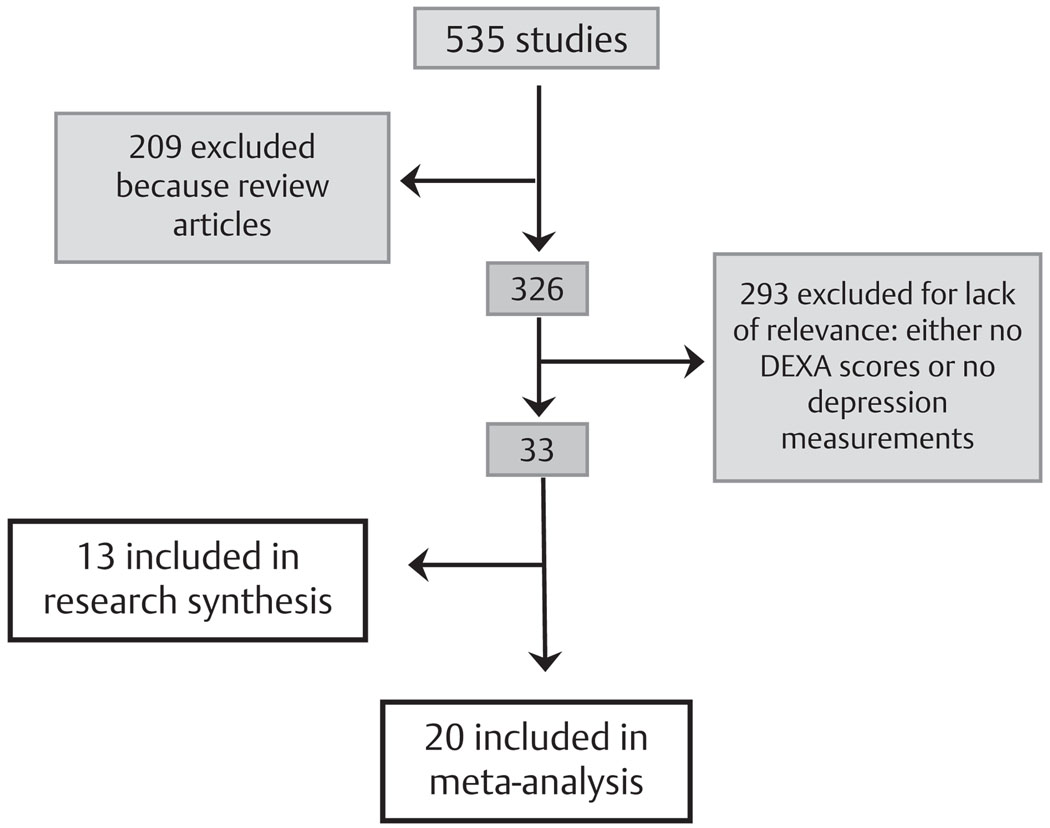
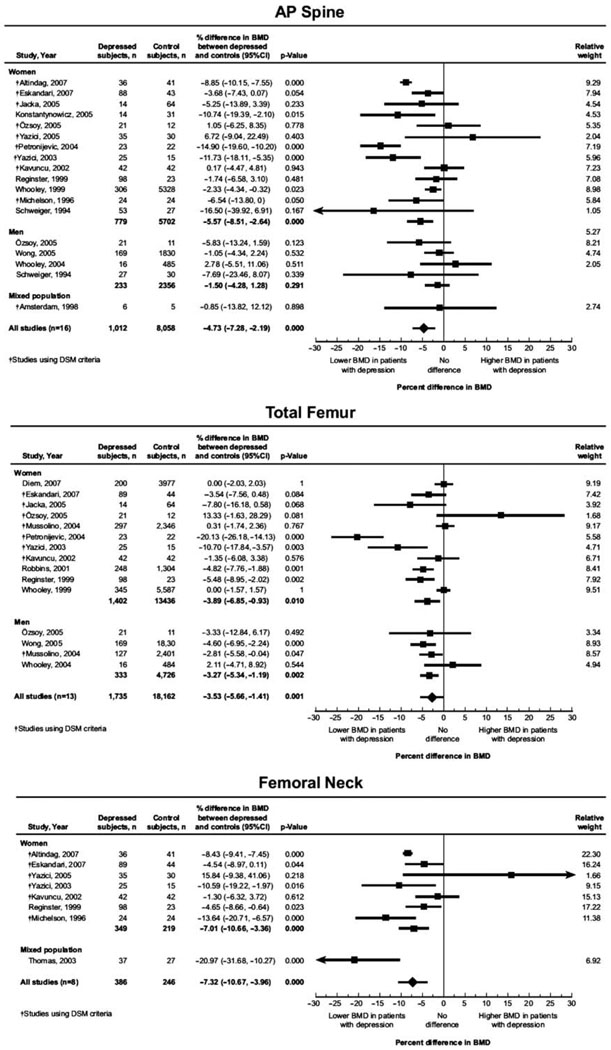
Major depressive disorder has been associated with low bone mineral density. The strength of this association, however, varies greatly among studies; the direction of the causative link is still controversial, and the etiology remains unclear. We aimed to confirm this association, assess its magnitude and estimate its clinical relevancy. A total of 535 articles were initially identified and the research synthesis was based on 33 qualified articles. Of these, 25 articles (or 76%) showed an inverse relationship between major depression or minor depression or depressive symptoms and bone mineral density or bone turnover. Meta-analysis could be performed on 20 of the initially selected 33 articles. Standardized weighted differences in mean AP spine, total femur and femoral neck bone mineral density, each from at least 10 studies, were computed in g/cm (2) and transformed into percent differences. At each site, bone mass was lower in subjects with depression as compared to controls: AP spine bone mineral density was 4.73% lower (95% CI -7.28% to -2.19%, p<0.0001; n=16 studies), total femur bone mineral density was 3.53% lower (95% CI -5.66% to -1.41%, p<0.001; n=13 studies), and femoral neck bone mineral density was 7.32% lower (95% CI -10.67% to -3.96%; p<0.0005; n=8 studies). In conclusion, major depressive disorder was associated with lower bone mineral density at the AP spine, femoral neck, and total femur. The deficits in bone mineral density in subjects with depression are of clinical significance and likely to increase fracture risk over the lifetime of these subjects.
Georg Thieme Verlag KG Stuttgart * New York.
Figures
Similar articles
-
Low grip strength is associated with bone mineral density and vertebral fracture in women.Rheumatology (Oxford). 2005 May;44(5):642-6. doi: 10.1093/rheumatology/keh569. Epub 2005 Feb 22. Rheumatology (Oxford). 2005. PMID: 15728415
-
Prevalence of low bone mass in postmenopausal Kuwaiti women residents in the largest province of Kuwait.Arch Osteoporos. 2012;7:147-53. doi: 10.1007/s11657-012-0092-1. Epub 2012 Sep 1. Arch Osteoporos. 2012. PMID: 23225292
-
Bone mineral density at femoral neck and lumbar spine in adults with type 1 diabetes: a meta-analysis and review of the literature.Osteoporos Int. 2017 Sep;28(9):2601-2610. doi: 10.1007/s00198-017-4097-x. Epub 2017 Jun 3. Osteoporos Int. 2017. PMID: 28580510 Review.
-
Skeletal site bone mineral density heterogeneity in women and men.Osteoporos Int. 2001;12(5):362-5. doi: 10.1007/s001980170103. Osteoporos Int. 2001. PMID: 11444083
-
Depression and low bone mineral density: a meta-analysis of epidemiologic studies.Osteoporos Int. 2009 Aug;20(8):1309-20. doi: 10.1007/s00198-009-0918-x. Epub 2009 Apr 3. Osteoporos Int. 2009. PMID: 19343469 Review.
Cited by
-
Emerging evidence on the link between depressive symptoms and bone loss in postmenopausal women.Int J Womens Health. 2017 Dec 28;10:1-9. doi: 10.2147/IJWH.S147006. eCollection 2018. Int J Womens Health. 2017. PMID: 29343990 Free PMC article. Review.
-
Depression, anxiety, and quality of life in a large cohort of patients with rheumatic diseases: common, yet undertreated.Clin Rheumatol. 2016 Mar;35(3):733-9. doi: 10.1007/s10067-014-2677-0. Epub 2014 May 25. Clin Rheumatol. 2016. PMID: 24859781
-
Effect of RANKL on Lower Depressive Symptoms In Hemodialysis Patients.Calcif Tissue Int. 2024 Aug;115(2):124-131. doi: 10.1007/s00223-024-01215-2. Epub 2024 Jun 15. Calcif Tissue Int. 2024. PMID: 38878178
-
Depressive symptoms, body composition and bone mass in young adults: a prospective cohort study.Int J Obes (Lond). 2017 Apr;41(4):576-581. doi: 10.1038/ijo.2016.214. Epub 2016 Nov 24. Int J Obes (Lond). 2017. PMID: 27881857
-
The effect of serum calcium on the association of depression with infertility among U.S. women.Heliyon. 2023 Nov 11;9(11):e22220. doi: 10.1016/j.heliyon.2023.e22220. eCollection 2023 Nov. Heliyon. 2023. PMID: 38045116 Free PMC article.
References
-
- Evans DL, Charney DS, Lewis L, Golden RN, Gorman JM, Krishnan KR, Nemeroff CB, Bremner JD, Carney RM, Coyne JC, Delong MR, Frasure-Smith N, Glassman AH, Gold PW, Grant I, Gwyther L, Ironson G, Johnson RL, Kanner AM, Katon WJ, Kaufmann PG, Keefe FJ, Ketter T, Laughren TP, Leserman J, Lyketsos CG, McDonald WM, McEwen BS, Miller AH, Musselman D, O’Connor C, Petitto JM, Pollock BG, Robinson RG, Roose SP, Rowland J, Sheline Y, Sheps DS, Simon G, Spiegel D, Stunkard A, Sunderland T, Tibbits P, Jr, Valvo WJ. Mood disorders in the medically ill: scientific review and recommendations. Biol Psychiatry. 2005;58:175–189. - PubMed
-
- Cizza G, Ravn P, Chrousos GP, Gold PW. Depression: a major, unrecognized risk factor for osteoporosis? Trends Endocrinol Metab. 2001;12:198–203. - PubMed
-
- Anonymous Management of osteoporosis in postmenopausal women: 2006 position statement of The North American Menopause Society. Menopause. 2006;13:340–367. quiz 368-349. - PubMed
-
- Kristiansen C. Catching secondary causes of osteoporosis. Endocrine News. 2006;1
-
- Altindag O, Altindag A, Asoglu M, Gunes M, Soran N, Deveci Z. Relation of cortisol levels and bone mineral density among premenopausal women with major depression. Int J Clin Pract. 2007;61:416–420. - PubMed
Publication types
MeSH terms
Grants and funding
LinkOut - more resources
Full Text Sources
Medical
