


Randomized, controlled clinical trial of zinc supplementation to prevent immunological failure in HIV-infected adults
- PMID: 20455705
- PMCID: PMC2874106
- DOI: 10.1086/652864
Randomized, controlled clinical trial of zinc supplementation to prevent immunological failure in HIV-infected adults
Abstract
Background: Adequate zinc is critical for immune function; however, zinc deficiency occurs in >50% of human immunodeficiency virus (HIV)-infected adults. We examined the safety and efficacy of long-term zinc supplementation in relation to HIV disease progression.
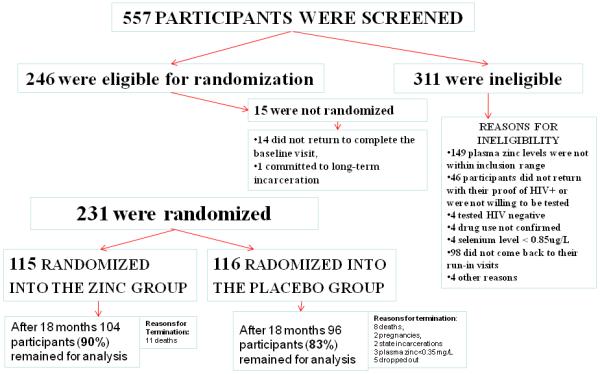
Methods: A prospective, randomized, controlled clinical trial was conducted involving 231 HIV-infected adults with low plasma zinc levels (<0.75 mg/L), who were randomly assigned to receive zinc (12 mg of elemental zinc for women and 15 mg for men) or placebo for 18 months. The primary end point was immunological failure. HIV viral load and CD4(+) cell count were determined every 6 months. Questionnaires, pill counts, and plasma zinc and C-reactive protein levels were used to monitor adherence to study supplements and antiretroviral therapy. Intent-to-treat analysis used multiple-event analysis, treating CD4(+) cell count <200 cells/mm(3) as a recurrent immunological failure event. Cox proportional hazard models and the general-linear model were used to analyze morbidity and mortality data.
Results: Zinc supplementation for 18 months reduced 4-fold the likelihood of immunological failure, controlling for age, sex, food insecurity, baseline CD4(+) cell count, viral load, and antiretroviral therapy (relative rate, 0.24; 95% confidence interval, 0.10-0.56; P<.002). Viral load indicated poor control with antiretroviral therapy but was not affected by zinc supplementation. Zinc supplementation also reduced the rate of diarrhea by more than half (odds ratio, 0.4; 95% confidence interval, 0.183-0.981; P=.019), compared with placebo. There was no significant difference in mortality between the 2 groups.
Conclusions: This study demonstrated that long-term (18-month) zinc supplementation at nutritional levels delayed immunological failure and decreased diarrhea over time. This evidence supports the use of zinc supplementation as an adjunct therapy for HIV-infected adult cohorts with poor viral control. Trial registration. ClinicalTrials.gov identifier: NCT00149552.
Figures
Comment in
-
Micronutrient Supplementation as Adjunct Treatment for HIV-Infected Patients.Clin Infect Dis. 2010 Jun 15;50(12):1661-3. doi: 10.1086/652865. Clin Infect Dis. 2010. PMID: 20455704 No abstract available.
References
-
- Chandra RK. Nutrition and the immune system: an introduction. Am J Clin Nutr. 1997 Aug;66(2):460S–463S. - PubMed
-
- Endre L, Beck F, Prasad A. The role of zinc in human health. J Trace Element Exp Med. 1990;3:337–75.
-
- Baum MK, Shor-Posner G, Zhang G, et al. HIV-1 infection in women is associated with severe nutritional deficiencies. J Acquire Immune Defic Syndr Hum Retroviral. 1997;16:272–278. - PubMed
-
- Beach RS, Mantero-Atienza E, Shor-Posner G, Javier JJ, Szapocznik J, Morgan R, Sauberlich HE, Cornwell PE, Eisdorfer C, Baum MK. Specific nutrient abnormalities in asymptomatic HIV-1 infection. AIDS. 1992;6:701–708. - PubMed
-
- Jones CY, Tang AM, Forrester JE, Huang J, Hendricks KM, Knox TA, Spiegelman D, Semba RD, Woods MN. Micronutrient levels and HIV disease status in HIV-infected patients on highly active antiretroviral therapy in the Nutrition for Healthy Living cohort. J Acquir Immune Defic Syndr. 2006 Dec 1;43(4):475–82. - PubMed
Publication types
MeSH terms
Substances
Associated data
Grants and funding
LinkOut - more resources
Full Text Sources
Medical
Research Materials
