


Increased expression of bFGF is associated with carotid atherosclerotic plaques instability engaging the NF-κB pathway
- PMID: 20455997
- PMCID: PMC3822568
- DOI: 10.1111/j.1582-4934.2010.01082.x
Increased expression of bFGF is associated with carotid atherosclerotic plaques instability engaging the NF-κB pathway
Abstract
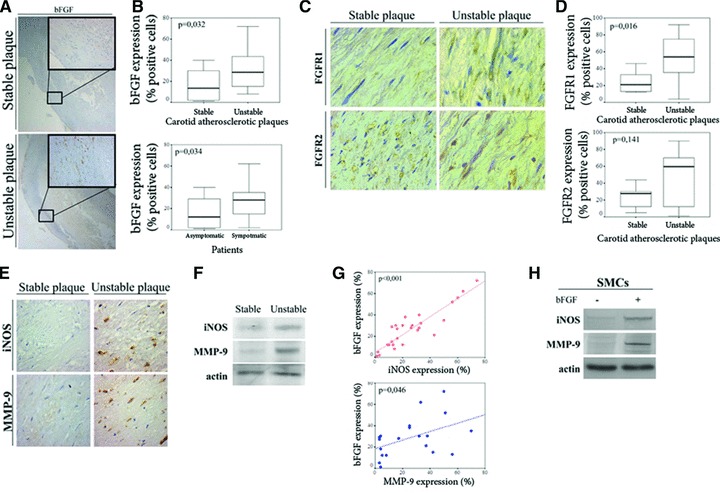
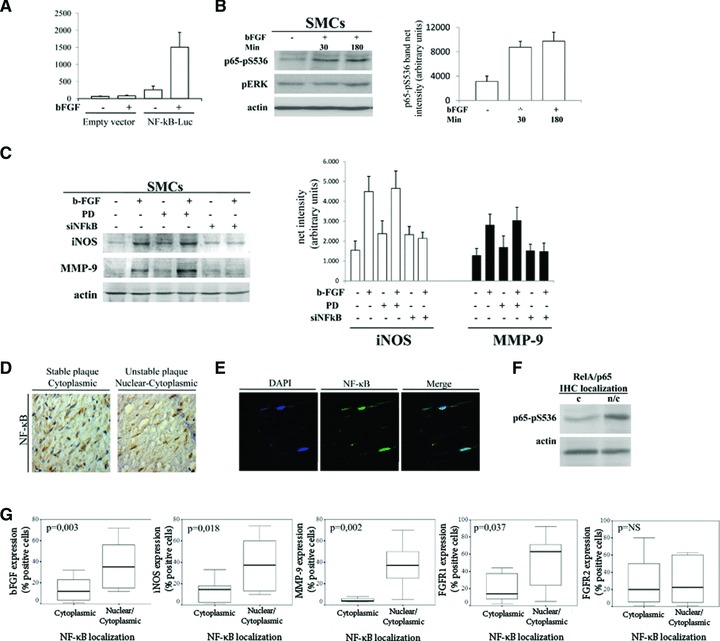
Unstable atherosclerotic plaques of the carotid arteries are at great risk for the development of ischemic cerebrovascular events. The degradation of the extracellular matrix by matrix metalloproteinases (MMPs) and NO-induced apoptosis of vascular smooth muscle cells (VSMCs) contribute to the vulnerability of the atherosclerotic plaques. Basic fibroblast growth factor (bFGF) through its mitogenic and angiogenic properties has already been implicated in the pathogenesis of atherosclerosis. However, its role in plaque stability remains elusive. To address this issue, a panel of human carotid atherosclerotic plaques was analyzed for bFGF, FGF-receptors-1 and -2 (FGFR-1/-2), inducible nitric oxide synthase (iNOS) and MMP-9 expression. Our data revealed increased expression of bFGF and FGFR-1 in VSMCs of unstable plaques, implying the existence of an autocrine loop, which significantly correlated with high iNOS and MMP-9 levels. These results were recapitulated in vitro by treatment of VSMCs with bFGF. bFGF administration led to up-regulation of both iNOS and MMP-9 that was specifically mediated by nuclear factor-kappaB (NF-kappaB) activation. Collectively, our data demonstrate a novel NF-kappaB-mediated pathway linking bFGF with iNOS and MMP-9 expression that is associated with carotid plaque vulnerability.
Figures
References
-
- Sacco RL, Benjamin EJ, Broderick JP, et al. Risk factors: AHA Conference Proceedings. Stroke. 1997;28:1507–17. - PubMed
-
- Luigi Giusto S, Alessandro M, Giampiero P, et al. Relationships between risk factors and morphological patterns of human carotid atherosclerotic plaques. A multivariate discriminant analysis. Atherosclerosis. 1994;108:39–60. - PubMed
-
- Inzitari D, Eliasziw M, Gates P, et al. The causes and risk of stroke in patients with asymptomatic internal-carotid-artery stenosis. N Engl J Med. 2000;342:1693–701. - PubMed
-
- Sitzer M, Muller W, Siebler M, et al. Plaque ulceration and lumen thrombus are the main sources of cerebral microemboli in high-grade internal carotid artery stenosis. Stroke. 1995;26:1231–3. - PubMed
-
- Carr S, Farb A, Pearce WH, et al. Atherosclerotic plaque rupture in symptomatic carotid artery stenosis. J Vasc Surg. 1996;23:755–66. - PubMed
Publication types
MeSH terms
Substances
LinkOut - more resources
Full Text Sources
Medical
Miscellaneous
