


Social and non-social visual attention patterns and associative learning in infants at risk for autism
- PMID: 20456532
- PMCID: PMC3653974
- DOI: 10.1111/j.1469-7610.2010.02262.x
Social and non-social visual attention patterns and associative learning in infants at risk for autism
Abstract
Background: Social inattention is common in children with autism whereas associative learning capabilities are considered a relative strength. Identifying early precursors of impairment associated with autism could lead to earlier identification of this disorder. The present study compared social and non-social visual attention patterns as well as associative learning in infant siblings of children with autism (AU sibs) and low-risk (LR) infants at 6 months of age.
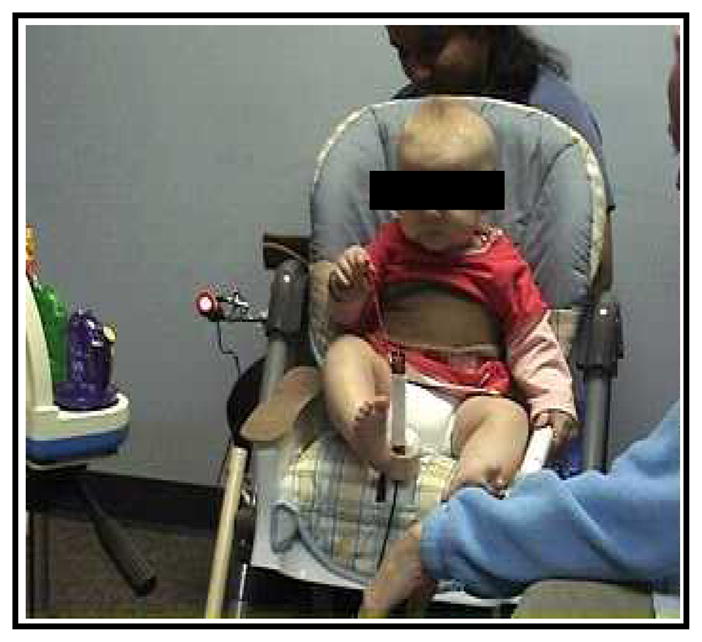
Methods: Twenty-five AU sibs and 25 LR infants were observed in a novel social-object learning task, within which attention to social and non-social cues was contrasted. Video recorded data were coded for percent duration of gaze to objects or caregiver. Movement rates to activate the toy within the associative learning task were also quantified.
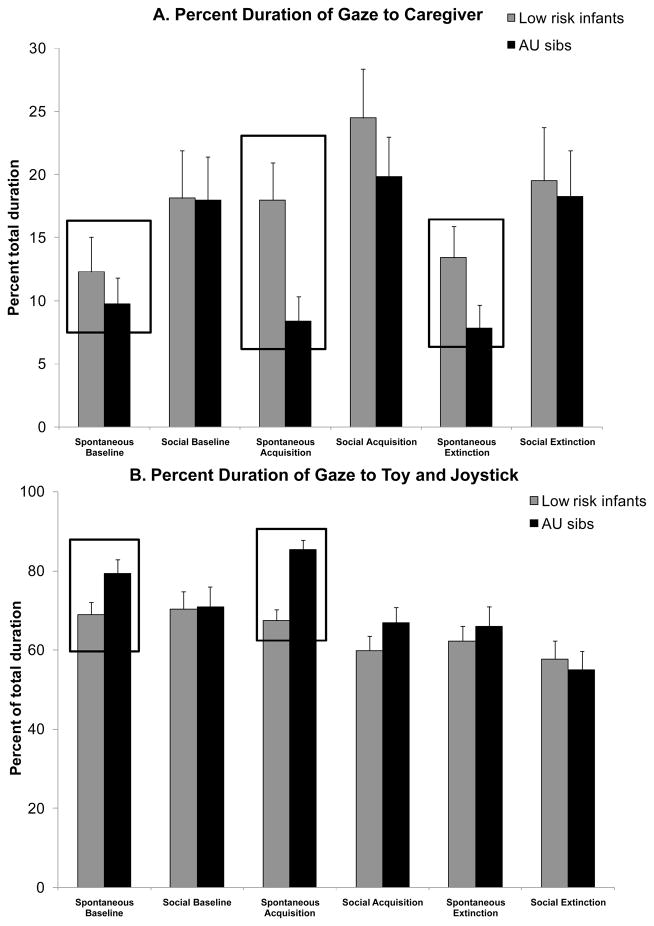
Results: Both groups learned the association between moving a switch and activating a cause-effect toy. AU sibs spent less time looking at caregivers and more time looking at the toy or joystick when their caregivers made no attempts to engage their attention. However, response to caregiver-initiated social bids was comparable for both groups.
Conclusions: Infrequent self-initiated socially directed gaze may be an early marker of later social and communication delays.
Figures
Comment in
-
Proceeding with caution--the importance of negative findings in the science of psychopathology.J Child Psychol Psychiatry. 2010 Sep;51(9):965-6. doi: 10.1111/j.1469-7610.2010.02297.x. J Child Psychol Psychiatry. 2010. PMID: 20698912 No abstract available.
References
-
- Alessandri SM, Sullivan MW, Lewis M. Violation of expectancy and frustration in early infancy. Developmental Psychology. 1990;26(5):738–744.
-
- Alessandri SM, Sullivan MW, Imaizumi S, Lewis M. Learning and emotional responsivity in cocaine-exposed infants. Developmental Psychology. 1993;29(6):989–997.
-
- American Psychiatric Association. Diagnostic and statistical manual of mental disorders (DSM-IV-TR) 4. Washington, DC: 2000.
-
- Baglio C, Benavidiz D, Compton L, Matson J, Paclawskyj T. Behavioral treatment of autistic persons: A review of research from 1980 to present. Research in Developmental Disabilities. 1996;17:433–465. - PubMed
-
- Bailey A, Phillips W, Rutter M. Autism: Towards an integration of clinical, genetic, neuropsychological, and neurobiological perspectives. Journal of Child Psychology and Psychiatry. 1996;37:89–126. - PubMed
Publication types
MeSH terms
Grants and funding
LinkOut - more resources
Full Text Sources
Medical
