


Attentional networks in children and adolescents with autism spectrum disorder
- PMID: 20456535
- PMCID: PMC3145814
- DOI: 10.1111/j.1469-7610.2010.02257.x
Attentional networks in children and adolescents with autism spectrum disorder
Abstract
Background: Individuals diagnosed with autism spectrum disorder (ASD) exhibit lifelong abnormalities in the adaptive allocation of visual attention. The ubiquitous nature of attentional impairments in ASD has led some authors to hypothesize that atypical attentional modulation may be a factor in the development of higher-level sociocommunicative deficits.
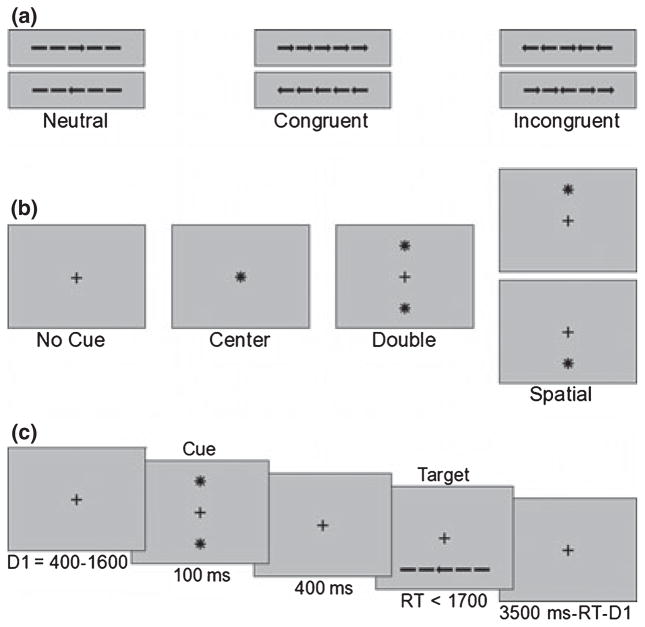
Method: Participants were 20 children with ASD and 20 age- and Nonverbal IQ-matched typically developing (TD) children. We used the Attention Network Test (ANT) to investigate the efficiency and independence of three discrete attentional networks: alerting, orienting, and executive control. Additionally, we sought to investigate the relationship between each attentional network and measures of sociocommunicative symptom severity in children with ASD.
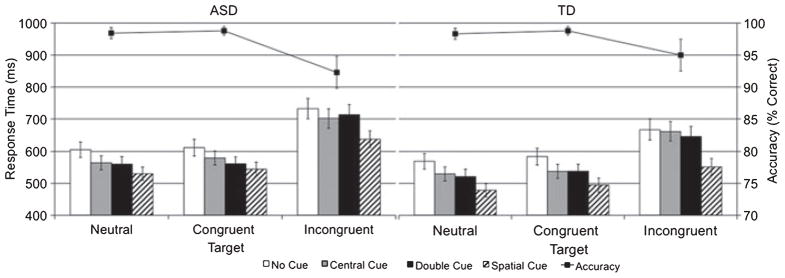
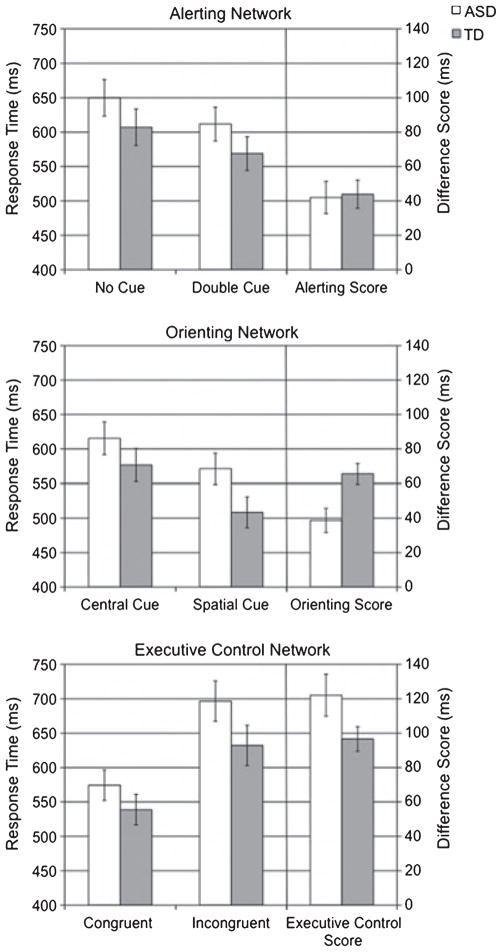
Results: Results indicate that the orienting, but not alerting or executive control, networks may be impaired in children with ASD. In contrast to TD children, correlational analyses suggest that the alerting and executive control networks may not function as independently in children with ASD. Additionally, an association was found between the alerting network and social impairment and between the executive control network and IQ in children with ASD.
Conclusions: The results provide further evidence of an impairment in the visuospatial orienting network in ASD and suggest that there may be greater interdependence of alerting and executive control networks in ASD. Furthermore, decreased ability to efficiently modulate levels of alertness was related to increased sociocommunicative deficits, suggesting that domain-general attentional function may be associated with ASD symptomatology.
© 2010 The Authors. Journal of Child Psychology and Psychiatry © 2010 Association for Child and Adolescent Mental Health.
Conflict of interest statement
Conflict of interest statement: No conflicts declared.
Figures
References
-
- Allen G, Courchesne E. Attention function and dysfunction in autism. Frontiers in Bioscience. 2001;6:D105– 119. - PubMed
-
- American Psychiatric Association (APA) Diagnostic and statistical manual of mental disorders: Text revision DSM-IV-TR. 4. Washington, DC: American Psychiatric Association; 2000.
-
- Belmonte MK, Yurgelun-Todd DA. Functional anatomy of impaired selective attention and compensatory processing in autism. Brain Research. 2003;17:651–664. - PubMed
-
- Burack JA, Enns JT, Stauder JEA, Mottron L, Randolph B. Attention and autism: Behavioral and electrophysiological evidence. In: Cohen DJ, Volkmar FR, editors. Handbook of autism and pervasive developmental disorders. 2. New York: John Wiley & Sons; 1997. pp. 226–247.
Publication types
MeSH terms
Grants and funding
LinkOut - more resources
Full Text Sources
Other Literature Sources
