


Review
doi: 10.1074/jbc.R110.133017.
Epub 2010 May 10.
Hepatitis C virus: assembly and release of virus particles
Affiliations
- PMID: 20457608
- PMCID: PMC2906262
- DOI: 10.1074/jbc.R110.133017
Item in Clipboard
Review
Hepatitis C virus: assembly and release of virus particles
J Biol Chem.
.
Abstract
Hepatitis C virus is a blood-borne virus that typically establishes a chronic infection in the liver, which often results in cirrhosis and hepatocellular carcinoma. Progress in understanding the complete virus life cycle has been greatly enhanced by the recent availability of a tissue culture system that produces infectious virus progeny. Thus, it is now possible to gain insight into the roles played by viral components in assembly and egress and the cellular pathways that contribute to virion formation. This minireview describes the key determining viral and host factors that are needed to produce infectious virus.
Figures
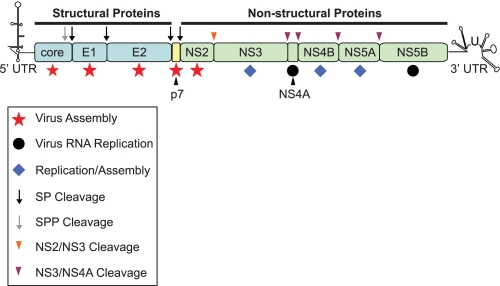
Schematic representation of the HCV genome. The single open reading frame encodes 10 viral proteins that are divided into the structural (core, E1, and E2; shown in blue) and non-structural (NS2, NS3, NS4A, NS4B, NS5A, and NS5B; shown in green) regions. The small peptide p7 is currently unassigned into either category (shown in yellow). The open reading frame is flanked by untranslated regions (UTR) at the 5′ and 3′ termini that are involved in both replication and translation. Following translation, the viral polyprotein is processed by two cellular protease activities, signal peptidase (SP; black arrow) and signal peptide peptidase (SPP; gray arrow), to yield core, E1, E2, and p7. Two virus-encoded proteases, the NS2-NS3 autoprotease (orange arrowhead) and the NS3 serine protease as a complex with NS4A (purple arrowhead), generate mature proteins from the NS2–NS5B region. Core, E1, and E2 provide physical components of the virion. p7 and NS2 appear to function exclusively in and are essential for virus assembly (red stars). NS4A and NS5B (black circles) are critical for viral RNA replication, but there are no reports suggesting that either protein is required for generation of infectious progeny. NS3, NS4B, and NS5A have dual functions in viral RNA replication and particle production (blue diamonds).
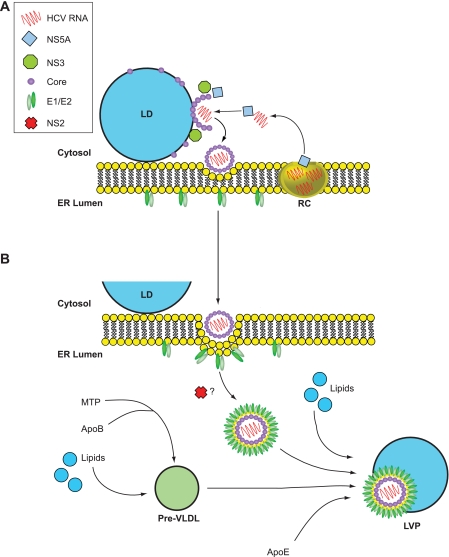
Model for HCV virion assembly. Based on current evidence, assembly initiates on the cytosolic side of the ER membrane (A), and complete maturation occurs in the ER lumen (B) prior to release from the cell. A, in the early steps of assembly, core protein is targeted to LDs, where it coats the organelle surface. Viral RCs are recruited to LD surfaces in a core- and NS5A-dependent manner to enable transfer of replicated RNA from RCs for association with core to permit encapsidation of the genome. During this stage, NS3 is required for the formation of fast-sedimenting core-containing particles, which are presumed to represent non-infectious virions that will undergo further stages of maturation. B, late assembly steps involve the acquisition of a lipid envelope and the incorporation of the E1 and E2 glycoproteins into virions. NS2 appears to confer infectivity to virions, perhaps by mediating an interaction between glycoprotein complexes (E1 and E2) and immature particles. During maturation, nascent virus particles combine with pre-VLDLs (produced by initial lipidation of apoB by MTP), lipids in the form of lumenal LDs, and other lipoprotein components such as apoE to generate LVPs. The stage at which p7 participates is unclear, and therefore, it has not been included in the model.
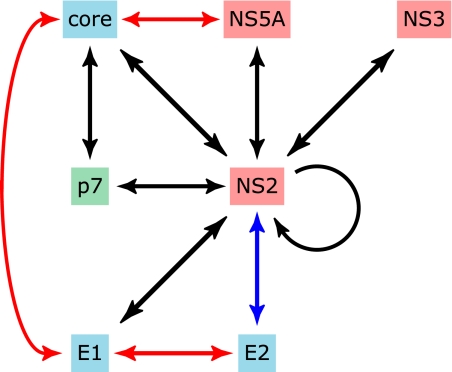
Interactions between viral proteins that occur during virion assembly. Black arrows indicate genetic interactions between viral components that have been identified by passaging viral genomes, which are defective in one gene (e.g. core), until compensatory mutations arise within other coding regions that restore the generation of infectious progeny (e.g. p7). Red arrows show core-NS5A, core-E1, and E1-E2 interactions that have been determined experimentally. The blue arrow indicates colocalization between NS2 and E2, but there is no available evidence for physical association between the proteins.
References
-
- Kim Y. K., Kim C. S., Lee S. H., Jang S. K. (2002) Biochem. Biophys. Res. Commun. 290, 105–112 - PubMed
Publication types
MeSH terms
Substances
Grants and funding
LinkOut - more resources
Full Text Sources
Other Literature Sources
