IFNgamma restores breast cancer sensitivity to fulvestrant by regulating STAT1, IFN regulatory factor 1, NF-kappaB, BCL2 family members, and signaling to caspase-dependent apoptosis
- PMID: 20457620
- PMCID: PMC2925293
- DOI: 10.1158/1535-7163.MCT-09-1169
IFNgamma restores breast cancer sensitivity to fulvestrant by regulating STAT1, IFN regulatory factor 1, NF-kappaB, BCL2 family members, and signaling to caspase-dependent apoptosis
Abstract
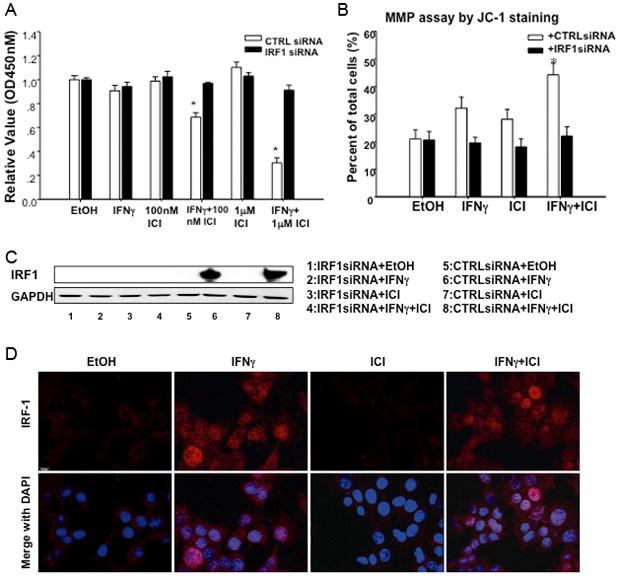
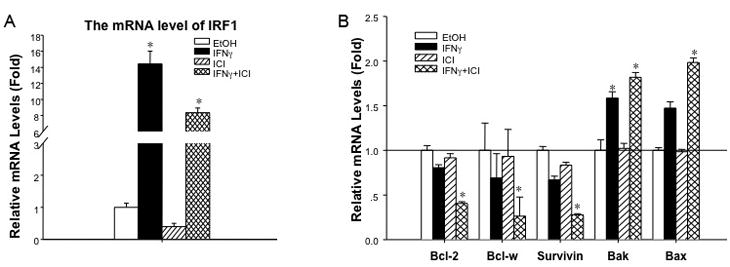
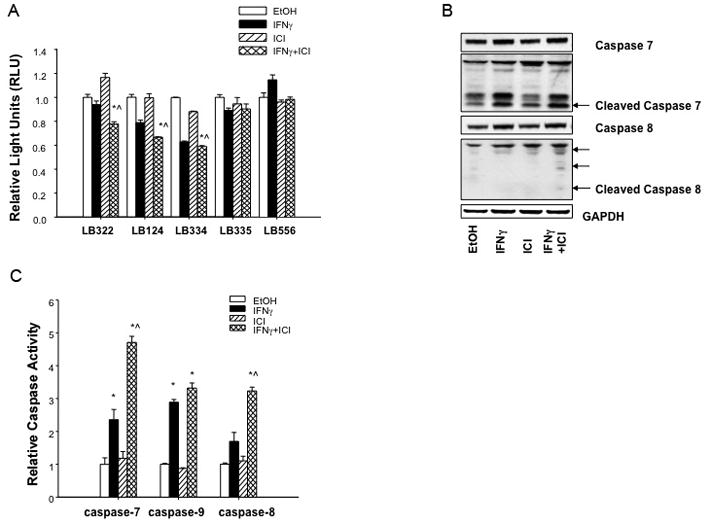
Antiestrogens are effective therapies for the management of many estrogen receptor-alpha (ER)-positive breast cancers. Nonetheless, both de novo and acquired resistance occur and remain major problems in the clinical setting. IFNgamma is an inflammatory cytokine that induces the expression and function of IFN regulatory factor 1 (IRF1), a tumor suppressor gene that can increase antiestrogen responsiveness. We show that IFNgamma, but not IFNalpha, IFNbeta, or fulvestrant (ICI; ICI 182,780; Faslodex), induces IRF1 expression in antiestrogen-resistant MCF7/LCC9 and LY2 cells. Moreover, IFNgamma restores the responsiveness of these cells to fulvestrant. Increased IRF1 activation suppresses NF-kappaB p65 (RELA) activity, inhibits the expression of prosurvival (BCL2, BCL-W), and induces the expression of proapoptotic members (BAK, mitochondrial BAX) of the BCL2 family. This molecular signaling is associated with the activation of signal transducer and activator of transcription 1 and leads to increased mitochondrial membrane permeability; activation of caspase-7 (CASP7), CASP8, and CASP9; and induction of apoptosis but not autophagy. Whereas antiestrogen-resistant cells are capable of inducing autophagy through IFN-mediated signaling, their ability to do so through antiestrogen-regulated signaling is lost. The abilities of IFNgamma to activate CASP8, induce apoptosis, and restore antiestrogen sensitivity are prevented by siRNA targeting IRF1, whereas transient overexpression of IRF1 mimics the effects of IFNgamma treatment. These observations support the exploration of clinical trials combining antiestrogens and compounds that can induce IRF1, such as IFNgamma, for the treatment of some ER-positive breast cancers.
Figures



References
-
- Jemal A, Siegel R, Ward E, Hao Y, Xu J, Murray T, et al. Cancer statistics. CA Cancer J Clin. 2008;58:71–96. - PubMed
-
- Clarke R, Liu MC, Bouker KB, Gu Z, Lee RY, Zhu Y, et al. Antiestrogen resistance in breast cancer and the role of estrogen receptor signaling. Oncogene. 2003;22:7316–39. - PubMed
-
- Clarke R, Leonessa F, Welch JN, Skaar TC. Cellular and molecular pharmacology of antiestrogen action and resistance. Pharmacol Rev. 2001;53:25–71. - PubMed
-
- Riggins R, Bouton AH, Liu MC, Clarke R. Antiestrogens, aromatase inhibitors, and apoptosis in breast cancer. Vitam Horm. 2005;71:201–37. - PubMed
-
- Howell A, DeFriend D, Robertson JFR, Blamey RW, Walton P. Response to a specific antioestrogen (ICI 182,780) in tamoxifen-resistant breast cancer. Lancet. 1995;345:29–30. - PubMed
Publication types
MeSH terms
Substances
Grants and funding
LinkOut - more resources
Full Text Sources
Medical
Research Materials
Miscellaneous