


Heart-type fatty acid binding protein is an independent predictor of death and ventricular dysfunction after coronary artery bypass graft surgery
- PMID: 20457766
- PMCID: PMC3006085
- DOI: 10.1213/ANE.0b013e3181dd9516
Heart-type fatty acid binding protein is an independent predictor of death and ventricular dysfunction after coronary artery bypass graft surgery
Abstract
Background: Heart-type fatty acid binding protein (hFABP) functions as a myocardial fatty acid transporter and is released into the circulation early after myocardial injury. We hypothesized that hFABP is superior to conventional cardiac biomarkers for predicting early perioperative myocardial injury after coronary artery bypass graft (CABG) surgery.
Methods: A prospective cohort study of 1298 patients undergoing primary CABG with cardiopulmonary bypass (CPB) was performed at 2 institutions. Four plasma myocardial injury biomarkers (hFABP; cardiac troponin I [cTnI]; creatine kinase, MB [CK-MB] fraction; and myoglobin) were measured at 7 perioperative time points. The association among perioperative cardiac biomarkers and ventricular dysfunction, hospital length of stay (HLOS), and up to 5-year postoperative mortality (median 3.3 years) was assessed using Cox proportional hazard models. We defined in-hospital ventricular dysfunction as a new requirement for 2 or more inotropes, or new placement of an intraaortic balloon pump, or ventricular assist device either during the intraoperative period after the patient separated from CPB or postoperatively in the intensive care unit.
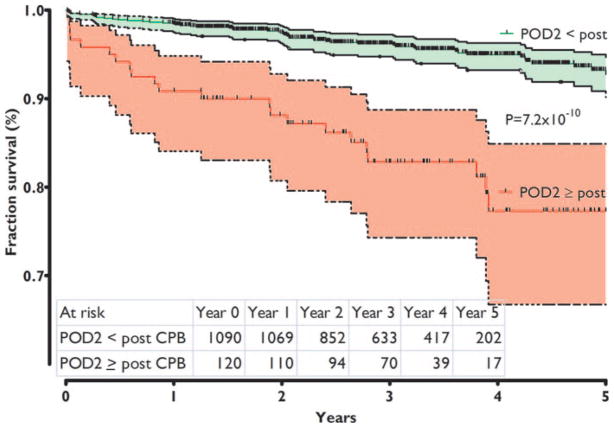
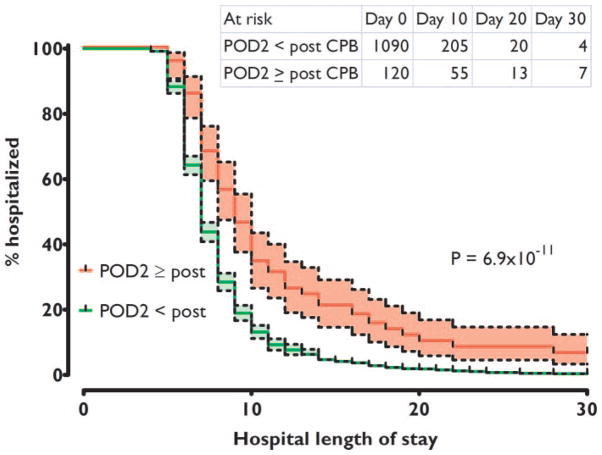
Results: The positive and negative predictive values of mortality for hFABP are 13% (95% confidence interval [CI], 9%-19%) and 95% (95% CI, 94%-96%), respectively, which is higher than for cTnI and CK-MB. After adjusting for clinical predictors, both postoperative day (POD) 1 and peak hFABP levels were independent predictors of ventricular dysfunction (P < 0.0001), HLOS (P < 0.05), and 5-year mortality (P < 0.0001) after CABG surgery. Furthermore, POD1 and peak hFABP levels were significantly superior to other evaluated biomarkers for predicting mortality. In a repeated-measures analysis, hFABP outperformed all other models of fit for HLOS. Patients with POD2 hFABP levels higher than post-CPB hFABP levels had an increased mortality compared with those patients whose POD2 hFABP levels decreased from their post-CPB level (hazard ratio, 10.9; 95% CI, 5.0-23.7; P = 7.2 × 10(-10)). Mortality in the 120 patients (10%) with a later hFABP peak was 18.3%, compared with 4.7% in those who did not peak later. Alternatively, for cTnI or CK-MB, no difference in mortality was detected.
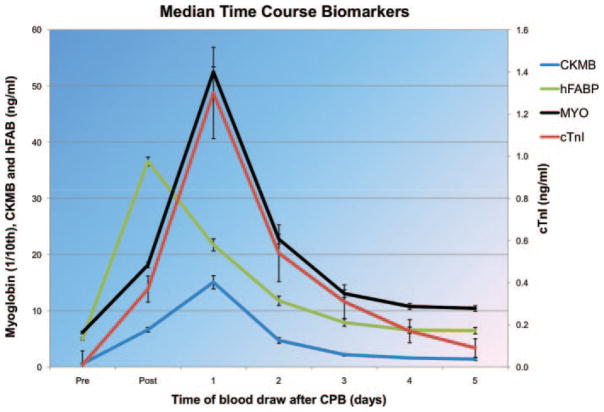
Conclusion: Compared with traditional markers of myocardial injury after CABG surgery, hFABP peaks earlier and is a superior independent predictor of postoperative mortality and ventricular dysfunction.
Trial registration: ClinicalTrials.gov NCT00281164.
Figures
Comment in
-
Do we really need another biomarker to diagnose myocardial infarction after coronary artery bypass graft surgery?Anesth Analg. 2010 Nov;111(5):1086-7. doi: 10.1213/ANE.0b013e3181f4db4c. Anesth Analg. 2010. PMID: 20971957 Free PMC article. No abstract available.
References
-
- Croal BL, Hillis GS, Gibson PH, Fazal MT, El-Shafei H, Gibson G, Jeffrey RR, Buchan KG, West D, Cuthbertson BH. Relationship between postoperative cardiac troponin I levels and outcome of cardiac surgery. Circulation. 2006;114:1468–75. - PubMed
-
- Chen JC, Kaul P, Levy JH, Haverich A, Menasche P, Smith PK, Carrier M, Verrier ED, Van de Werf F, Burge R, Finnegan P, Mark DB, Shernan SK. Myocardial infarction following coronary artery bypass graft surgery increases healthcare resource utilization. Crit Care Med. 2007;35:1296–301. - PubMed
-
- Ramsay J, Shernan S, Fitch J, Finnegan P, Todaro T, Filloon T, Nussmeier NA. Increased creatine kinase MB level predicts postoperative mortality after cardiac surgery independent of new Q waves. J Thorac Cardiovasc Surg. 2005;129:300–6. - PubMed
-
- Azzazy HM, Pelsers MM, Christenson RH. Unbound free fatty acids and heart-type fatty acid-binding protein: diagnostic assays and clinical applications. Clin Chem. 2006;52:19–29. - PubMed
-
- Glatz JF, van der Vusse GJ, Simoons ML, Kragten JA, van Dieijen-Visser MP, Hermens WT. Fatty acid-binding protein and the early detection of acute myocardial infarction. Clin Chim Acta. 1998;272:87–92. - PubMed
Publication types
MeSH terms
Substances
Associated data
Grants and funding
LinkOut - more resources
Full Text Sources
Other Literature Sources
Medical
Research Materials
Miscellaneous
