


Advanced hepatocellular carcinoma: which staging systems best predict prognosis?
- PMID: 20458042
- PMCID: PMC3651603
- DOI: 10.1200/JCO.2009.25.9895
Advanced hepatocellular carcinoma: which staging systems best predict prognosis?
Abstract
Purpose: The purpose of cancer staging systems is to accurately predict patient prognosis. The outcome of advanced hepatocellular carcinoma (HCC) depends on both the cancer stage and the extent of liver dysfunction. Many staging systems that include both aspects have been developed. It remains unknown, however, which of these systems is optimal for predicting patient survival.
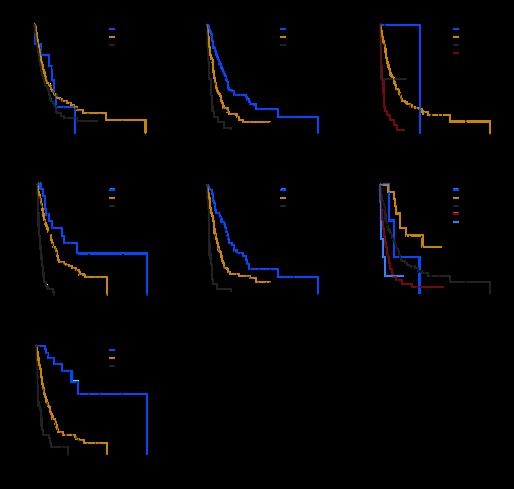
Patients and methods: Patients with advanced HCC treated over a 5-year period at Memorial Sloan-Kettering Cancer Center were identified from an electronic medical record database. Patients with sufficient data for utilization in all staging systems were included. TNM sixth edition, Okuda, Barcelona Clinic Liver Cancer (BCLC), Cancer of the Liver Italian Program (CLIP), Chinese University Prognostic Index (CUPI), Japan Integrated Staging (JIS), and Groupe d'Etude et de Traitement du Carcinome Hepatocellulaire (GETCH) systems were ranked on the basis of their accuracy at predicting survival by using concordance index (c-index). Other independent prognostic variables were also identified.
Results: Overall, 187 eligible patients were identified and were staged by using the seven staging systems. CLIP, CUPI, and GETCH were the three top-ranking staging systems. BCLC and TNM sixth edition lacked any meaningful prognostic discrimination. Performance status, AST, abdominal pain, and esophageal varices improved the discriminatory ability of CLIP.
Conclusion: In our selected patient population, CLIP, CUPI, and GETCH were the most informative staging systems in predicting survival in patients with advanced HCC. Prospective validation is required to determine if they can be accurately used to stratify patients in clinical trials and to direct the appropriate need for systemic therapy versus best supportive care. BCLC and TNM sixth edition were not helpful in predicting survival outcome, and their use is not supported by our data.
Conflict of interest statement
Authors' disclosures of potential conflicts of interest and author contributions are found at the end of this article.
Figures
Comment in
-
Back to basics: staging and prognosis in HCC for medical oncologist.J Hepatol. 2012 Feb;56(2):488-9. doi: 10.1016/j.jhep.2011.06.023. Epub 2011 Jul 26. J Hepatol. 2012. PMID: 21798220 No abstract available.
References
-
- Abou-Alfa GK. Selection of patients with hepatocellular carcinoma for sorafenib. J Natl Compr Canc Netw. 2009;7:397–403. - PubMed
-
- Lei HJ, Chau GY, Lui WY, et al. Prognostic value and clinical relevance of the 6th Edition 2002 American Joint Committee on Cancer staging system in patients with resectable hepatocellular carcinoma. J Am Coll Surg. 2006;203:426–435. - PubMed
-
- Okuda K, Ohtsuki T, Obata H, et al. Natural history of hepatocellular carcinoma and prognosis in relation to treatment: Study of 850 patients. Cancer. 1985;56:918–928. - PubMed
-
- Llovet JM, Brú C, Bruix J. Prognosis of hepatocellular carcinoma: The BCLC staging classification. Sem Liv Dis. 1999;19:329–338. - PubMed
MeSH terms
LinkOut - more resources
Full Text Sources
Medical
