Editorial
. 2010 May 7;1(1):11.
doi: 10.1186/1758-907X-1-11.

How do miRNAs mediate translational repression?

Affiliations
Editorial

How do miRNAs mediate translational repression?

Shuo Gu et al. Silence. .

Abstract

Micro(mi)RNAs regulate gene expression by what are believed to be related but separate mechanistic processes. The relative contribution that each process plays, their mechanistic overlap, and the degree by which they regulate complex genetic networks is still being unraveled. One process by which miRNAs inhibit gene expression occurs through translational repression. In recent years, there has been a plethora of studies published, which have resulted in various molecular models of how miRNAs impair translation. At first evaluation, it appears that these models are quite different and incompatible with one another. In this paper, we focus on possible explanations for the various interpretations of these data sets, and provide a model that we believe is consistent with many of the observations published to date.


Figures
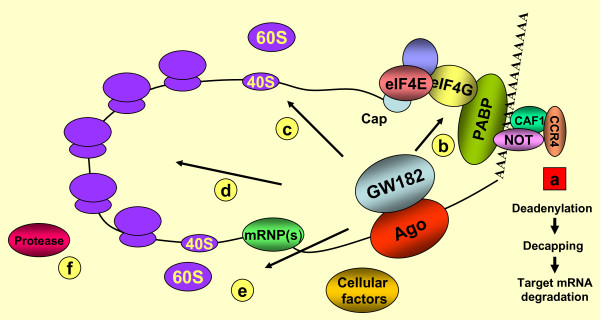
Figure 1
Figure 1
Model for miRNA-mediated repression. The interaction between GW182 and any of the Ago proteins is the first event of or occurs during micro(mi)RNA-target interaction. Several different pathways downstream of GW182 are possible. The specific pathway is probably determined by the composition of the RNA-induced silencing complex (RISC) and interaction with mRNA-ribonucleoprotein (mRNP) complex), microRNA-associated ribonucleoproteins (miRNPs), or cellular factors. (a) GW182 mediates deadenylation, followed by de-capping and mRNA degradation via NOT/CCR4/CAF1 complexes; this is the primary non-cleaving degradation pathway and considered separate from the translational repression pathway. (b) GW182 competes with eIF4G in association with poly-A binding protein (PABP), preventing the circularization required for efficient translation. (c) The 60S ribosome is prevented from joining with the 40S ribosome to form 80S ribosomes. Steps (b) and (c) represent initiation blocks. (d) Slowed or stalled ribosomes along the mRNA, representing a translation elongation block. (e) Premature translation termination and (f) co-translation degradation.

References

    1. Carthew RW, Sontheimer EJ. Origins and mechanisms of miRNAs and siRNAs. Cell. 2009;136:642–655. doi: 10.1016/j.cell.2009.01.035. - DOI - PMC - PubMed
    1. Su H, Trombly MI, Chen J, Wang X. Essential and overlapping functions for mammalian Argonautes in microRNA silencing. Genes Dev. 2009;23:304–317. doi: 10.1101/gad.1749809. - DOI - PMC - PubMed
    1. Brodersen P, Sakvarelidze-Achard L, Bruun-Rasmussen M, Dunoyer P, Yamamoto YY, Sieburth L, Voinnet O. Widespread translational inhibition by plant miRNAs and siRNAs. Science. 2008;320:1185–1190. doi: 10.1126/science.1159151. - DOI - PubMed
    1. Lanet E, Delannoy E, Sormani R, Floris M, Brodersen P, Crete P, Voinnet O, Robaglia C. Biochemical evidence for translational repression by Arabidopsis microRNAs. Plant Cell. 2009;21:1762–1768. doi: 10.1105/tpc.108.063412. - DOI - PMC - PubMed
    1. Filipowicz W, Bhattacharyya SN, Sonenberg N. Mechanisms of post-transcriptional regulation by microRNAs: are the answers in sight? Nat Rev Genet. 2008;9:102–114. doi: 10.1038/nrg2290. - DOI - PubMed

Publication types

LinkOut - more resources