. 2010 May 7:11:34.
doi: 10.1186/1471-2199-11-34.

Sequence features involved in the mechanism of 3' splice junction wobbling

Affiliations

Sequence features involved in the mechanism of 3' splice junction wobbling

Kuo-Wang Tsai et al. BMC Mol Biol. .

Abstract

Background: Alternative splicing is an important mechanism mediating the diversified functions of genes in multicellular organisms, and such event occurs in around 40-60% of human genes. Recently, a new splice-junction wobbling mechanism was proposed that subtle modifications exist in mRNA maturation by alternatively choosing at 5'- GTNGT and 3'- NAGNAG, which created single amino acid insertion and deletion isoforms.

Results: By browsing the Alternative Splicing Database information, we observed that most 3' alternative splice site choices occur within six nucleotides of the dominant splice site and the incidence significantly decreases further away from the dominant acceptor site. Although a lower frequency of alternative splicing occurs within the intronic region (alternative splicing at the proximal AG) than in the exonic region (alternative splicing at the distal AG), alternative AG sites located within the intronic region show stronger potential as the acceptor. These observations revealed that the choice of 3' splice sites during 3' splicing junction wobbling could depend on the distance between the duplicated AG and the branch point site (BPS). Further mutagenesis experiments demonstrated that the distance of AG-to-AG and BPS-to-AG can greatly influence 3' splice site selection. Knocking down a known alternative splicing regulator, hSlu7, failed to affect wobble splicing choices.

Conclusion: Our results implied that nucleotide distance between proximal and distal AG sites has an important regulatory function. In this study, we showed that occurrence of 3' wobble splicing occurs in a distance-dependent manner and that most of this wobble splicing is probably caused by steric hindrance from a factor bound at the neighboring tandem motif sequence.


Figures
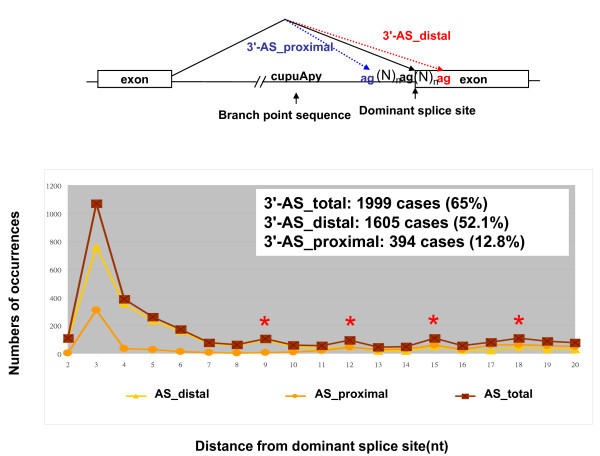
Figure 1
Figure 1
Distribution of 3' alternative splicing at positions ranging from two to twenty nucleotides from the dominant splice site. Schematic representation of three groups of 3' alternative splicing occurring close to the dominant site: 3'-AS_dominant site (black line), 3'-AS_proximal site (blue dashed line) and distal site (red dashed line). The brown squares indicate the total number of alternative splices at the 3' splice sites. Alternative splicing at the proximal splice site (intronic splice site) and the distal splice site (exonic splice site) is indicated by triangles and circles. The numbers of each of the three groups of alternative splicing occurring within six nucleotides of the dominant splice site are indicated in the top panel and the percentage in each group was determined as (number of alternative splices within six nucleotides of the dominant site)/(total number of alternative splices within 20 nucleotides of the dominant splice site) × 100. The red asterisks indicate that alternative splicing occurred at in-frame sites.
Figure 2
Figure 2
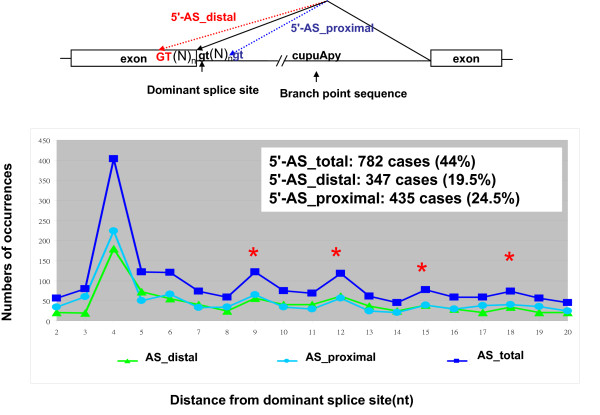
Distribution of 5' alternative splicing at positions ranging from two to twenty nucleotides from the dominant splice site. Schematic representation of three groups of 5' alternative splicing occurring close to the dominant site: 5'-AS_dominant site (black line), 5'-AS_proximal site (blue dashed line) and distal site (red dashed line). The blue squares indicate the total number of alternative splices at the 5' splice sites. Alternative splicing at the proximal splice site (intronic splice site) and the distal splice site (exonic splice site) is indicated by triangles and circles. The numbers of each of the three groups of alternative splicing occurring within six nucleotides of the dominant splice site are indicated in the top panel and the percentage in each group was determined as (number of alternative splices within six nucleotides of the dominant site)/(total number of alternative splices within 20 nucleotides of the dominant splice site) × 100. The red asterisks indicate that alternative splicing occurred at in-frame sites.
Figure 3
Figure 3
The ratios of ESTs between 3'-AS at major and minor sites was plotted respective to their positions. The Y-axis indicates the distribution of ratio of ESTs between major and minor sites. The X-axis denotes the nucleotide distance between alternative and dominant splice sites. Alternative 3' splice sites upstream from the dominant splice site (red line) denote as negative, those downstream are positive. Pink dashed line denotes the alternative splices within ten nucleotides of the dominant site.
Figure 4
Figure 4
The effect of hSlu7 on tandem splice site selection. HeLa cells were transfected with the RNAi oligonucleotide directed against either hSlu7 or luciferase (control). (A) After 48 h, total protein was extracted, separated by 10% SDS-PAGE, transferred to a membrane and probed for hSlu7 and actin. (B) The total RNA was collected, followed by RT-PCR using specific primers. The alternative splicing of the DDO-1 gene was affected by the hSlu7 protein concentration (positive control). GAPDH, a housekeeping gene, was amplified in each sample to confirm that approximately the same amount of cDNA was used for each reaction. (C) and (D) Analysis of 3' wobble splicing of three endogenous genes (FOXM1: NM_021953, PGAM5: NM_138575 and METTL9: NM_016025) and four minigenes (RAGE: NM_014226, SIPA1L1: NM_015556, ARID1A: NM_018450 and AG(T)9CAG) in hSlu7 knockdown HeLa cells using capillary electrophoresis (upper panel). The relative percentage of the two isoforms was calculated using GeneScan 3.7 (lower panel).
Figure 5
Figure 5
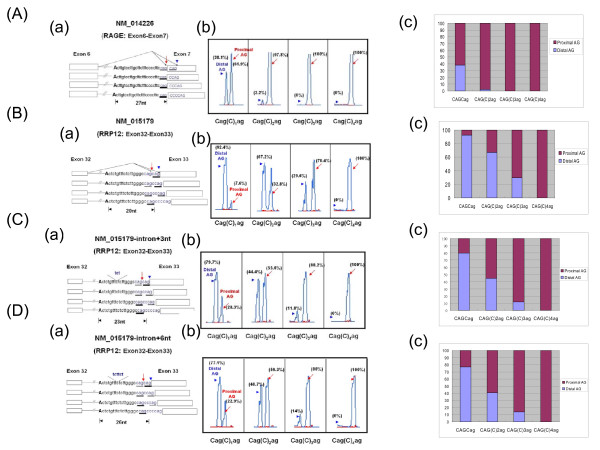
3' acceptor site selection depends on the AG-to-AG and BPS-to-AG distances. NM_014226-E6-I6-E7 (RAGE) (A) and NM_015179-E32-I32-E33 (RRP12) (B) minigene vectors containing four different distances between the proximal and distal AG, CAG(C)1AG, CAG(C)2AG; CAG(C)3AG and CAG(C)4AG (construction as shown in a panels). These minigenes were transfected into a HeLa cell line, and after 48 h total RNA and alternative splicing patterns were assayed as mentioned in the Materials and Methods. The expression profiles of these minigenes are indicated in the b panels and the relative percentage of the two isoforms was showed in the c panels. (C) and (D) The BPS-to-AG distance of NM_015179-E32-I32-E33 was extended by inserting cytosines into the PPT region. These constructs are shown in the a panels and their expression profiles are indicated in the b panels and the relative percentage of the two isoforms was showed in the c panels. The arrowheads and arrows indicate the use of distal and proximal AG, respectively. The percentage of wobble splicing isoforms is shown at the top of each b panel and the relative use of each AG is indicated by the thickness of the underlining in each a panel.

References

    1. Black DL. Mechanisms of alternative pre-messenger RNA splicing. Annu Rev Biochem. 2003;72:291–336. doi: 10.1146/annurev.biochem.72.121801.161720. - DOI - PubMed
    1. Sugnet CW, Kent WJ, Ares M, Jr, Haussler D. Transcriptome and genome conservation of alternative splicing events in humans and mice. Pacific Symposium on Biocomputing. 2004. pp. 66–77. - PubMed
    1. Stetefeld J, Ruegg MA. Structural and functional diversity generated by alternative mRNA splicing. Trends Biochem Sci. 2005;30(9):515–521. doi: 10.1016/j.tibs.2005.07.001. - DOI - PubMed
    1. Zavolan M, Kondo S, Schonbach C, Adachi J, Hume DA, Hayashizaki Y, Gaasterland T. Impact of alternative initiation, splicing, and termination on the diversity of the mRNA transcripts encoded by the mouse transcriptome. Genome Res. 2003;13(6B):1290–1300. doi: 10.1101/gr.1017303. - DOI - PMC - PubMed
    1. Wen F, Li F, Xia H, Lu X, Zhang X, Li Y. The impact of very short alternative splicing on protein structures and functions in the human genome. Trends Genet. 2004;20(5):232–236. doi: 10.1016/j.tig.2004.03.005. - DOI - PubMed

Publication types

Substances

LinkOut - more resources