


Viral quasispecies profiles as the result of the interplay of competition and cooperation
- PMID: 20459709
- PMCID: PMC2885392
- DOI: 10.1186/1471-2148-10-137
Viral quasispecies profiles as the result of the interplay of competition and cooperation
Abstract
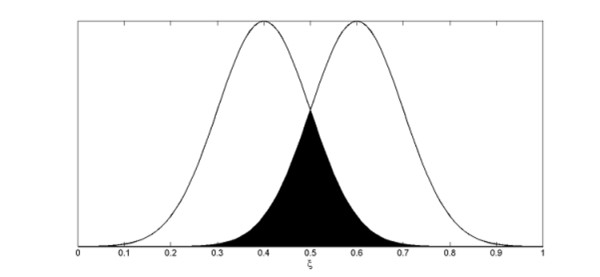
Background: Viral quasispecies can be regarded as a swarm of genetically related mutants. A common approach employed to describe viral quasispecies is by means of the quasispecies equation (QE). However, a main criticism of QE is its lack of frequency-dependent selection. This can be overcome by an alternative formulation for the evolutionary dynamics: the replicator-mutator equation (RME). In turn, a problem with the RME is how to quantify the interaction coefficients between viral variants. Here, this is addressed by adopting an ecological perspective and resorting to the niche theory of competing communities, which assumes that the utilization of resources primarily determines ecological segregation between competing individuals (the different viral variants that constitute the quasispecies). This provides a theoretical framework to estimate quantitatively the fitness landscape.
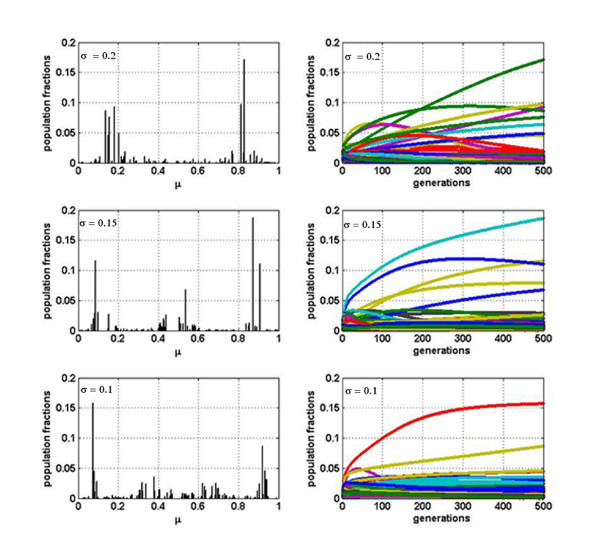
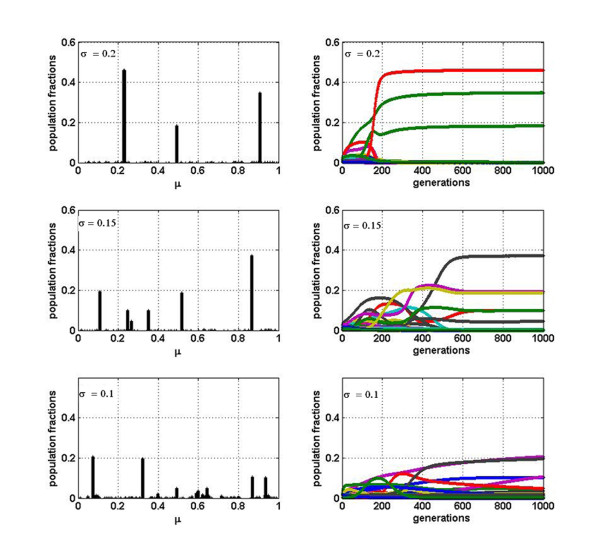
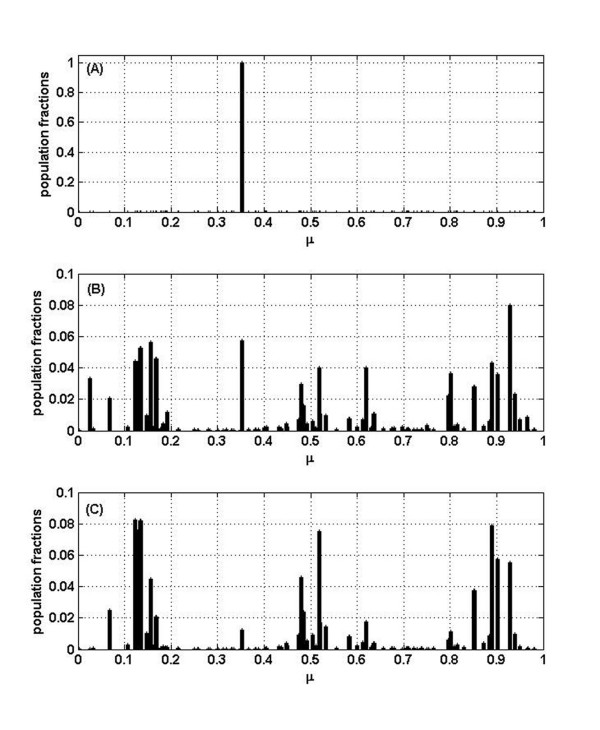
Results: Using this novel combination of RME plus the ecological concept of niche overlapping for describing a quasispecies we explore the population distributions of viral variants that emerge, as well as the corresponding dynamics. We observe that the population distribution requires very long transients both to A) reach equilibrium and B) to show a clear dominating master sequence. Based on different independent and recent experimental evidence, we find that when some cooperation or facilitation between variants is included in appropriate doses we can solve both A) and B). We show that a useful quantity to calibrate the degree of cooperation is the Shannon entropy.
Conclusions: In order to get a typical quasispecies profile, at least within the considered mathematical approach, it seems that pure competition is not enough. Some dose of cooperation among viral variants is needed. This has several biological implications that might contribute to shed light on the mechanisms operating in quasispecies dynamics and to understand the quasispecies as a whole entity.
Figures

References
-
- Eigen M, Schuster P. The Hypercycle: a principle of natural self-organization. Springer-Verlag New York; 1979. - PubMed
-
- Domingo E, Escarmis C, Sevilla N, Moya A, Elena SF, Quer J, Novella IS, Holland J. Basic concepts in RNA virus evolution. FASEB Jour. 1996;10:859–864. - PubMed
-
- Eigen M, Biebricher CK. In: RNA Genetics. Domingo E, Holland J, Ahiquist P, editor. Vol. 3. CRC Press. Inc., Boca Raton, Florida; 1998. Sequence space and quasispecies distribution; pp. 211–245.
-
- May RM. Stability and complexity in model ecosystems. Princeton; Princeton University Press; 1974.
Publication types
MeSH terms
Substances
LinkOut - more resources
Full Text Sources
