. 2010 May 10:7:93.
doi: 10.1186/1743-422X-7-93.

Diametrically opposed effects of hypoxia and oxidative stress on two viral transactivators

Affiliations

Diametrically opposed effects of hypoxia and oxidative stress on two viral transactivators

Amber T Washington et al. Virol J. .

Abstract

Background: Many pathogens exist in multiple physiological niches within the host. Differences between aerobic and anaerobic conditions are known to alter the expression of bacterial virulence factors, typically through the conditional activity of transactivators that modulate their expression. More recently, changes in physiological niches have been shown to affect the expression of viral genes. For many viruses, differences in oxygen tension between hypoxia and normoxia alter gene expression or function. Oxygen tension also affects many mammalian transactivators including AP-1, NFkB, and p53 by affecting the reduced state of critical cysteines in these proteins. We have recently determined that an essential cys-x-x-cys motif in the EBNA1 transactivator of Epstein-Barr virus is redox-regulated, such that transactivation is favoured under reducing conditions. The crucial Tat transactivator of human immunodeficiency virus (HIV) has an essential cysteine-rich region, and is also regulated by redox. Contrary to EBNA1, it is reported that Tat's activity is increased by oxidative stress. Here we have compared the effects of hypoxia, oxidative stress, and cellular redox modulators on EBNA1 and Tat.

Results: Our results indicate that unlike EBNA1, Tat is less active during hypoxia. Agents that generate hydroxyl and superoxide radicals reduce EBNA1's activity but increase transactivation by Tat. The cellular redox modulator, APE1/Ref-1, increases EBNA1's activity, without any effect on Tat. Conversely, thioredoxin reductase 1 (TRR1) reduces Tat's function without any effect on EBNA1.

Conclusions: We conclude that oxygen partial pressure and oxidative stress affects the functions of EBNA1 and Tat in a dramatically opposed fashion. Tat is more active during oxidative stress, whereas EBNA1's activity is compromised under these conditions. The two proteins respond to differing cellular redox modulators, suggesting that the oxidized cysteine adduct is a disulfide bond(s) in Tat, but sulfenic acid in EBNA1. The effect of oxygen partial pressure on transactivator function suggests that changes in redox may underlie differences in virus-infected cells dependent upon the physiological niches they traffic to.


Figures
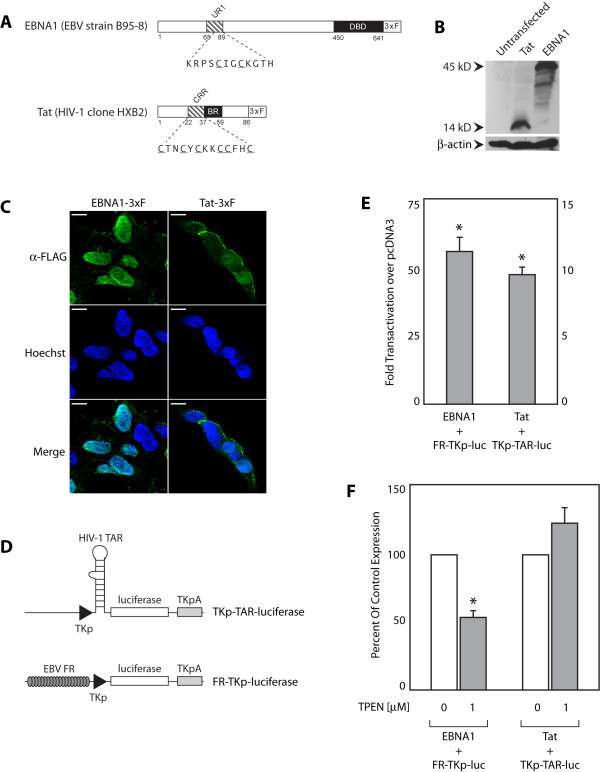
Figure 1
Figure 1
Characterization of epitope-tagged EBNA1 and Tat. (A) Diagrams of epitope-tagged EBNA1 and Tat. EBNA1 is 641 a.a. long and binds 20 sites in the EBV FR through its DNA binding domain (DBD). EBNA1's UR1 domain, essential for transactivation, contains a redox-regulated cys-x-x-cys motif. Tat is 87 a.a. long and binds HIV-1 TAR RNA through its basic region (BR) Tat's redox-regulated cysteine-rich (CRR) is required for transactivation. (B) Epitope-tagged EBNA1 and Tat, expressed in C33a cells, were visualized as described in the materials and methods. (C) Indirect immunofluorescence indicates EBNA1 is primarily nuclear, while Tat is nuclear and cytoplasmic. Proteins were visualized as described in the materials and methods. Bars indicate a scale of 10 μM. (D) Diagram of the transcription reporter plasmids. The minimal TK promoter (TKp) in both reporters has -1 to -80 of the HSV-1 TK promoter. The Tat reporter, TKp-TAR-luciferase, contains the HIV-1 TAR between the promoter and the luciferase gene. The EBNA1 reporter, FR-TKp-luciferase, contains the EBV FR 5' to the TKp. The HSV-1 TK polyadenylation signal (TKpA) was used for polyadenylation. (E) 24 hours post-transfection, epitope-tagged EBNA1 transactivates FR-TKp-luciferase 55-fold over the control (pcDNA3) (left-hand scale). Epitope-tagged Tat transactivates TKp-TAR-luciferase 10-fold over pcDNA3 (right-hand scale). (F) Exposure to 1 μM TPEN, a zinc chelator, reduced transactivation of FR-TKp-luciferase by EBNA1 to 50% of control, as observed for native EBNA1. TPEN did not alter transactivation by Tat. The asterisk indicates statistical significance by the Wilcoxon rank-sum test (p < 0.05) over control conditions.
Figure 2
Figure 2
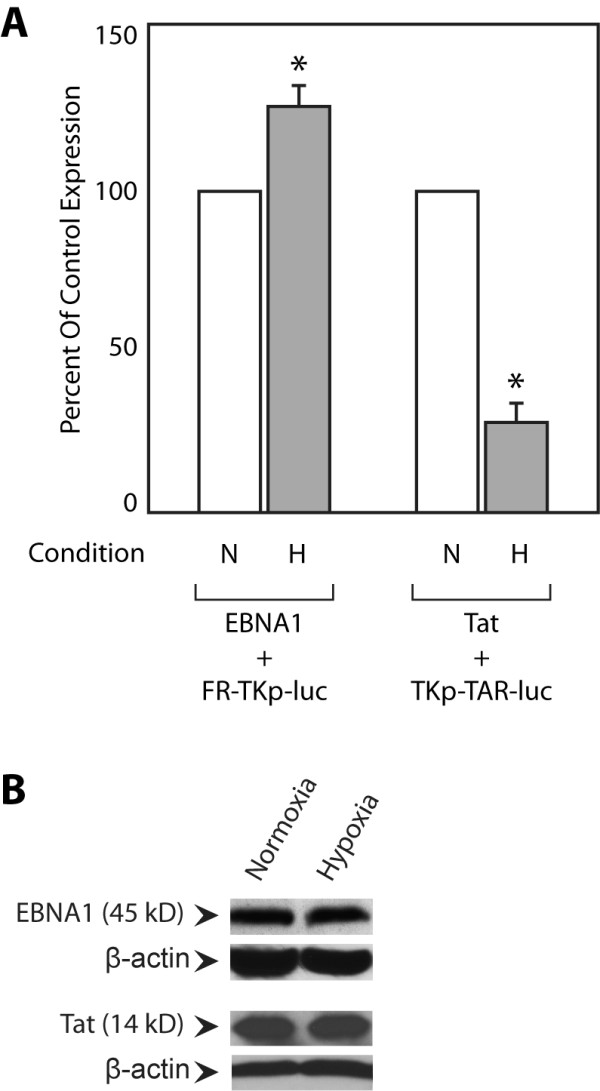
Hypoxia increases transactivation by EBNA1 and reduces transactivation by Tat. (A) Transfected C33a cells were split 6 hours post-transfection into aliquots incubated under normoxia (N) or hypoxia (H). Luciferase activity was assayed at 24 hours post-transfection. Transactivation is expressed as a percent of transactivation observed under normoxic (control) conditions. Hypoxia increased transactivation by EBNA1 increased to 125% of normoxic conditions, but decreased transactivation by Tat to 25% of normoxic conditions. (B) Immunoblots indicate that hypoxia did not alter expression of Tat or EBNA1. β-actin was used as a loading control. Asterisks indicate statistical significance by the Wilcoxon rank-sum test (p < 0.05) when comparing results obtained under hypoxia against normoxia.
Figure 3
Figure 3
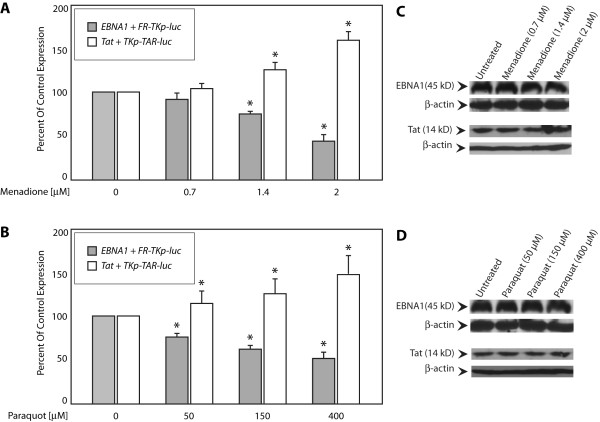
Oxidative stress induced by menadione and paraquot decrease transactivation by EBNA1, but increase transactivation by Tat. (A) Transfected C33a cells were split 6 hours post-transfection into aliquots and exposed to the indicated concentrations of menadione, or paraquot (B) for an additional 18 hours, prior to reporter analysis. The inset legend indicates the columns corresponding to each effector/reporter combination. Control cells were vehicle treated. Transactivation is expressed as a percent of transactivation observed in the control cells. Immunoblots indicate that neither menadione (C), nor paraquot (D) altered the expression of EBNA1 or Tat. β-actin was used as a loading control. Asterisks indicate statistical significance by the Wilcoxon rank-sum test (p < 0.05) for treated samples compared to vehicle-treated controls.
Figure 4
Figure 4
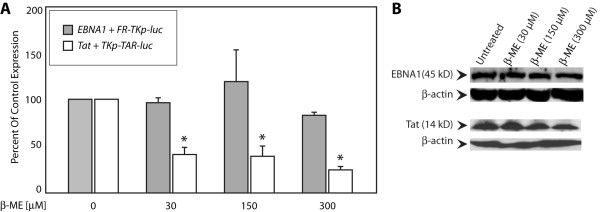
Beta-mercaptoethanol reduces transactivation by Tat, but has no effect on transactivation by EBNA1. (A) Transfected C33a cells were split 6 hours post-transfection into aliquots and exposed to the indicated concentrations of beta-mercaptoethanol (β-ME) for an additional 18 hours, prior to reporter analysis. The inset legend indicates the columns corresponding to each effector/reporter combination. Control cells were vehicle treated. Transactivation is expressed as a percent of transactivation in the absence of beta-mercaptoethanol (control conditions). (B) Immunoblots indicate that beta-mercaptoethanol did not affect expression of EBNA1 or Tat. β-actin was used as a loading control. Asterisks indicate statistical significance by the Wilcoxon rank-sum test (p < 0.05) for treated samples compared to vehicle-treated controls.
Figure 5
Figure 5
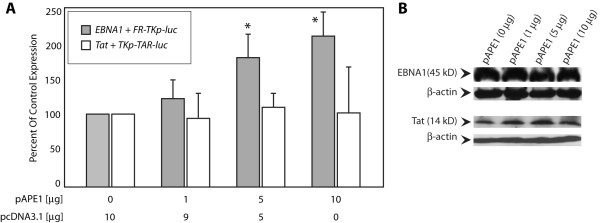
APE1/Ref-1 increases transactivation by EBNA1, but does not alter transactivation by Tat. (A) C33a cells were co-transfected with reporter and effector plasmids, and the indicated amount of an APE1/Ref-1 expression plasmid. The backbone expression plasmid, pcDNA3.1 was used to normalize the amount of DNA used in each transfection. Reporter activity was measured 24 hours post-transfection. Transactivation is expressed as a percent of transactivation observed in the absence of co-transfected pAPE1 (control conditions). The inset legend indicates the columns corresponding to each effector/reporter combination. (B) Immunoblots indicate that expression of APE1/Ref-1 did not alter expression of EBNA1 or Tat. β-actin was used as a loading control. Asterisks indicate statistical significance by the Wilcoxon rank-sum test (p < 0.05) for APE1/Ref-1 transfected cells compared to control cells where pcDNA3.1 was co-transfected with the effector and reporter plasmids.
Figure 6
Figure 6
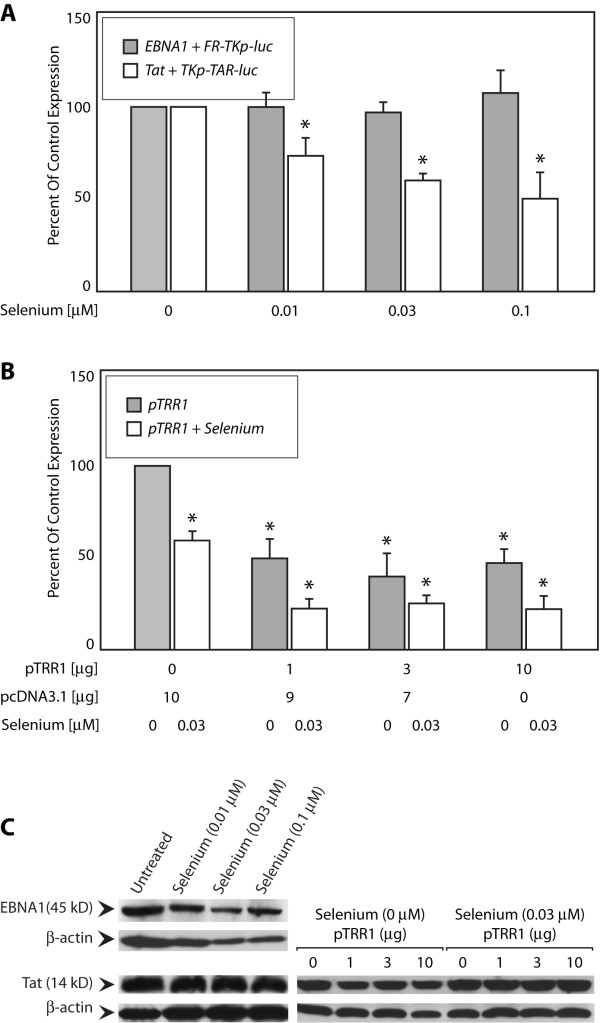
Selenium and thioredoxin reductase 1 (TRR1) reduce transactivation by Tat. (A) Transfected cells were split 6 hours post-transfection into aliquots and exposed to the indicated concentrations of sodium selenite for 18 hours before analysis. The inset legend indicates the columns corresponding to each effector/reporter combination. Asterisks indicate statistical significance by the Wilcoxon rank-sum test (p < 0.05) for selenium treated samples compared to vehicle treated samples (B) C33a cells were co-transfected with Tat expression and reporter plasmids and indicated amounts of a TRR1 expression plasmid. pcDNA3.1 was used to normalize the amount of DNA used per transfection. Transfections was split six hours post-transfection, and half the transfected cells were exposed to 0.03 μM sodium selenite for an additional 18 hours before analysis. Transactivation is expressed as a percent of transactivation observed in the absence of co-transfected pTRR1 or added sodium selenite (control conditions). The inset legend indicates the columns corresponding to co-transfected pTRR1 alone, or co-transfected pTRR1 with sodium selenite addition. Asterisks indicate statistical significance by the Wilcoxon rank-sum test (p < 0.05) for TRR1 transfected cells compared to controls in which pcDNA3.1 was co-transfected with reporter and effector plasmids, and cells were not exposed to sodium selenite. (C) Immunoblot analysis indicates that treatment with sodium selenite does not alter the expression of EBNA1 or Tat. In addition, co-transfected pTRR1 does not affect the expression of Tat in the presence of absence of 0.03 μM sodium selenite added to the media. β-actin was used as a loading control.

Similar articles

Cited by

References

    1. Star-Lack JM, Adalsteinsson E, Adam MF, Terris DJ, Pinto HA, Brown JM, Spielman DM. In vivo 1H MR spectroscopy of human head and neck lymph node metastasis and comparison with oxygen tension measurements. AJNR Am J Neuroradiol. 2000;21:183–193. - PMC - PubMed
    1. Krieger JA, Landsiedel JC, Lawrence DA. Differential in vitro effects of physiological and atmospheric oxygen tension on normal human peripheral blood mononuclear cell proliferation, cytokine and immunoglobulin production. Int J Immunopharmacol. 1996;18:545–552. doi: 10.1016/S0192-0561(96)00057-4. - DOI - PubMed
    1. Dardzinski BJ, Sotak CH. Rapid tissue oxygen tension mapping using 19F inversion-recovery echo-planar imaging of perfluoro-15-crown-5-ether. Magn Reson Med. 1994;32:88–97. doi: 10.1002/mrm.1910320112. - DOI - PubMed
    1. Sahaf B, Atkuri K, Heydari K, Malipatlolla M, Rappaport J, Regulier E, Herzenberg LA. Culturing of human peripheral blood cells reveals unsuspected lymphocyte responses relevant to HIV disease. Proc Natl Acad Sci USA. 2008;105:5111–5116. doi: 10.1073/pnas.0712363105. - DOI - PMC - PubMed
    1. Xanthoudakis S, Miao G, Wang F, Pan YC, Curran T. Redox activation of Fos-Jun DNA binding activity is mediated by a DNA repair enzyme. EMBO J. 1992;11:3323–3335. - PMC - PubMed

Publication types

MeSH terms

Substances