


Constrained patterns of covariation and clustering of HIV-1 non-nucleoside reverse transcriptase inhibitor resistance mutations
- PMID: 20462946
- PMCID: PMC2882873
- DOI: 10.1093/jac/dkq140
Constrained patterns of covariation and clustering of HIV-1 non-nucleoside reverse transcriptase inhibitor resistance mutations
Abstract
Objectives: We characterized pairwise and higher order patterns of non-nucleoside reverse transcriptase inhibitor (NNRTI)-selected mutations because multiple mutations are usually required for clinically significant resistance to second-generation NNRTIs.
Patients and methods: We analysed viruses from 13 039 individuals with sequences containing at least one of 52 published NNRTI-selected mutations, including 1133 viruses from individuals who received efavirenz but no other NNRTI and 1510 viruses from individuals who received nevirapine but no other NNRTI. Of the 17 reported etravirine resistance-associated mutations (RAMs), Y181C/I/V, L100I, K101P and M230L were considered major based on published in vitro susceptibility data.
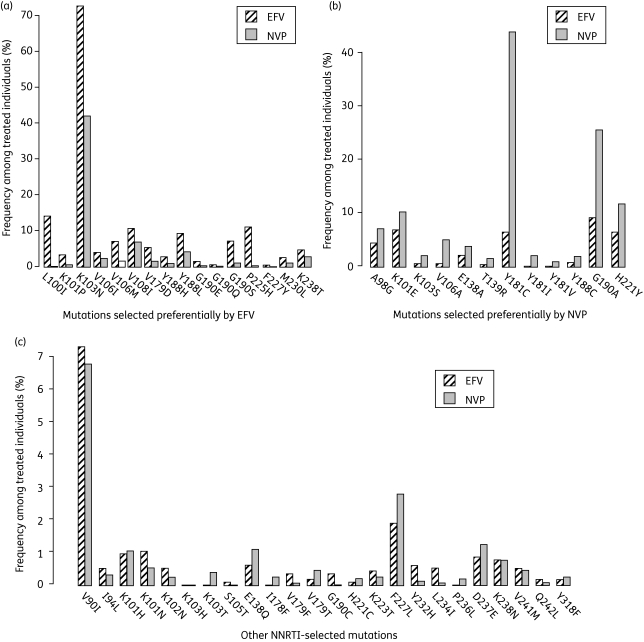
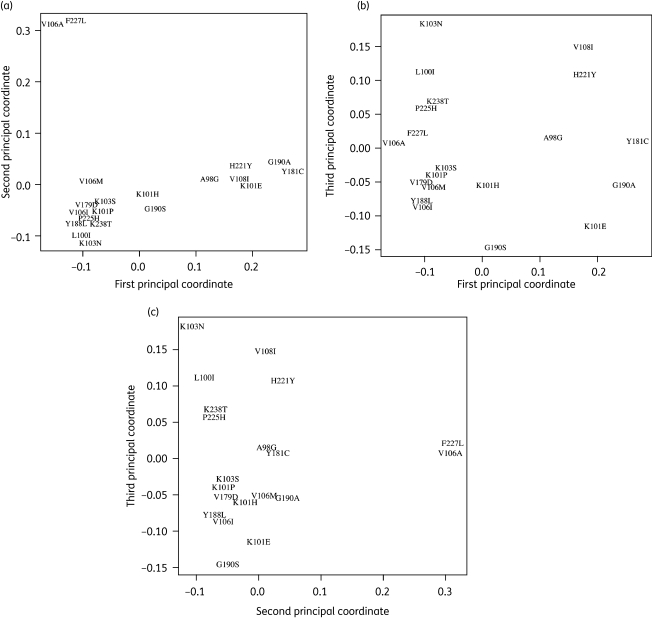
Results: Efavirenz preferentially selected for 16 mutations, including L100I (14% versus 0.1%, P < 0.001), K101P (3.3% versus 0.4%, P < 0.001) and M230L (2.8% versus 1.3%, P = 0.004), whereas nevirapine preferentially selected for 12 mutations, including Y181C/I/V (48% versus 6.9%, P < 0.001). Twenty-nine pairs of NNRTI-selected mutations covaried significantly, including Y181C with seven other mutations (A98G, K101E/H, V108I, G190A/S and H221Y), L100I with K103N, and K101P with K103S. Two pairs (Y181C + V179F and Y181C + G190S) were predicted to confer >10-fold decreased etravirine susceptibility. Seventeen percent of sequences had three or more NNRTI-selected mutations, mostly in clusters of covarying mutations. Many clusters had Y181C plus a non-major etravirine RAM; few had more than one major etravirine RAM.
Conclusions: Although major etravirine RAMs rarely occur in combination, 2 of 29 pairs of covarying mutations were associated with >10-fold decreased etravirine susceptibility. Viruses with three or more NNRTI-selected mutations often contained Y181C in combination with one or more minor etravirine RAMs; however, phenotypic and clinical correlates for most of these higher order combinations have not been published.
Figures
References
-
- Sarafianos SG, Marchand B, Das K, et al. Structure and function of HIV-1 reverse transcriptase: molecular mechanisms of polymerization and inhibition. J Mol Biol. 2009;385:693–713. doi:10.1016/j.jmb.2008.10.071. - DOI - PMC - PubMed
-
- Azijn H, Tirry I, Vingerhoets J, et al. TMC278, a next-generation nonnucleoside reverse transcriptase inhibitor (NNRTI), active against wild-type and NNRTI-resistant HIV-1. Antimicrob Agents Chemother. 2010;54:718–27. doi:10.1128/AAC.00986-09. - DOI - PMC - PubMed
-
- Moyle G, Boffito M, Manhard K, et al. Antiviral activity of RDEA806, a novel HIV non-nucleoside reverse transcriptase inhibitor, in treatment of näive HIV patients. XVII International AIDS Conference; 2008; Mexico City. Geneva, Switzerland: International AIDS Society; Abstract THAB0403.
-
- Vingerhoets J, Tambuyzer L, Azijn H, et al. Resistance profile of etravirine: combined analysis of baseline genotypic and phenotypic data from the randomized, controlled Phase III clinical studies. AIDS. 2010;24:503–14. doi:10.1097/QAD.0b013e32833677ac. - DOI - PubMed
-
- Zala C, Murphy R, Zhou XJ, et al. IDX899, a novel HIV-1 NNRTI with high barrier to resistance, provides suppression of HIV viral load in treatment-naïve HIV-1-infected subjects. XVII International AIDS Conference; 2008; Mexico City. Geneva, Switzerland: International AIDS Society; Abstract THAB0402.
Publication types
MeSH terms
Substances
Grants and funding
LinkOut - more resources
Full Text Sources
Medical
Molecular Biology Databases
