


Nonsense mutations in FGF8 gene causing different degrees of human gonadotropin-releasing deficiency
- PMID: 20463092
- PMCID: PMC3213864
- DOI: 10.1210/jc.2010-0176
Nonsense mutations in FGF8 gene causing different degrees of human gonadotropin-releasing deficiency
Erratum in
- J Clin Endocrinol Metab. 2011 Aug;96(8):2624
Abstract
Context: FGFR1 mutations cause isolated hypogonadotropic hypogonadism (IHH) with or without olfactory abnormalities, Kallmann syndrome, and normosmic IHH respectively. Recently, missense mutations in FGF8, a key ligand for fibroblast growth factor receptor (FGFR) 1 in the ontogenesis of GnRH, were identified in IHH patients, thus establishing FGF8 as a novel locus for human GnRH deficiency.
Objective: Our objective was to analyze the clinical, hormonal, and molecular findings of two familial IHH patients due to FGF8 gene mutations.
Methods and patients: The entire coding region of the FGF8 gene was amplified and sequenced in two well-phenotyped IHH probands and their relatives.
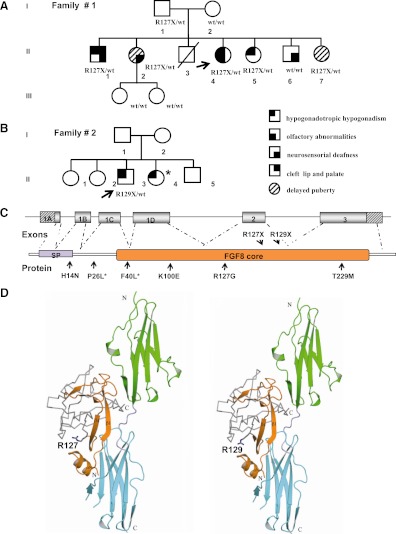
Results: Two unique heterozygous nonsense mutations in FGF8 (p.R127X and p.R129X) were identified in two unrelated IHH probands, which were absent in 150 control individuals. These two mutations, mapped to the core domain of FGF8, impact all four human FGF8 isoforms, and lead to the deletion of a large portion of the protein, generating nonfunctional FGF8 ligands. The p.R127X mutation was identified in an 18-yr-old Kallmann syndrome female. Her four affected siblings with normosmic IHH or delayed puberty also carried the p.R127X mutation. Additional developmental anomalies, including cleft lip and palate and neurosensorial deafness, were also present in this family. The p.R129X mutation was identified in a 30-yr-old man with familial normosmic IHH and severe GnRH deficiency.
Conclusions: We identified the first nonsense mutations in the FGF8 gene in familial IHH with variable degrees of GnRH deficiency and olfactory phenotypes, confirming that loss-of-function mutations in FGF8 cause human GnRH deficiency.
Figures
References
-
- Turner N, Grose R 2010 Fibroblast growth factor signalling: from development to cancer. Nat Rev Cancer 10:116–129 - PubMed
-
- Eswarakumar VP, Lax I, Schlessinger J 2005 Cellular signaling by fibroblast growth factor receptors. Cytokine Growth Factor Rev 16:139–149 - PubMed
-
- Marie PJ, Coffin JD, Hurley MM 2005 FGF and FGFR signaling in chondrodysplasias and craniosynostosis. J Cell Biochem 96:888–896 - PubMed
-
- Trarbach EB, Silveira LG, Latronico AC 2007 Genetic insights into human isolated gonadotropin deficiency. Pituitary 10:381–391 - PubMed
-
- Seminara SB, Hayes FJ, Crowley Jr WF 1998 Gonadotropin-releasing hormone deficiency in the human (idiopathic hypogonadotropic hypogonadism and Kallmann’s syndrome): pathophysiological and genetic considerations. Endocr Rev 19:521–539 - PubMed
Publication types
MeSH terms
Substances
Grants and funding
LinkOut - more resources
Full Text Sources
Medical
Miscellaneous
