


Comment
doi: 10.1038/jid.2010.76.
Founder mutations in xeroderma pigmentosum
Affiliations
- PMID: 20463673
- PMCID: PMC3486739
- DOI: 10.1038/jid.2010.76
Item in Clipboard
Comment
Founder mutations in xeroderma pigmentosum
J Invest Dermatol.
2010 Jun.
Abstract
In this issue, Soufir et al. report a founder mutation in the XPC DNA repair gene in 74% of families with xeroderma pigmentosum (XP) in the Maghreb region (Algeria, Morocco, and Tunisia) of northern Africa. These patients have a high frequency of skin cancer. The presence of this founder mutation provides an opportunity for genetic counseling and early diagnosis of XP.
Conflict of interest statement
Conflict of Interest: The authors state no conflict of interest.
Figures
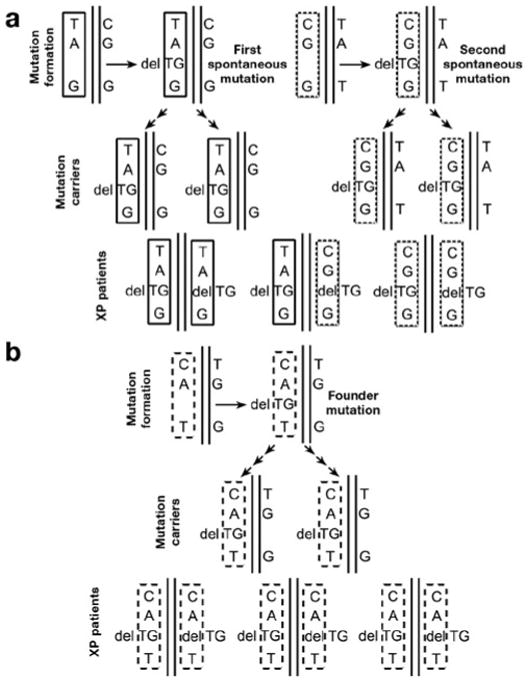
(a) Mutation hotspot. (Top row) The same mutation (delTG) arises independently in two individuals with different single-nucleotide polymorphism (SNP) haplotypes in the region of the mutation: TA (delTG) G (solid rectangle) and CG (delTG) G (dotted rectangle). Over generations these individuals pass the delTG mutation and adjacent regions to their progeny, who are asymptomatic carriers with one mutated allele and one normal allele (center row). Eventually, carriers of the delTG mutation have children with the same mutation in both alleles (bottom row). All of these affected individuals (XP patients) are homozygous for the delTG mutation. However, different XP patients have different haplotypes (TA (delTG) G, CG (delTG) G, or both). (b) Founder mutation. (Top row) The delTG mutation arises in one individual with a SNP haplotype in the region of the mutation: CA (delTG) T (dashed rectangle). This individual passes the delTG mutation and adjacent regions to many generations of progeny who are asymptomatic carriers with one mutated allele and one normal allele (center row). Eventually, two carriers of the delTG mutation have a child with the same mutation in both alleles (bottom row). All of the affected individuals are homozygous for the delTG mutation and have the same haplotype (CA (delTG) T).
Comment on
-
A prevalent mutation with founder effect in xeroderma pigmentosum group C from north Africa.J Invest Dermatol. 2010 Jun;130(6):1537-42. doi: 10.1038/jid.2009.409. Epub 2010 Jan 7. J Invest Dermatol. 2010. PMID: 20054342
References
-
- Ben RM, Messaoud O, Talmoudi F, et al. High frequency of the V548A fs X572 XPC mutation in Tunisia: implication for molecular diagnosis. J Hum Genet. 2009;54:426–9. - PubMed
-
- Gozukara EM, Khan SG, Metin A, et al. A stop codon in xeroderma pigmentosum group C families in Turkey and Italy: molecular genetic evidence for a common ancestor. J Invest Dermatol. 2001;117:197–204. - PubMed
-
- Hirai Y, Kodama Y, Moriwaki S, et al. Heterozygous individuals bearing a founder mutation in the XPA DNA repair gene comprise nearly 1% of the Japanese population. Mutat Res. 2006;601:171–8. - PubMed
Publication types
MeSH terms
Substances
Grants and funding
LinkOut - more resources
Full Text Sources
