Identification of key processes that control tumor necrosis factor availability in a tuberculosis granuloma
- PMID: 20463877
- PMCID: PMC2865521
- DOI: 10.1371/journal.pcbi.1000778
Identification of key processes that control tumor necrosis factor availability in a tuberculosis granuloma
Abstract
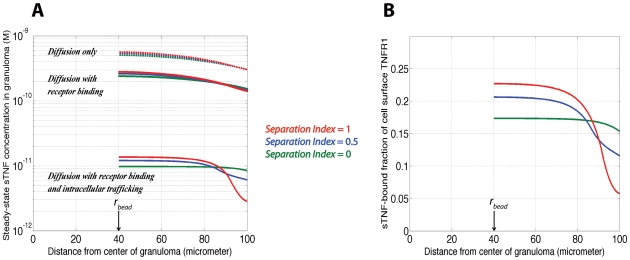
Tuberculosis (TB) granulomas are organized collections of immune cells comprised of macrophages, lymphocytes and other cells that form in the lung as a result of immune response to Mycobacterium tuberculosis (Mtb) infection. Formation and maintenance of granulomas are essential for control of Mtb infection and are regulated in part by a pro-inflammatory cytokine, tumor necrosis factor-alpha (TNF). To characterize mechanisms that control TNF availability within a TB granuloma, we developed a multi-scale two compartment partial differential equation model that describes a granuloma as a collection of immune cells forming concentric layers and includes TNF/TNF receptor binding and trafficking processes. We used the results of sensitivity analysis as a tool to identify experiments to measure critical model parameters in an artificial experimental model of a TB granuloma induced in the lungs of mice following injection of mycobacterial antigen-coated beads. Using our model, we then demonstrated that the organization of immune cells within a TB granuloma as well as TNF/TNF receptor binding and intracellular trafficking are two important factors that control TNF availability and may spatially coordinate TNF-induced immunological functions within a granuloma. Further, we showed that the neutralization power of TNF-neutralizing drugs depends on their TNF binding characteristics, including TNF binding kinetics, ability to bind to membrane-bound TNF and TNF binding stoichiometry. To further elucidate the role of TNF in the process of granuloma development, our modeling and experimental findings on TNF-associated molecular scale aspects of the granuloma can be incorporated into larger scale models describing the immune response to TB infection. Ultimately, these modeling and experimental results can help identify new strategies for TB disease control/therapy.
Conflict of interest statement
The authors have declared that no competing interests exist.
Figures




References
-
- Algood HM, Chan J, Flynn JL. Chemokines and tuberculosis. Cytokine Growth Factor Rev. 2003;14:467–477. - PubMed
-
- Russell DG. Who puts the tubercle in tuberculosis? Nat Rev Microbiol. 2007;5:39–47. - PubMed
-
- Flynn JL. Immunology of tuberculosis and implications in vaccine development. Tuberculosis (Edinb) 2004;84:93–101. - PubMed
-
- Morel PA, Ta'asan S, Morel BF, Kirschner DE, Flynn JL. New insights into mathematical modeling of the immune system. Immunol Res. 2006;36:157–165. - PubMed
Publication types
MeSH terms
Substances
Grants and funding
LinkOut - more resources
Full Text Sources
Medical