. 2010 May 13:10:140.
doi: 10.1186/1471-2148-10-140.

The gene transformer-2 of Anastrepha fruit flies (Diptera, Tephritidae) and its evolution in insects

Affiliations

The gene transformer-2 of Anastrepha fruit flies (Diptera, Tephritidae) and its evolution in insects

Francesca Sarno et al. BMC Evol Biol. .

Abstract

Background: In the tephritids Ceratitis, Bactrocera and Anastrepha, the gene transformer provides the memory device for sex determination via its auto-regulation; only in females is functional Tra protein produced. To date, the isolation and characterisation of the gene transformer-2 in the tephritids has only been undertaken in Ceratitis, and it has been shown that its function is required for the female-specific splicing of doublesex and transformer pre-mRNA. It therefore participates in transformer auto-regulatory function. In this work, the characterisation of this gene in eleven tephritid species belonging to the less extensively analysed genus Anastrepha was undertaken in order to throw light on the evolution of transformer-2.

Results: The gene transformer-2 produces a protein of 249 amino acids in both sexes, which shows the features of the SR protein family. No significant partially spliced mRNA isoform specific to the male germ line was detected, unlike in Drosophila. It is transcribed in both sexes during development and in adult life, in both the soma and germ line. The injection of Anastrepha transformer-2 dsRNA into Anastrepha embryos caused a change in the splicing pattern of the endogenous transformer and doublesex pre-mRNA of XX females from the female to the male mode. Consequently, these XX females were transformed into pseudomales. The comparison of the eleven Anastrepha Transformer-2 proteins among themselves, and with the Transformer-2 proteins of other insects, suggests the existence of negative selection acting at the protein level to maintain Transformer-2 structural features.

Conclusions: These results indicate that transformer-2 is required for sex determination in Anastrepha through its participation in the female-specific splicing of transformer and doublesex pre-mRNAs. It is therefore needed for the auto-regulation of the gene transformer. Thus, the transformer/transfomer-2 > doublesex elements at the bottom of the cascade, and their relationships, probably represent the ancestral state (which still exists in the Tephritidae, Calliphoridae and Muscidae lineages) of the extant cascade found in the Drosophilidae lineage (in which tra is just another component of the sex determination gene cascade regulated by Sex-lethal). In the phylogenetic lineage that gave rise to the drosophilids, evolution co-opted for Sex-lethal, modified it, and converted it into the key gene controlling sex determination.


Figures
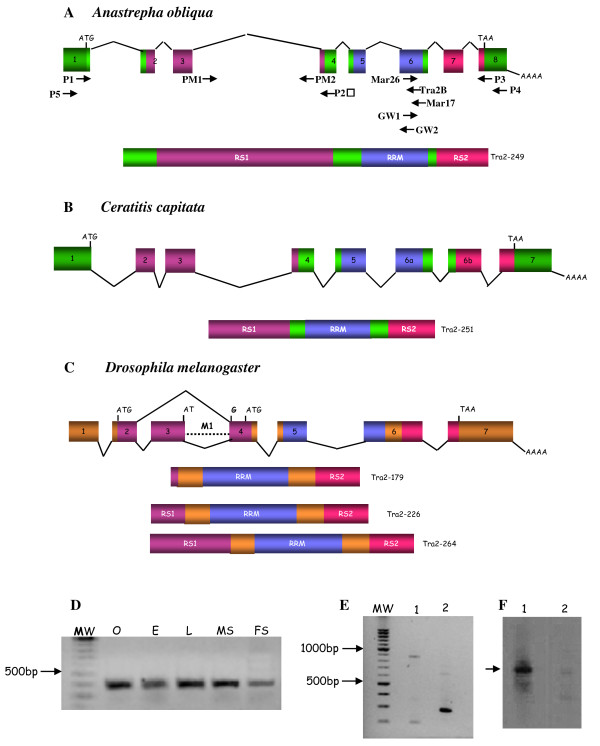
Figure 1
Figure 1
Comparison of the molecular organisation of the tra-2 of A. obliqua (A), C. capitata (B) and D. melanogaster (C) and their proteins. Exons (boxes) and introns (dashed lines) are not drawn to scale. The numbers inside the boxes indicate the number of the exon. The beginning and the end of the ORF are indicated by ATG and TAA respectively. AAA stands for poly-A(+). (D) Expression of gene tra-2 of A. obliqua. RT-PCR analyses of total RNA from ovaries (O), embryos (E), from male and female larvae (L), male soma (head plus thorax, MS) and female soma (head plus thorax, FS). (E) Expression of gene tra-2 of A. obliqua. RT-PCR analysis of total RNA from A. obliqua testis. Lane 1 corresponds to PCR with primers PM1 and P2; lane 2 corresponds to PCR with primers P1 and P2 (see location of primers in Figure 1A). (F) Southern-blot corresponding to the gel shown in (E) and hybridisation with a probe specific for intron 3 of A. obliqua. The arrow marks the hybridisation to the higher band in lane 1 of Figure 1E. The size of the mRNAs encoding the proteins shown in this figure are: 1923 bp for A. obliqua mRNA, 1113 bp for C. capitata mRNA, and 960, 1583 and 1391 bp for D. melanogaster mRNAs tra2-179, tra2-226 and tra2-264, respectively.
Figure 2
Figure 2
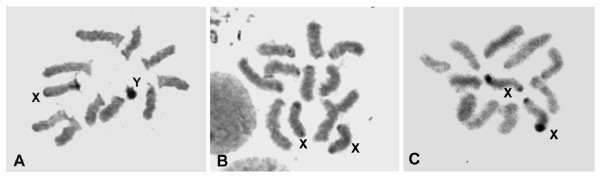
Chromosomes of A. sp.1 aff. fraterculus. (A) Normal karyotype in a male that developed from an egg injected with buffer; (B) karyotype of a pseudomale that developed from an egg injected with tra-2 dsRNA; and (C) karyotype of a normal female.
Figure 3
Figure 3
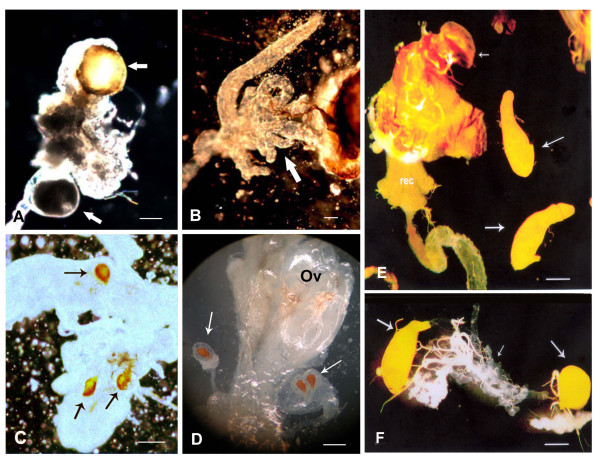
Internal terminalia of Anastrepha flies. Parts of the reproductive tract of an intersexual mosaic developed from an injected egg with Aotra2 dsRNA (A-C), and of a normal female (D). In (A) arrows point to two vesicles, one of which is yellow (similar to normal testes). (B) Arrow points to the accessory gland. (C) Arrows point to the spermathecae. (D) Parts of a normal female reproductive tract showing an ovary (ov) and the three regular spermathecae (arrows). Bar = 200 μm. (E, F) Parts of the reproductive tract of A. sp.1 aff. fraterculus males. (E) Testes of a normal male (larger arrows). Small arrow points to the male terminalia; rec, rectum. (F) Asymmetric testes of a male that developed from an egg injected with Aotra2 dsRNA. The right testis is spherical and the other shows the normal elliptical form; the small arrow points to the accessory gland. Bar = 300 μm.
Figure 4
Figure 4
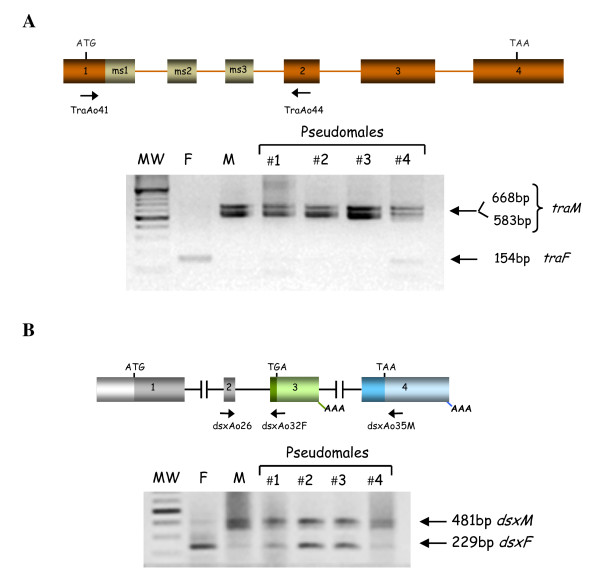
Analyses of the splicing pattern of tra (A) and dsx (B) pre-mRNAs of A. sp.1 aff. fraterculus in XX pseudomales developed from eggs injected with Aotra2 dsRNA. F and M indicates normal female and male respectively. The sequences of the TraAo41 and TraAo44 primers used, the locations of which are shown with arrows in Figure 4A, are described in Ruiz et al. [18]; the sequences of the dsxA26, dsxAo32F and dsxAo35M primers used, the locations of which is shown with arrows in Figure 4B, are described in Ruiz et al. [21].
Figure 5
Figure 5
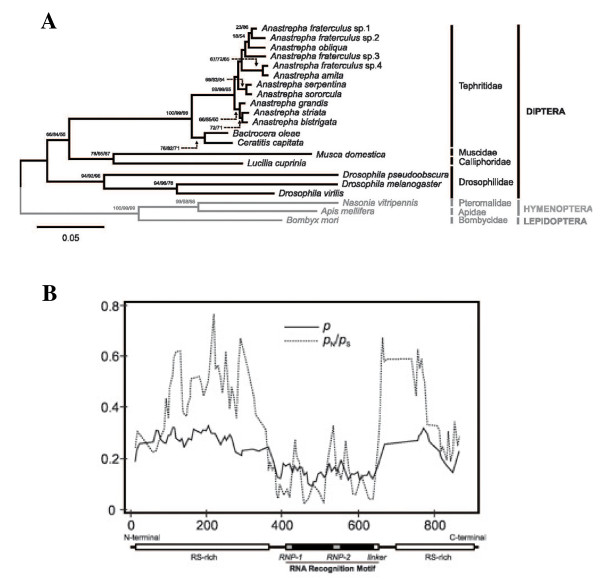
Molecular evolution of Tra2 proteins. (A) Amino acid phylogeny encompassing Tra2 proteins from Diptera. Taxonomic relationships are indicated in the right margin of the tree. Numbers for interior nodes represent bootstrap and confidence probabilities based on 1000 replicates, followed by the BP corresponding to the maximum parsimony tree topology (shown only when greater than 50%). The topology was rooted with the Tra2 protein from the lepidopteran B. mori and the hymenopterans A. mellifera and N. vitripennis. (B) Proportion of nucleotide sites at which two sequences being compared were different (p, nucleotide substitutions per site) and ratio between the numbers of non-synonymous (pN) and synonymous (pS) substitutions per site across the coding regions of tra-2 in the analysed species. The different functional regions defined for the Tra2 proteins are indicated below the graph.
Figure 6
Figure 6
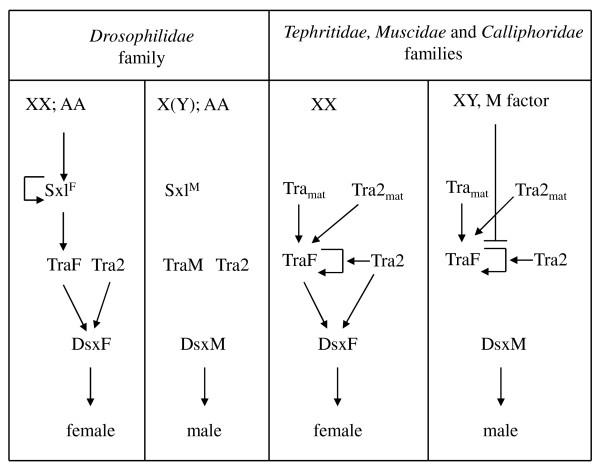
Comparison of the sex determination gene cascades between Drosophilidae (Drosophila), and Tephritidae (Ceratitis Anastrepha and Bactrocera), Muscidae (Musca) and Calliphoridae (Lucilia) families of Diptera. Tramat and Tra2mat indicate maternal Tra and Tra2 product. DsxF and DsxM stands for female and male Dsx protein, respectively. Though the maternal expression of gene tra-2 in Lucilia and the characterisation of this gene in Bactrocera have not been reported, both species are included in the scheme of this Figure because the analysis of tra in Bactrocera [17] and the analysis of tra and tra-2 in Lucilia [30] suggests their tra-2 genes have a similar function as in Ceratitis, Anastrepha and Musca. Scheme based on references 16, 17, 18, 23, 29, 30 and 36.

References

    1. Sánchez L, Gorfinkiel N, Guerrero I. In: Comprehensive Molecular Insect Science. Gilbert LI, Iatrou K, Gill SS, editor. Vol. 1. Oxford: Elsevier Pergamon; 2005. Sex determination and the development of the genital disc; pp. 1–38. full_text.
    1. Bell LR, Maine EM, Schedl P, Cline TW. Sex-lethal, a Drosophila sex determination switch gene, exhibits sex-specific RNA splicing and sequence similar to RNA binding proteins. Cell. 1988;55:1037–1046. doi: 10.1016/0092-8674(88)90248-6. - DOI - PubMed
    1. Bell LR, Horabin JI, Schedl P, Cline TW. Positive autoregulation of Sex-lethal by alternative splicing maintains the female determined state in Drosophila. Cell. 1991;65:229–239. doi: 10.1016/0092-8674(91)90157-T. - DOI - PubMed
    1. Boggs RT, Gregor P, Idriss S, Belote JM, McKeown M. Regulation of sexual differentiation in Drosophila melanogaster via alternative splicing of RNA from the transformer gene. Cell. 1987;50:739–747. doi: 10.1016/0092-8674(87)90332-1. - DOI - PubMed
    1. Belote JM, McKeown M, Boggs RT, Ohkawa R, Sosnowski BA. The molecular genetics of transformer, a genetic switch-controlling sexual differentiation in Drosophila. Devel Genet. 1989;10:143–154. doi: 10.1002/dvg.1020100304. - DOI - PubMed

Publication types