


Pork contaminated with Salmonella enterica serovar 4,[5],12:i:-, an emerging health risk for humans
- PMID: 20472721
- PMCID: PMC2901716
- DOI: 10.1128/AEM.02991-09
Pork contaminated with Salmonella enterica serovar 4,[5],12:i:-, an emerging health risk for humans
Abstract
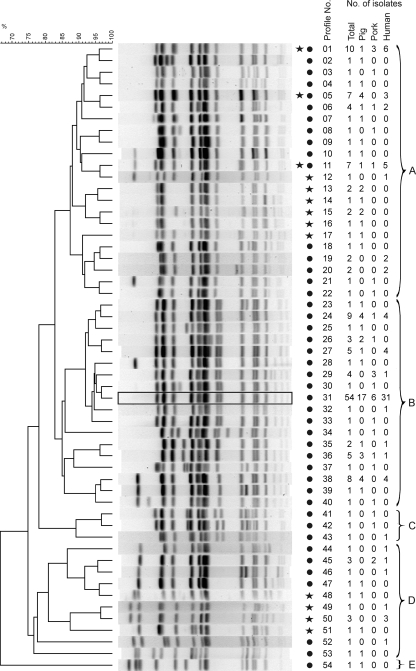
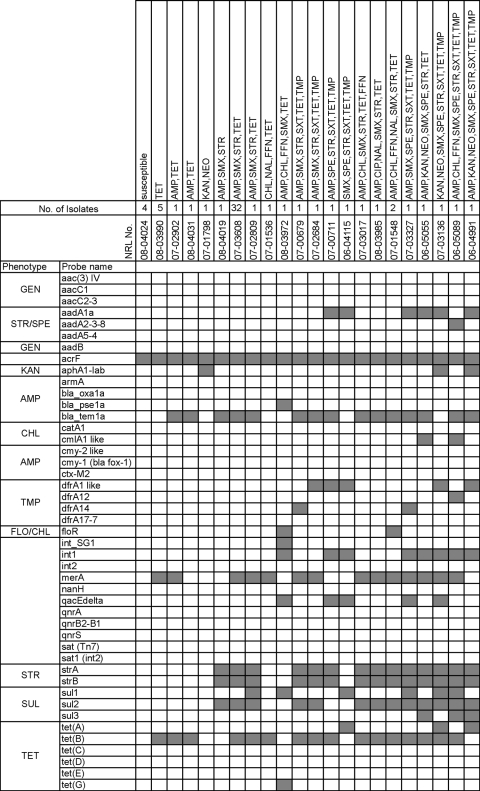
Salmonella enterica subsp. enterica serovar 4,[5],12:i:- is a monophasic variant of S. enterica serovar Typhimurium (antigenic formula 4,[5],12:i:1,2). Worldwide, especially in several European countries and the United States, it has been reported among the 10 most frequently isolated serovars in pigs and humans. In the study reported here, 148 strains of the monophasic serovar isolated from pigs, pork, and humans in 2006 and 2007 in Germany were characterized by various phenotypic and genotypic methods. This characterization was done in order to investigate their clonality, the prevalence of identical subtypes in pigs, pork, and humans, and the genetic relatedness to other S. enterica serovar Typhimurium subtypes in respect to the pathogenic and resistance gene repertoire. Two major clonal lineages of the monophasic serovar were detected which can be differentiated by their phage types and pulsed-field gel electrophoresis (PFGE) profiles. Seventy percent of the strains tested belonged to definite phage type DT193, and those strains were mainly assigned to PFGE cluster B. Nineteen percent of the strains were typed to phage type DT120 and of these 86% belonged to PFGE cluster A. Sixty-five percent of the isolates of both lineages carried core multiresistance to ampicillin, streptomycin, tetracycline, and sulfamethoxazole encoded by the genes bla(TEM1-like), strA-strB, tet(B), and sul2. No correlation to the source of isolation was observed in either lineage. Microarray analysis of 61 S. enterica serovar 4,[5],12:i:- and 20 S. enterica serovar Typhimurium isolates tested determining the presence or absence of 102 representative pathogenicity genes in Salmonella revealed no differences except minor variations in single strains within and between the serovars, e.g., by presence of the virulence plasmid in four strains. Overall the study indicates that in Germany S. enterica serovar 4,[5],12:i:- strains isolated from pig, pork, and human are highly related, showing their transmission along the food chain. Since the pathogenicity gene repertoire is highly similar to that of S. enterica serovar Typhimurium, it is essential that interventions are introduced at the farm level in order to limit human infection.
Figures
References
-
- Anonymous. 2006. Commission decision of 29 September 2006 concerning a financial contribution by the Community towards a baseline survey on the prevalence of Salmonella in slaughter pigs to be carried out in the Member States [notified under document number C(2006) 4306 (2006/668/EC)]. Official J. Eur. Union 2006:L275/51-L275/61.
-
- Centers for Disease Control and Prevention. 2007. Investigation of outbreak of human infections caused by Salmonella serotype I 4,[5],12:i:−. Centers for Disease Control and Prevention, Atlanta, GA. http://www.cdc.gov/salmonella/4512eyeminus.html.
Publication types
MeSH terms
Substances
LinkOut - more resources
Full Text Sources
Medical
Miscellaneous
