


Who can respond to treatment? Identifying patient characteristics related to heterogeneity of treatment effects
- PMID: 20473205
- PMCID: PMC5769476
- DOI: 10.1097/MLR.0b013e3181d99161
Who can respond to treatment? Identifying patient characteristics related to heterogeneity of treatment effects
Abstract
Background: Interest in comparative effectiveness research and the rising number of negative or "small effect" trials have stimulated research into differential response to treatment among subgroups of patients.
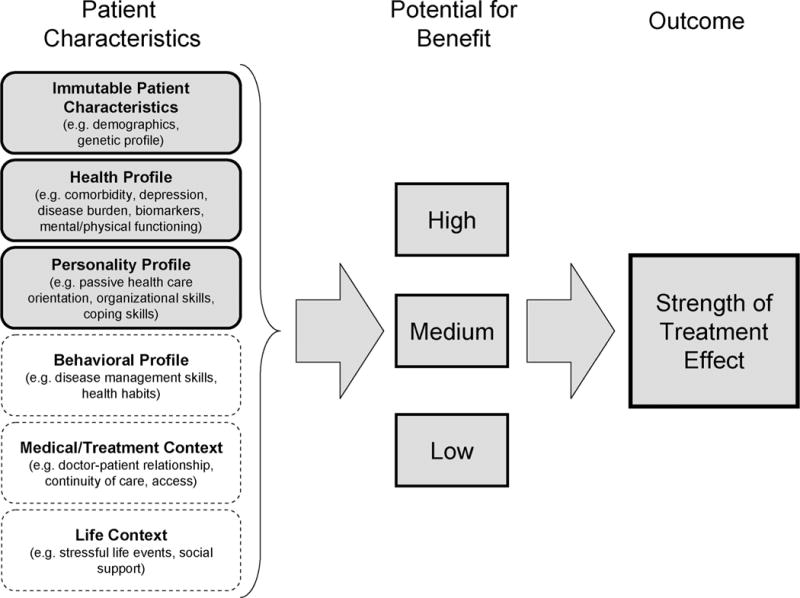
Objective: To develop and test the Potential for Benefit Scale (PBS), a composite measure to identify subgroups of patients with differential potential for response to treatment, using diabetes as a model.
Design: Cross-sectional and longitudinal cohort study.
Subjects and setting: Type 2 diabetes patients (n = 1361) were identified from 7 outpatient clinics serving a diverse population. Of these, 611 completed a 1-year follow-up.
Measures: To represent patients' health status, we used the Total Illness Burden Index, the Physical Function Index of the SF-36, the Center for Epidemiologic Studies Depression Scale, and the Diabetes Burden Scale. To represent personality characteristics related to health, we used the Provider-Dependent Health Care Orientation scale. We assessed the contribution of these measures to a composite scale of patients' potential for treatment response in terms of self-reported medication adherence and glycemic control.
Results: Principal components analysis confirmed associations among these measures. The internal consistency reliability of the PBS was adequate (Cronbach alpha = 0.65). Patients in the lowest versus highest quartile of the PBS reported poorer adherence (18% vs. 55%, P < 0.001) and poorer glycemic control at baseline (mean hemoglobin A1c values: 7.75 vs. 7.39, P < 0.001). Those in the highest quartile of the PBS also were more likely to reach target values for glycemic control (HbA1c <7%) at 1-year follow-up, (adjusted OR = 1.61, P < 0.05).
Conclusions: The PBS, a composite scale, may be helpful in identifying patients with differential potential for response to treatment.
Figures
References
-
- Greenfield S, Billimek J, Pellegrini F, et al. Comorbidity affects the relationship between glycemic control and cardiovascular outcomes in diabetes: a cohort study. Ann Intern Med. 2009;151:854–860. - PubMed
-
- Greenfield S, Kravitz RL, Duan N, et al. Heterogeneity of treatment effects: implications for guidelines, payment, and quality assessment. Am J Med. 2007;120:S3–S9. - PubMed
-
- Greenfield S, Kravitz RL. Engaging the implications of subgroup heterogeneity: the increasing inadequacy of randomized trials for guidelines, payment and quality. Washington, DC: Institute of Medicine Report on the Learning Healthcare Environment: National Academy of Sciences; 2007.
-
- Kent D, Hayward R. When Averages hide individual differences in clinical trials: analyzing the results of clinical trials to expose individual patients’ risks might help doctors make better treatment decisions. Am Sci. 2007;95:60–68.
Publication types
MeSH terms
Substances
Grants and funding
LinkOut - more resources
Full Text Sources
Medical
