Comparative Study
. 2010 Dec;32(4):435-49.
doi: 10.1007/s11357-010-9149-5. Epub 2010 May 15.

Effects of oxygen, growth state, and senescence on the antioxidant responses of WI-38 fibroblasts

Affiliations
Comparative Study

Effects of oxygen, growth state, and senescence on the antioxidant responses of WI-38 fibroblasts

Arthur K Balin et al. Age (Dordr). 2010 Dec.

Abstract

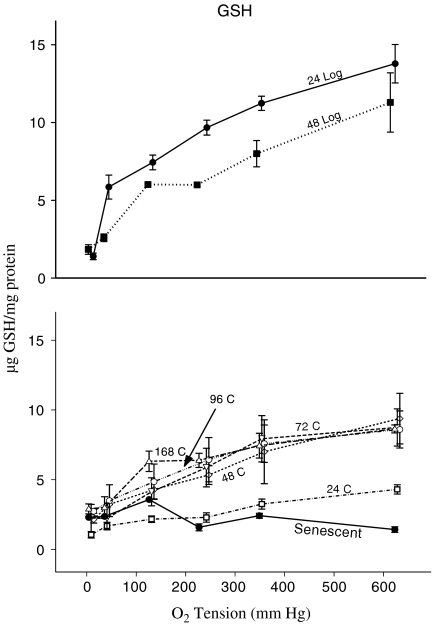
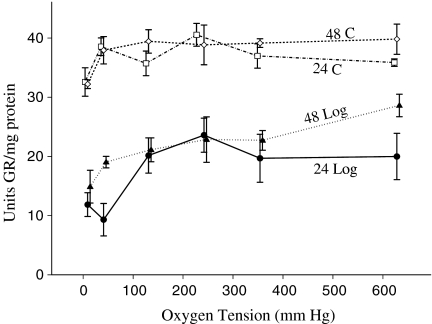
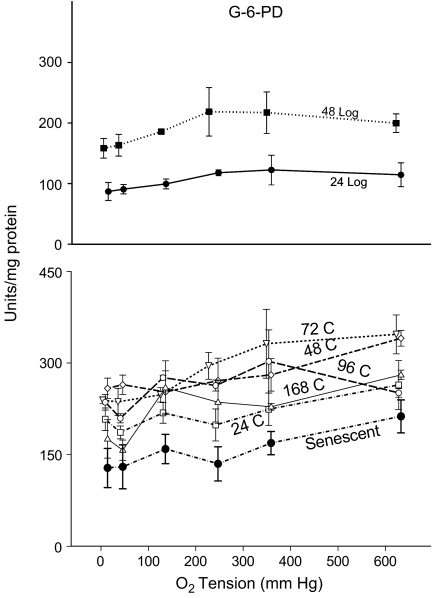
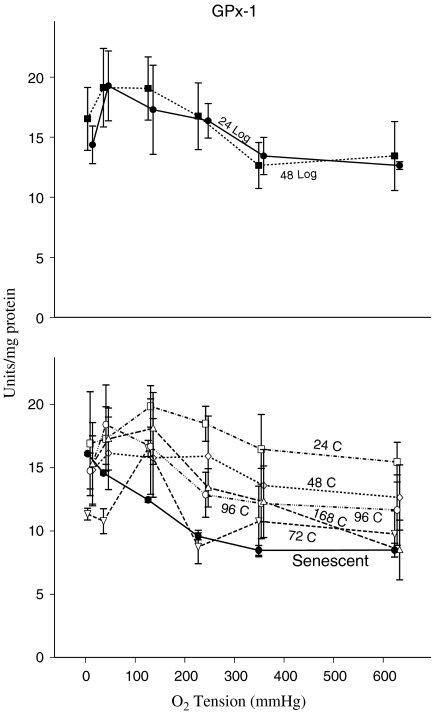
Mitotically active, growth-arrested cells and proliferatively senescent cultures of human fetal lung fibroblasts (WI-38) were exposed to six different oxygen tensions for various lengths of time and then analyzed to determine the responses of their antioxidant defense system. Glutathione (GSH) concentration increased as a function of ambient oxygen tension in early passage cultures; the effect was larger in exponentially growing cultures than in those in a state of contact-inhibited growth arrest, but was absent in senescent cells. Conversely, the activity of glutathione disulfide reductase was greater in growth-arrested cultures than in mitotically active cells irrespective of oxygen tension. Glucose-6-phosphate dehydrogenase was lowest in log-phase cells exposed to different oxygen tensions for 24 h and in senescent cells. Both hypoxia and hyperoxia depressed selenium-dependent glutathione peroxidase activity in early passage cultures, while the activity of the enzyme progressively declined with increasing oxygen in senescent cells. The GSH S-transferase activity was unresponsive to changes in ambient oxygen tension in either young or senescent cultures. Manganese-containing superoxide dismutase (MnSOD) activity was unaffected by oxygen tension, but was elevated in young confluent cultures as compared with cultures in log-phase growth. MnSOD activity was significantly higher in senescent cultures than in early passage cultures and was also responsive to increased oxygen tension in senescent cultures. Copper-zinc-containing superoxide dismutases activity was not affected by oxygen tension or the passage of time, but it declined in senescent cultures.


Figures
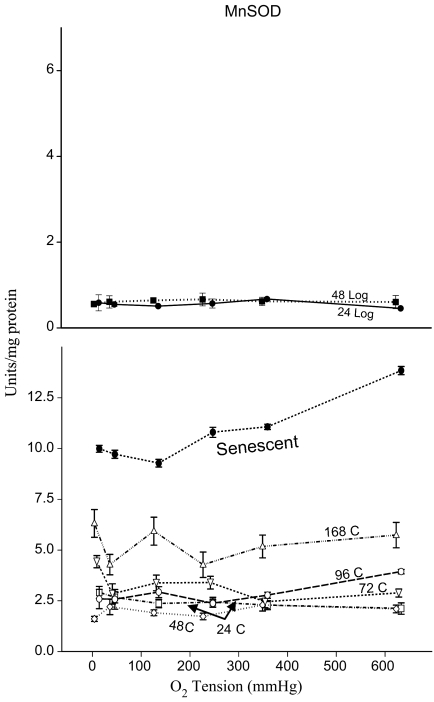
Fig. 1
Fig. 1
MnSOD activity in WI-38 cultures exposed to different oxygen tensions for various periods of time. Mitotically active cultures were grown 3 days at under an ambient oxygen tension of 38 mm Hg then refed and transferred to the different oxygen tensions for 24 or 48 h (24 Log and 48 Log; upper panel). Non-growing cultures were grown to saturation density under 5% oxygen, refed with medium that contained 0.5% serum, and then transferred to different oxygen tensions. The non-proliferating, confluent (C) cultures were harvested and analyzed after 24, 48, 72, 96, and 168 h (24 C, 48 C, 72 C, 96 C, and 168 C; lower panel). Senescent cultures were harvested after 48-h exposure to different oxygen tensions (see “Methods”)
Fig. 2
Fig. 2
GSH concentration in WI-38 cultures exposed to different oxygen tensions for various periods of time. Mitotically active cultures were grown 3 days under an ambient oxygen tension of 38 mm Hg then were refed and transferred to the different oxygen tensions for 24 or 48 h prior to harvest and analysis (24 Log and 48 Log). Exposures of non-growing, confluent cultures to different oxygen tensions was achieved by growing cells to saturation density under 38 mm Hg oxygen; the growth-arrested, confluent cultures (C) were then refed with medium that contained 0.5% serum and transferred to different oxygen tensions for 24, 48, 72, 96, or 168 h (24 C, 48 C, 72 C, 96 C, and 168 C; lower panel). Senescent cultures were harvested after 48-h exposure to different oxygen tensions (see “Methods”)
Fig. 3
Fig. 3
GSSG reductase activity in WI-38 cultures exposed to different oxygen tensions for various periods of time. Mitotically active cultures were grown 3 days under an ambient oxygen tension of 38 mm Hg then were refed and transferred to the different oxygen tensions for 24 or 48 h (24 Log and 48 Log). Mitotically quiescent cultures were obtained by allowing them to grow to saturation density under 38 mm Hg oxygen for 7 days. The resulting stationary phase, confluent cultures (C) were refed with medium that contained 0.5% serum and then transferred to different oxygen tensions for 24 or 48 h prior to harvest and analysis (24 C, 48 C)
Fig. 4
Fig. 4
G-6PD activity in WI-38 cultures exposed to different oxygen tensions for various periods of time. Mitotically active cultures were grown 3 days under an ambient oxygen tension of 5% then were refed and transferred to the different oxygen tensions for 24 or 48 h (24 Log and 48 Log; upper panel). Mitotically quiescent cultures were obtained by allowing them to grow to saturation density under 38 mm Hg oxygen for 7 days. The resulting stationary phase, confluent cultures (C) were refed with medium that contained 0.5% serum and then transferred to different oxygen tensions for 24, 48, 72, 96, or 168 h (24 C, 48 C, 72 C, 96 C, and 168 C; lower panel). Senescent cultures were harvested after 48-h exposure to different oxygen tensions (see “Methods”)
Fig. 5
Fig. 5
GPx activity in WI-38 cultures exposed to different oxygen tensions for various periods of time. Mitotically active cultures were grown 3 days under an ambient oxygen tension of 5% then refed and transferred to the different oxygen tensions for 24 or 48 h (24 Log and 48 Log; upper panel). Analysis of non-growing cultures was performed by allowing them to grow to saturation density under 5% oxygen; the confluent (C) cultures were refed with medium that contained 0.5% serum and then transferred to different oxygen tensions for 24, 48, 72, 96, and 168 h (24 C, 48 C, 72 C, 96 C, and 168 C; lower panel). Senescent cultures were harvested after 48-h exposure to different oxygen tensions (see “Methods”)
Fig. 6
Fig. 6
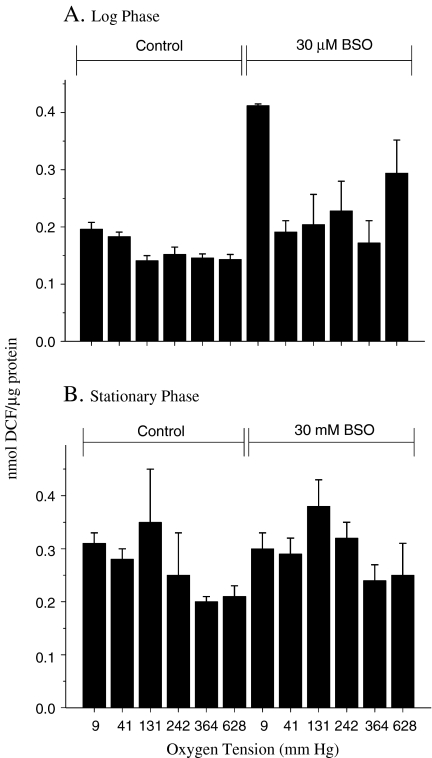
ROS formation in WI-38 cultures exposed to different oxygen tensions for 24 h. The cells were washed once with phenyl red, serum-free MEM and then treated with 100 μl of DCFH-DA containing medium. The plates were incubated at 37°C for 1 h. Following incubation, the cells were washed once with the wash buffer and read (ex 494, em 518) with a Victor 2 Plate Reader (Perkin Elmer) to determine the amount of oxidized DCF in the cells. Filters used were ex 485 (Perkin Elmer Filter 11440022) and em 535 (Perkin Elmer Filter 11440023). Protein in the samples was determined using Bradford protein assay reagent (Biorad). The reagent was diluted 1:5 with ultrapure water and filtered prior to treating samples. The Victor 2 plate reader was used to determine absorbance at 595 nm. Each point is an average of eight determinations

References

    1. Allen RG. Oxidative stress and superoxide dismutase in development, aging and gene regulation. Age. 1998;21:47–76. doi: 10.1007/s11357-998-0007-7. - DOI - PMC - PubMed
    1. Allen RG, Balin AK. Oxidative influence on development and differentiation: an overview of a free radical theory of development. Free Radic Biol Med. 1989;6:631–661. doi: 10.1016/0891-5849(89)90071-3. - DOI - PubMed
    1. Allen RG, Balin AK. Metabolic rate, free radicals and aging. In: Cutler RG, Rodriguez H, editors. Metabolic rate free radicals and aging: advances in basic science, diagnostics, and intervention. New York: World Scientific; 2003a. pp. 3–23.
    1. Allen RG, Balin AK. Effects of oxygen on the antioxidant responses of normal and transformed cells. Exp Cell Res. 2003b;289:207–316. doi: 10.1016/S0014-4827(03)00279-9. - DOI - PubMed
    1. Allen RG, Keogh BP, Gerhard G, Pignolo R, Horton J, Cristofalo VJ. Expression and regulation of SOD activity in human skin fibroblasts from donors of different ages. J Cell Physiol. 1995;165:576–587. doi: 10.1002/jcp.1041650316. - DOI - PubMed

Publication types