. 2010 Jun 1;107(22):10296-301.
doi: 10.1073/pnas.1004788107. Epub 2010 May 17.

Arabidopsis thaliana transcription factors bZIP19 and bZIP23 regulate the adaptation to zinc deficiency

Affiliations

Arabidopsis thaliana transcription factors bZIP19 and bZIP23 regulate the adaptation to zinc deficiency

Ana G L Assunção et al. Proc Natl Acad Sci U S A. .

Abstract

Zinc is an essential micronutrient for all living organisms. When facing a shortage in zinc supply, plants adapt by enhancing the zinc uptake capacity. The molecular regulators controlling this adaptation are not known. We present the identification of two closely related members of the Arabidopsis thaliana basic-region leucine-zipper (bZIP) transcription factor gene family, bZIP19 and bZIP23, that regulate the adaptation to low zinc supply. They were identified, in a yeast-one-hybrid screening, to associate to promoter regions of the zinc deficiency-induced ZIP4 gene of the Zrt- and Irt-related protein (ZIP) family of metal transporters. Although mutation of only one of the bZIP genes hardly affects plants, we show that the bzip19 bzip23 double mutant is hypersensitive to zinc deficiency. Unlike the wild type, the bzip19 bzip23 mutant is unable to induce the expression of a small set of genes that constitutes the primary response to zinc deficiency, comprising additional ZIP metal transporter genes. This set of target genes is characterized by the presence of one or more copies of a 10-bp imperfect palindrome in their promoter region, to which both bZIP proteins can bind. The bZIP19 and bZIP23 transcription factors, their target genes, and the characteristic cis zinc deficiency response elements they can bind to are conserved in higher plants. These findings are a significant step forward to unravel the molecular mechanism of zinc homeostasis in plants, allowing the improvement of zinc bio-fortification to alleviate human nutrition problems and phytoremediation strategies to clean contaminated soils.


Conflict of interest statement

The authors declare no conflict of interest.

Figures
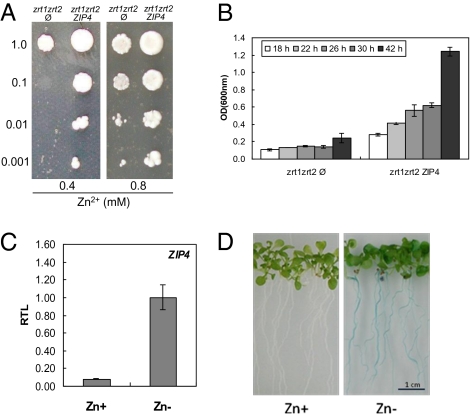
Fig. 1.
Fig. 1.
Gene expression and zinc transport of the Arabidopsis ZIP4 zinc transporter. (A) Growth of zrt1zrt2 S. cerevisiae cells carrying either the empty vector (zrt1zrt2 Ø) or expressing ZIP4 (zrt1zrt2 ZIP4) was assayed by spotting serial dilutions of cells (OD600 is shown on the left) on SD-URA selective medium with 0.4 or 0.8 mM ZnCl2. (B) OD measurements at the indicated time-intervals of zrt1zrt2 Ø and zrt1zrt2 ZIP4 on SD-URA selective liquid medium with 0.4 mM ZnCl2 (mean ± SEM). (C) Relative transcript levels (RTL) of ZIP4 in 3-week-old Arabidopsis seedlings grown in MS medium, with 30 μM ZnSO4 (Zn+) or without (Zn-) (mean ± SEM). (D) GUS expression analysis in roots of Arabidopsis 3-week-old seedlings, stably transformed with a ZIP4promoter::GUS construct, grown in MS medium, with 30 μM ZnSO4 (Zn+) or without (Zn-).
Fig. 2.
Fig. 2.
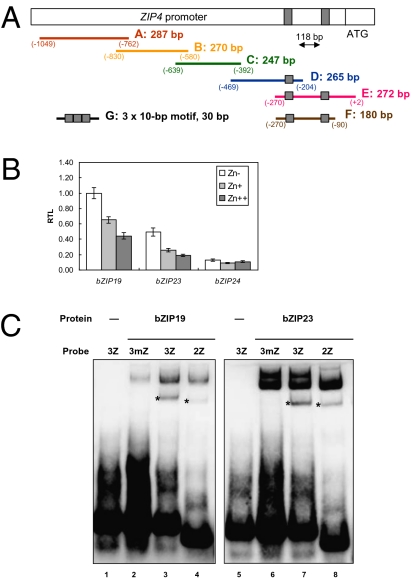
Yeast-one-hybrid baits, F group bZIP gene expression, and EMSA with bZIP19 and bZIP23. (A) Schematic diagram of the bait fragments (A-G) used to construct the reporter vectors in the yeast-one-hybrid assay. The gray box represents a 10-bp palindromic motif. (B) Relative transcript levels (RTL) of bZIP19, bZIP23, and bZIP24 in 3-week-old Arabidopsis seedlings grown in MS medium, without (Zn-), with 30 μM (Zn+) or with 300 μM ZnSO4 (Zn++) (mean ± SEM). (C) EMSA show that in vitro translated bZIP19 and bZIP23 protein can specifically bind to three tandem repeats of the 10-bp palindromic motif (3Z; 3 x ZDRE; lanes 3 and 7), corresponding to bait G in A, and to two tandem repeats (2Z; lanes 7 and 8), causing the bound fragments to migrate slower through the gel (*) than the labeled free probes found at the bottom of the gel. The observed shift (*) does not occur when using a three-tandem-repeat fragment of a mutated element (3mZ; lanes 2 and 6). A control assay, in which the empty vector was used for in vitro translation, does not show the band shift (lanes 1 and 5), indicating specific binding of bZIP19 and bZIP23 to the ZDRE probes.
Fig. 3.
Fig. 3.
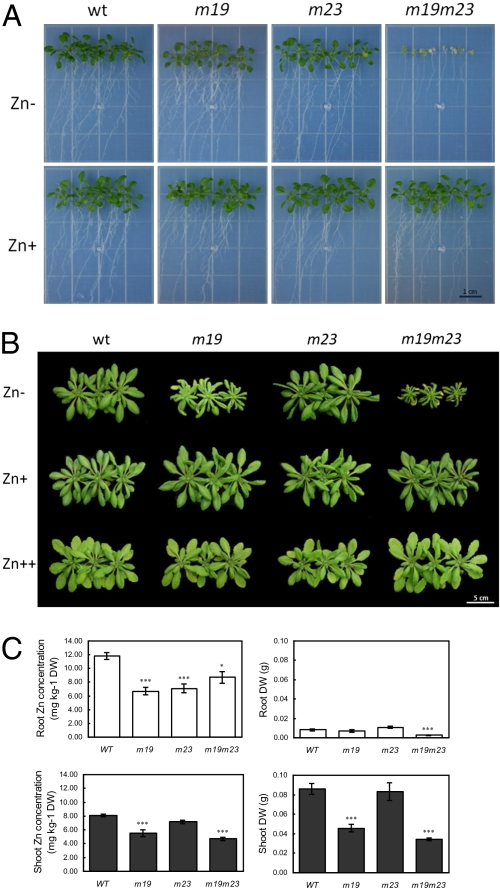
The double T-DNA insertion mutant m19m23 is hypersensitive to zinc deficiency. (A) Effect of zinc deficiency on 3-week-old seedlings of Arabidopsis (WT), bZIP19 T-DNA insertion mutants (m19), bZIP23 T-DNA insertion mutants (m23), and double T-DNA insertion mutants (m19m23) grown in MS medium without (Zn-) and with 30 μM ZnSO4 (Zn+). (B) Effect of zinc supply on 4-week-old plants of Arabidopsis (WT), m19, m23, and m19m23, grown in hydroponics at 0.05 μM (Zn-), 2 μM (Zn+), and 25 μM ZnSO4 (Zn++). (C) Zinc concentration, in mg·kg−1 of dry weight, and dry weight (DW), in g, of shoots (gray bars) and roots (white bars) of 4-week-old WT, m19, m23, and m19m23 plants, grown in hydroponics at 0.05 μM ZnSO4 (Zn-). *, P < 0.05; **, P < 0.01; ***, P < 0.001; representing significant differences of the mean in comparison with the WT mean (mean ± SEM).
Fig. 4.
Fig. 4.
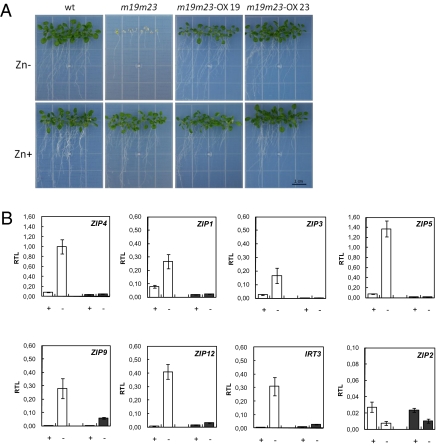
Complementation study and expression analysis of putative target genes. (A) Arabidopsis wild-type plants (WT), double T-DNA insertion mutants (m19m23), and double mutants constitutively expressing either bZIP19 (m19m23-OX19) or bZIP23 (m19m23-OX23), grown for 3 weeks in MS medium without (Zn-) and with 30 μM ZnSO4 (Zn+). (B) Relative transcript levels (RTL) of ZIP4, ZIP1, ZIP3, ZIP5, ZIP9, ZIP12, IRT3, and ZIP2 in 3-week-old wild-type seedlings of Arabidopsis (WT) (white bars) and m19m23 double mutants (gray bars) grown in MS medium with 30 μM ZnSO4 (Zn+) or without (Zn-) (mean ± SEM).

References

    1. Vallee BL, Auld DS. Zinc coordination, function, and structure of zinc enzymes and other proteins. Biochemistry. 1990;29:5647–5659. - PubMed
    1. Clemens S. Molecular mechanisms of plant metal tolerance and homeostasis. Planta. 2001;212:475–486. - PubMed
    1. Grotz N, et al. Identification of a family of zinc transporter genes from Arabidopsis that respond to zinc deficiency. Proc Natl Acad Sci USA. 1998;95:7220–7224. - PMC - PubMed
    1. Mäser P, et al. Phylogenetic relationships within cation transporter families of Arabidopsis. Plant Physiol. 2001;126:1646–1667. - PMC - PubMed
    1. Lin Y-F, et al. Arabidopsis IRT3 is a zinc-regulated and plasma membrane localized zinc/iron transporter. New Phytol. 2009;182:392–404. - PubMed

Publication types

MeSH terms