Pyoderma gangrenosum-like ulcer in a patient with X-linked agammaglobulinemia: identification of Helicobacter bilis by mass spectrometry analysis
- PMID: 20479300
- PMCID: PMC3179848
- DOI: 10.1001/archdermatol.2010.86
Pyoderma gangrenosum-like ulcer in a patient with X-linked agammaglobulinemia: identification of Helicobacter bilis by mass spectrometry analysis
Abstract
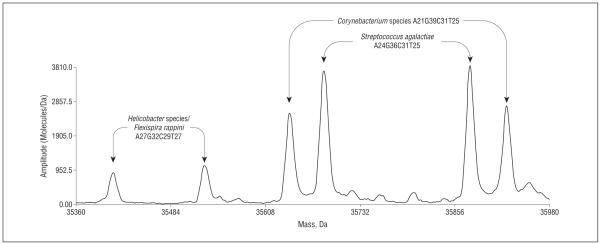
Background: Pyoderma gangrenosum-like ulcers and cellulitis of the lower extremities associated with recurrent fevers in patients with X-linked (Bruton) agammaglobulinemia have been reported to be caused by Helicobacter bilis (formerly classified as Flexispira rappini and then Helicobacter strain flexispira taxon 8). Consistent themes in these reports are the difficulty in recovering this organism in blood and wound cultures and in maintaining isolates in vitro. We confirmed the presence of this organism in a patient's culture by using a novel application of gene amplification polymerase chain reaction and electrospray ionization time-of-flight mass spectrometry.
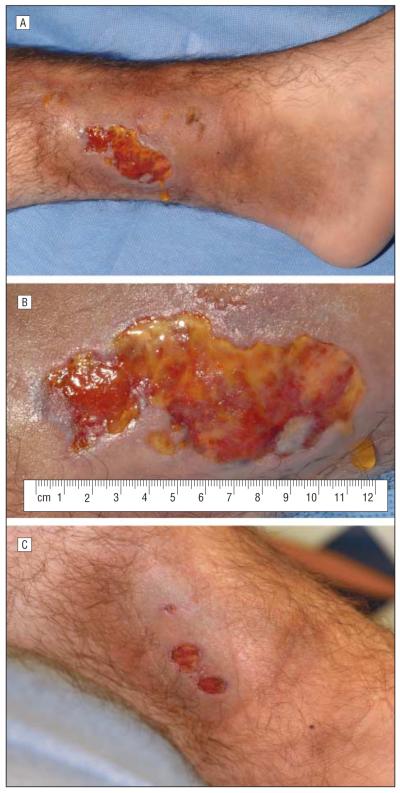
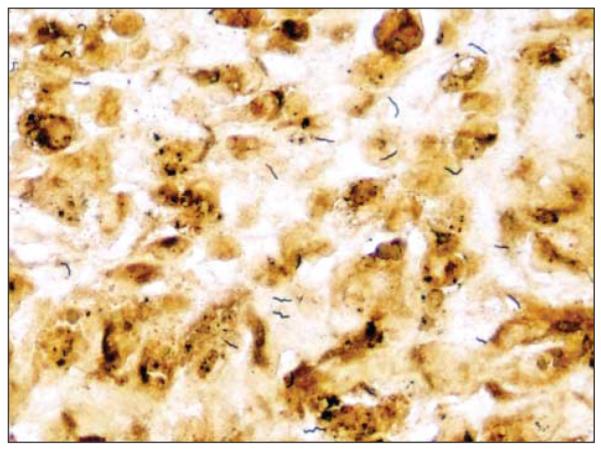
Observation: An adolescent boy with X-linked agammaglobulinemia presented with indurated plaques and a chronic leg ulcer whose origin was strongly suspected to be an H bilis organism. Histologic analysis demonstrated positive Warthin-Starry staining of curvilinear rods, which grew in culture but failed to grow when subcultured. They could not be identified by conventional techniques. A combination of gene amplification by polymerase chain reaction and electrospray ionization time-of-flight mass spectrometry confirmed the identity of this organism.
Conclusions: This novel technology was useful in the identification of a difficult-to-grow Helicobacter organism, the cause of pyoderma gangrenosum-like leg ulcers in patients with X-linked agammaglobulinemia. Correct identification of this organism as the cause of pyoderma gangrenosum-like ulcers in patients with X-linked agammaglobulinemia is of great importance for the early initiation of appropriate and curative antibiotic therapy.
Figures
References
-
- Bruton OC. Agammaglobulinemia. Pediatrics. 1952;9(6):722–728. - PubMed
-
- Tsukada S, Saffran DC, Rawlings DJ, et al. Deficient expression of a B cell cytoplasmic tyrosine kinase in human X-linked agammaglobulinemia. Cell. 1993;72(2):279–290. - PubMed
-
- Winkelstein JA, Marino MC, Lederman HM, et al. X-linked agammaglobulinemia: report and United States repository of 201 patients. Medicine (Baltimore) 2006;85(4):193–202. - PubMed
-
- Cuccherini B, Chua K, Gill V, et al. Bacteremia and skin/bone infections in two patients with X-linked agammaglobulinemia caused by an unusual organism related to Flexispira/Helicobacter species. Clin Immunol. 2000;97(2):121–129. - PubMed
Publication types
MeSH terms
Grants and funding
LinkOut - more resources
Full Text Sources
Medical