Review
. 2010 Jun;16(3):253-75.
doi: 10.1177/1073858409354385.

Is epilepsy a preventable disorder? New evidence from animal models

Affiliations
Review

Is epilepsy a preventable disorder? New evidence from animal models

Kathryn A Giblin et al. Neuroscientist. 2010 Jun.

Abstract

Epilepsy accounts for 0.5% of the global burden of disease, and primary prevention of epilepsy represents one of the three 2007 NINDS Epilepsy Research Benchmarks. In the past decade, efforts to understand and intervene in the process of epileptogenesis have yielded fruitful preventative strategies in animal models.This article reviews the current understanding of epileptogenesis, introduces the concept of a "critical period" for epileptogenesis, and examines strategies for epilepsy prevention in animal models of both acquired and genetic epilepsies. We discuss specific animal models, which may yield important insights into epilepsy prevention including kindling, poststatus epilepticus, prolonged febrile seizures, traumatic brain injury, hypoxia, the tuberous sclerosis mouse model, and the WAG/Rij rat model of primary generalized epilepsy. Hopefully, further investigation of antiepileptogenesis in animal models will soon enable human therapeutic trials to be initiated, leading to long-term epilepsy prevention and improved patient quality of life.


Conflict of interest statement

Declaration of Conflicting Interests

The authors declared no potential conflicts of interests with respect to the authorship and/or publication of this article.

Figures

Figure 1
Figure 1
Schematic of epileptogenesis. Reproduced with permission from White and others 2002.
Figure 2
Figure 2
Nav1.6 +/− mice kindle more slowly than wild-type littermates. (A) Behavioral severity of seizures (mean Racine score) increases more slowly in Nav1.6 +/− mice than in wild-type controls. (B) Nav1.6 +/− mice require more stimuli to reach each stage of kindling compared to wild-type controls. Reproduced with permission from Blumenfeld and others 2009.
Figure 3
Figure 3
Kindling is inhibited in TrkB−/− mice. (A) TrkB−/− mice do not progress beyond a seizure class 0, and behavioral severity of seizures increases more slowly in TrkB+/− mice than in wild-type mice. (B) Seizure duration is persistently decreased in TrkB−/− mice. (C) For each stage of kindling, up to 50 stimulations do not cause TrkB−/− mice to progress beyond class 0 seizures, and TrkB+/− mice require more stimuli to reach each stage of kindling compared to wild-type controls. Reproduced with permission from He and others 2004.
Figure 4
Figure 4
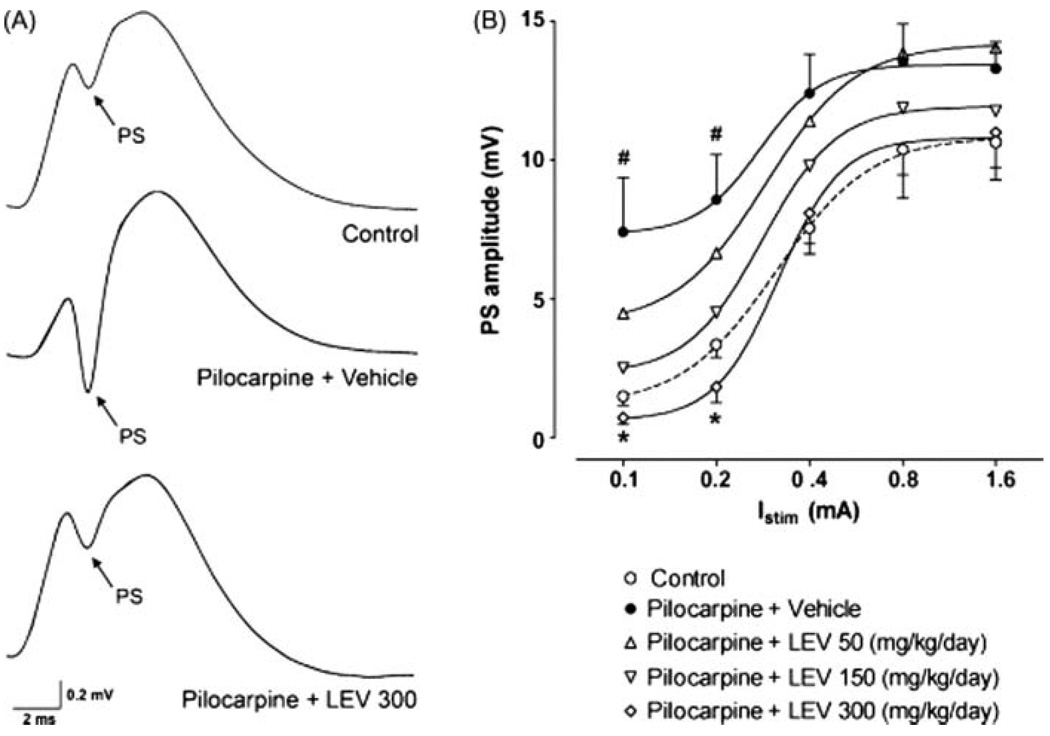
Rats treated with levetiracetam show a dose-dependent reduction in the increased population spike amplitude in the dentate gyrus as a function of perforant path stimulation current intensity (Istim) after pilocarpine-induced status epilepticus. (A) Averaged evoked field potentials show increased population spike amplitude in untreated poststatus rats (middle) in comparison to control rats (top) and poststatus rats treated with levetiracetam (bottom). (B) Mean ± SEM values of population spike amplitude show a dose-dependent reduction with levetiracetam treatment. Reproduced with permission from Margineanu and others 2008.
Figure 5
Figure 5
Rats treated with levetiracetam show an improvement in the reduced paired-pulse inhibition in CA1 seen after pilocarpine-induced status epilepticus. (A) Averaged traces evoked with paired pulses show reduced paired-pulse inhibition, as evidenced by greater second population spike amplitude, in untreated poststatus rats (middle) as compared with control rats (top) and poststatus rats treated with levetiracetam (bottom). (B) Mean values of paired-pulse population spike amplitude ratios show an increase in paired-pulse inhibition with levetiracetam treatment. Reproduced with permission from Margineanu and others 2008.
Figure 6
Figure 6
Gene transfer of the GABAA receptor α1 subunit decreases the risk of seizure development and increases the length of latency following status epilepticus. (A) Treated rats show decreased rates of seizure development than untreated rats. (B) Treated rats are seizure free longer than untreated rats. Reproduced with permission from Raol and others 2006.
Figure 7
Figure 7
Early tetrodotoxin (TTX) prevents epileptiform events and associated changes in immunoreactivity after neocortical isolation. (A) Tetrodotoxin inhibits epileptiform evoked field potentials after partial neocortical isolation. In a control-Elvax (vehicle)–treated animal (left), 3 of 4 stimuli evoke epileptiform events. In a TTX-Elvax–treated animal (right), equivalent stimuli fail to evoke epileptiform events. Reproduced with permission from Graber and Prince 1999. (B) Brief TTX treatment is more effective with 3 or more days of treatment duration. Treatment was started at the time of neocortical isolation. Activity was assessed at multiple sites per animal, and the percentage of those sites with epileptiform activity was calculated. Reproduced with permission from Graber and Prince 2004. (C) Delayed TTX treatment is less effective when initiated more than 4 days after lesioning. Reproduced with permission from Graber and Prince 2004. (D) Tetrodotoxin treatment after neocortical isolation reduced immunoreactivity (IR) to growth-associated protein (GAP) 43 antibody at 3 days and to 68-kDa neurofilament at 3 weeks. (A’, D’) Control sections from layer V contralateral to the undercut. (B’, E’) Untreated undercuts. (C’, F’) Undercuts in animals treated with TTX. Calibrations: 50 µm. Reproduced with permission from Prince and others 2009.
Figure 8
Figure 8
Early rapamycin (Rap) treatment prevents the development of epilepsy and premature death in presymptomatic Tsc1GFAPCKO mice. (A) Rapamycin treatment prevents the development of seizures and premature death in Tsc1GFAPCKO mice compared with vehicle-treated Tsc1GFAPCKO mice. (B) Rapamycin treatment prevents the increase in interictal spike frequency with age. (C) Electroencephalographic (EEG) background activity rating scale: grade 1 being less abnormal, grade 4 being more abnormal. (D) Rapamycin treatment prevents the age-related increase in interictal EEG grade (as defined in C). (E) Untreated Tsc1GFAPCKO mice begin to lose weight after 7 weeks of age. Rapamycin-treated Tsc1GFAPCKO mice gained weight at a similar rate to rapamycin-treated controls. (F) Rapamycin treatment prevents the premature death seen in Tsc1GFAPCKO mice. Reproduced with permission from Zeng and others 2008.
Figure 9
Figure 9
WAG/Rij rats that underwent early maternal deprivation (MD) or neonatal handling (NH) have less spike-wave discharges (SWDs) as adults. (A) Sample electroencephalographic (EEG) recordings from control, MD, and NH rats illustrate that control rats have more SWD than MD and NH rats. (B) Expanded from the control WAG/Rij rat EEG above at bar. (C) Rats that underwent MD or NH had less SWD as adults in a 4-hour recording period. (D) Mean ± SEM SWD duration was not significantly different between control, MD, and NH groups. Reproduced with permission from Schridde and others 2006.
Figure 10
Figure 10
Abnormal ion channel expression in WAG/Rij rats is blocked by early ethosuximide (ESX) treatment. (A-D) Nav1.1 is increased in untreated WAG/Rij rats (C) compared to nonepileptic (NE) rats (A, B). This increase is blocked by ESX treatment (D). (E-H) Nav1.6 is increased in untreated WAG/Rij rats (G) compared to NE rats (E, F). This increase is blocked by ESX treatment (H). (I-L) HCN1 is decreased in untreated WAG/Rij rats (K) compared to NE rats (I, J). This decrease is blocked by ESX treatment (L). (M) Untreated WAG/Rij rats have significantly increased Nav1.1 and Nav1.6 and decreased HCN1 by quantitative optical intensity of immunocytochemistry, while NE rats and WAG/Rij rats treated with early ESX do not. Calibration: 50 µm. Reproduced with permission from Blumenfeld and others 2008.
Figure 11
Figure 11
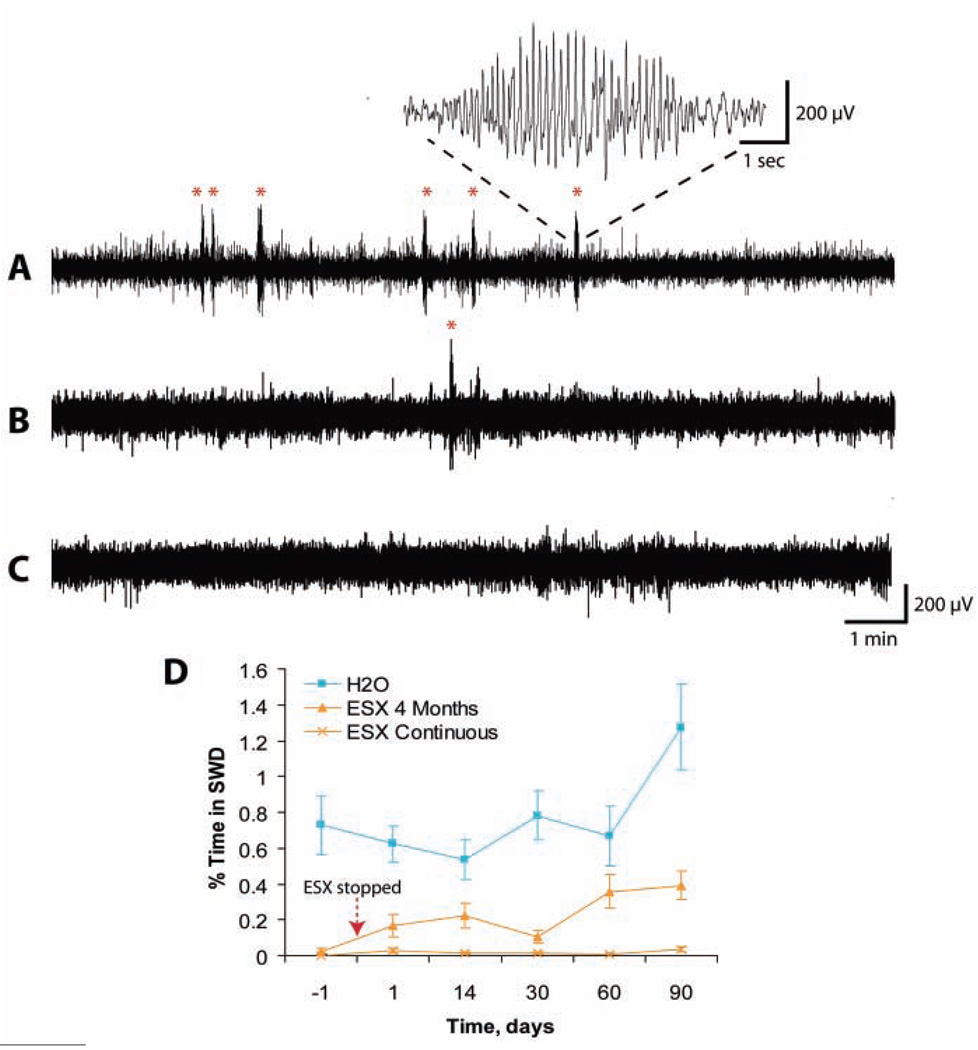
Spike-wave discharges (SWDs) in WAG/Rij rats are persistently suppressed by early ethosuximide (ESX) treatment after cessation of treatment. (A) Electroencephalographic (EEG) recording from untreated WAG/Rij rat at 8 months has frequent SWD. (B) EEG recording from WAG/Rij rat treated with ESX from P21 to 5 months shows suppressed SWD at 8 months. (C) EEG recording from WAG/Rij rat continuing to receive treatment with ESX that started at P21 shows continued blockade of SWD at 8 months. (D) WAG/Rij rats treated with early ESX show persistent reduction in percentage of time in SWD at up to 90 days after cessation of treatment. Reproduced with permission from Blumenfeld and others 2008.

References

    1. Adams B, Sazgar M, Osehobo P, Van der Zee CE, Diamond J, Fahnestock M, Racine RJ. Nerve growth factor accelerates seizure development, enhances mossy fiber sprouting, and attenuates seizure-induced decreases in neuronal density in the kindling model of epilepsy. J Neurosci. 1997;17:5288–5296. - PMC - PubMed
    1. Albertson TE, Joy RM, Stark LG. A pharmacological study in the kindling model of epilepsy. Neuropharmacology. 1984;23:1117–1123. - PubMed
    1. Andre V, Ferrandon A, Marescaux C, Nehlig A. Electroshocks delay seizures and subsequent epileptogenesis but do not prevent neuronal damage in the lithium-pilocarpine model of epilepsy. Epilepsy Res. 2000;42:7–22. - PubMed
    1. Andre V, Ferrandon A, Marescaux C, Nehlig A. Vigabatrin protects against hippocampal damage but is not antiepileptogenic in the lithium-pilocarpine model of temporal lobe epilepsy. Epilepsy Res. 2001;47:99–117. - PubMed
    1. Andre V, Rigoulot MA, Koning E, Ferrandon A, Nehlig A. Long-term pregabalin treatment protects basal cortices and delays the occurrence of spontaneous seizures in the lithium-pilocarpine model in the rat. Epilepsia. 2003;44:893–903. - PubMed

Publication types