


Maternal warmth buffers the effects of low early-life socioeconomic status on pro-inflammatory signaling in adulthood
- PMID: 20479762
- PMCID: PMC2925055
- DOI: 10.1038/mp.2010.53
Maternal warmth buffers the effects of low early-life socioeconomic status on pro-inflammatory signaling in adulthood
Abstract
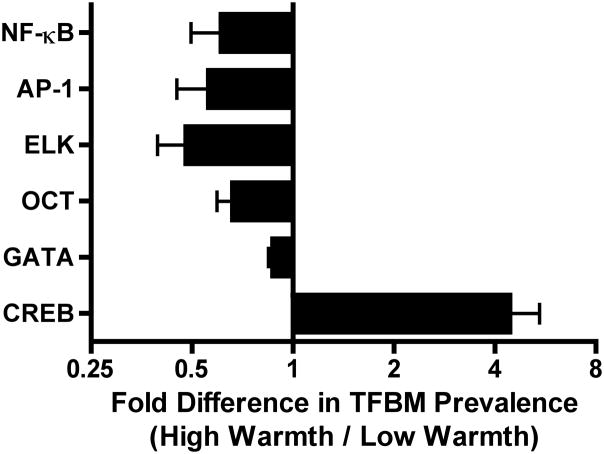
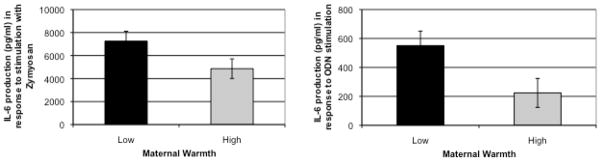
The notion that family support may buffer individuals under adversity from poor outcomes has been theorized to have important implications for mental and physical health, but little is known about the biological mechanisms that explain these links. We hypothesized that adults who grew up in low socioeconomic status (SES) households but who experienced high levels of maternal warmth would be protected from the pro-inflammatory states typically associated with low SES. A total of 53 healthy adults (aged 25-40 years) low in SES early in life were assessed on markers of immune activation and systemic inflammation. Genome-wide transcriptional profiling also was conducted. Low early-life SES individuals who had mothers, who expressed high warmth toward them, exhibited less Toll-like receptor-stimulated production of interleukin 6, and reduced bioinformatic indications of pro-inflammatory transcription factor activity (NF-κB) and immune activating transcription factor activity (AP-1) compared to those who were low in SES early in life but experienced low maternal warmth. To the extent that such effects are causal, they suggest the possibility that the detrimental immunologic effects of low early-life SES environments may be partly diminished through supportive family climates.
Conflict of interest statement
All authors declare no conflicts of interest.
Figures
References
-
- Dohrenwend BP, Levav I, Shrout PE, Schwartz S, Naveh G, Link BG, et al. Socioeconomic status and psychiatric disorders: The causation-selection issue. Science. 1992;255:946–952. - PubMed
-
- Johnson JG, Cohen P, Dohrenwend BP, Link BG, Brook JS. A longitudinal investigation of social causation and social selection processes involved in the association status and psychiatric disorders. J Abnorm Psychol. 1999;108:490–499. - PubMed
-
- Adler NE, Boyce T, Chesney MA, Cohen S, Folkman S, Kahn RL, et al. Socioeconomic status and health: The challenge of the gradient. American Psychologist. 1994;49:15–24. - PubMed
-
- Marmot MG, Shipley MJ, Rose G. Inequalities in death-specific explanations of a general pattern? Lancet. 1984;i:1003–1006. - PubMed
-
- Chen E, Matthews KA, Boyce WT. Socioeconomic differences in children’s health: How and why do these relationships change with age? Psychological Bulletin. 2002;128:295–329. - PubMed
Publication types
MeSH terms
Substances
Grants and funding
LinkOut - more resources
Full Text Sources
Other Literature Sources
Medical
Molecular Biology Databases
