. 2010 Jun 15;82(12):5005-11.
doi: 10.1021/ac1009047.

Catalytic and molecular beacons for amplified detection of metal ions and organic molecules with high sensitivity

Affiliations

Catalytic and molecular beacons for amplified detection of metal ions and organic molecules with high sensitivity

Xiao-Bing Zhang et al. Anal Chem. .

Abstract

The catalytic beacon has emerged as a general platform for sensing metal ions and organic molecules. However, few reports have taken advantage of the true potential of catalytic beacons in signal amplification through multiple enzymatic turnovers, as existing designs require either equal concentrations of substrate and DNAzyme or an excess of DNAzyme in order to maintain efficient quenching, eliminating the excess of substrate necessary for multiple turnovers. On the basis of the large difference in the melting temperatures between the intramolecular molecular beacon stem and intermolecular products of identical sequences, we here report a general strategy of catalytic and molecular beacon (CAMB) that combines the advantages of the molecular beacon for highly efficient quenching with the catalytic beacon for amplified sensing through enzymatic turnovers. Such a CAMB design allows detection of metal ions such as Pb(2+) with a high sensitivity (LOD = 600 pM). Furthermore, the aptamer sequence has been introduced into DNAzyme to use the modified CAMB for amplified sensing of adenosine with similar high sensitivity. These results together demonstrate that CAMB provides a general platform for amplified detection of a wide range of targets.


Figures
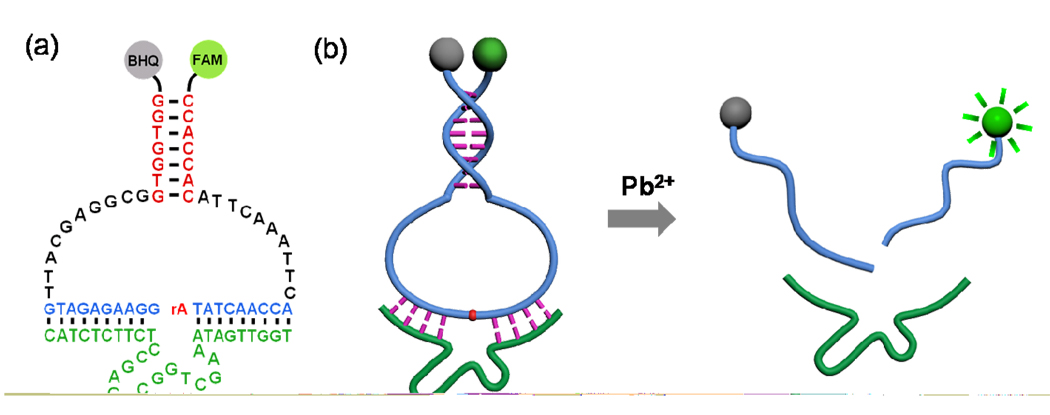
Figure 1
Figure 1
(a) Secondary structure of the CAMB on the 8–17 DNAzyme; (b) Schematic of the CAMB system for lead detection.
Figure 2
Figure 2
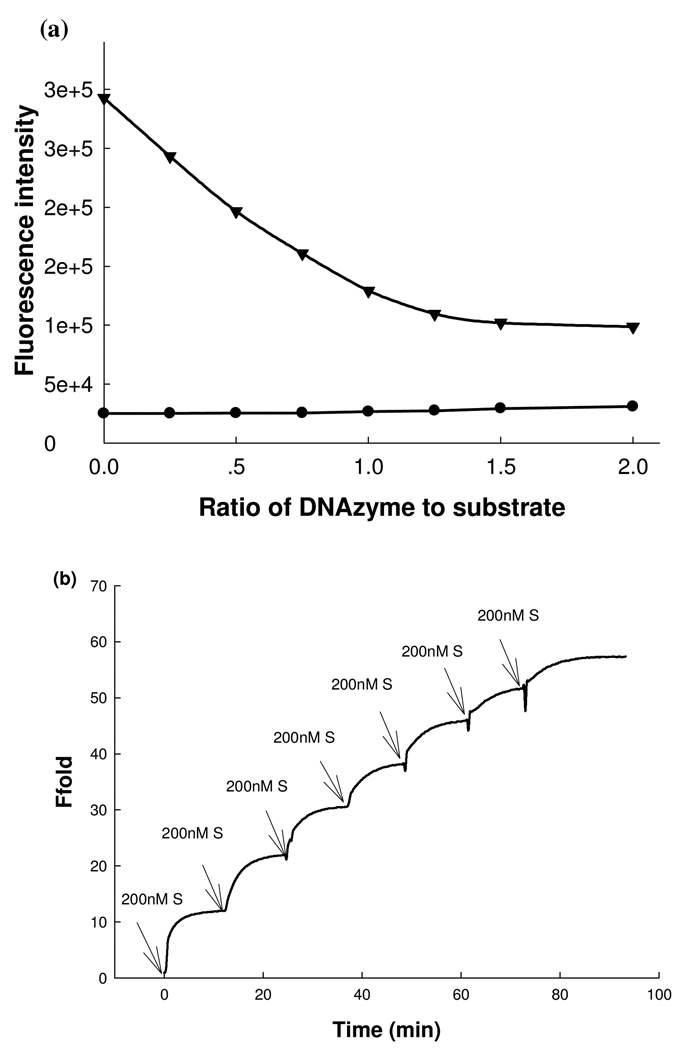
(a) Comparison of fluorescence backgrounds of the original catalytic beacon system (17DS-FD and 17E-Dy) and CAMB at varying ratios of DNAzyme to substrate (MB2): (filled triangles) original 8–17 DNAzyme catalytic beacon system; (filled circles) new designed catalytic and molecular beacon system. The substrate concentration was fixed at 200 nM. (b) Multiple-turnover catalytic activity of CAMB system by using the 8–17 DNAzyme and MB substrate (MB2). The kinetics of fluorescence enhancement were recorded in a 200 nM of 8–17 DNAzyme solution in the presence of 10 µM Pb2+ as a cofactor. The buffer contained 25 mM HEPES (pH 7.0) and 50 mM NaCl.
Figure 3
Figure 3
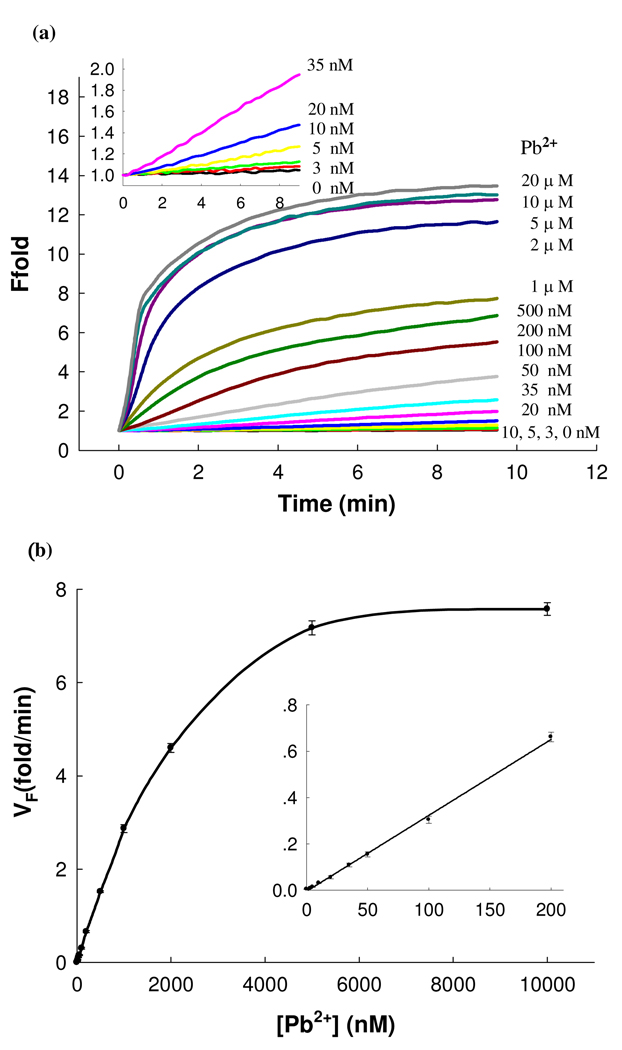
Sensitivity of the CAMB sensing system for Pb2+ detection. (a) Time-dependent fluorescence response over background fluorescence with varying concentrations of Pb2+. The concentration of DNAzyme and substrate was 200 nM, and 300 nM, respectively. The buffer contained 25 mM HEPES (pH 7.0) and 100 mM NaCl. Inset; Responses at low Pb2+ concentrations. (b) Calibration curve of the CAMB Pb2+ sensor. The curve was plotted with the initial rate of fluorescence enhancement vs. Pb2+ concentration. Inset shows the linear responses at low Pb2+ concentrations.
Figure 4
Figure 4
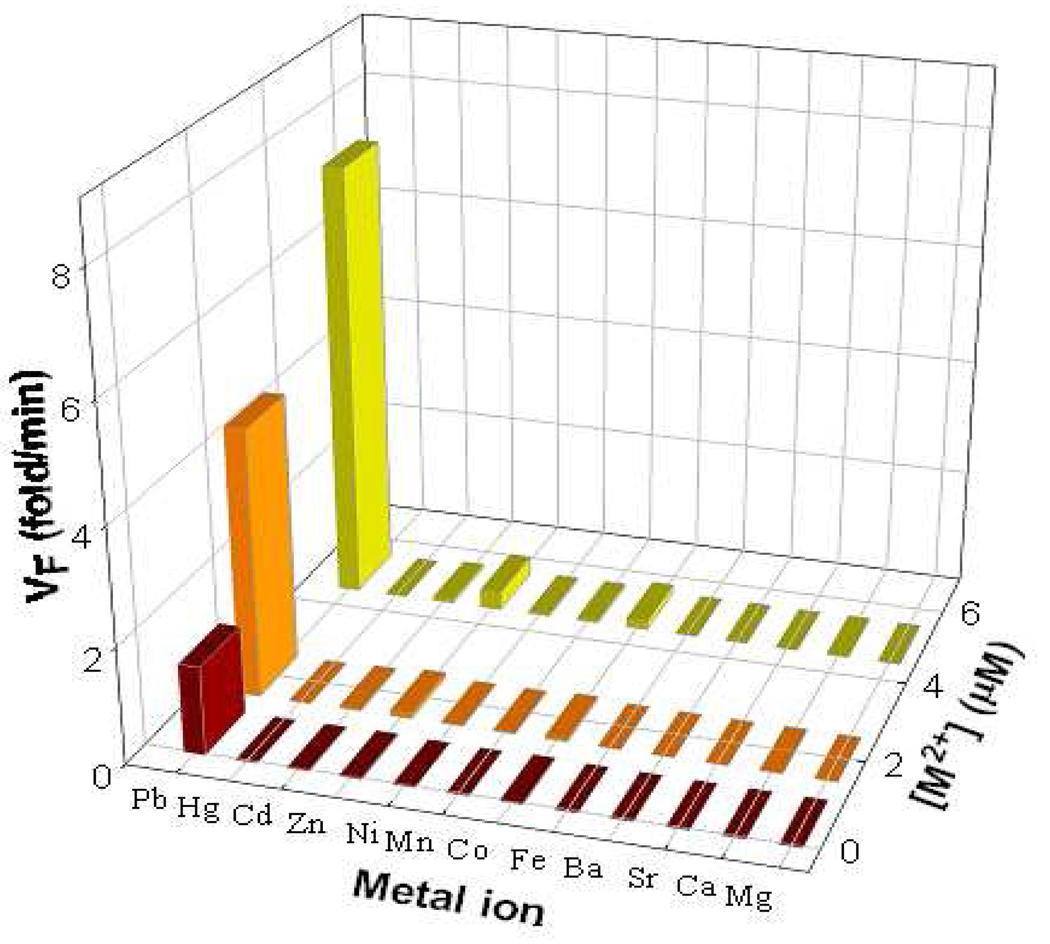
Selectivity of CAMB sensor for Pb2+ over other competing divalent metal ions. The initial rate of fluorescence enhancement of the sensing system induced by different metal ions at three concentrations (0.5, 2 and 5 µM) are shown. The concentration for DNAzyme and substrate was 200 nM and 300 nM, respectively. The buffer solution contained 25 mM HEPES (pH 7.0) and 100 mM NaCl.
Figure 5
Figure 5
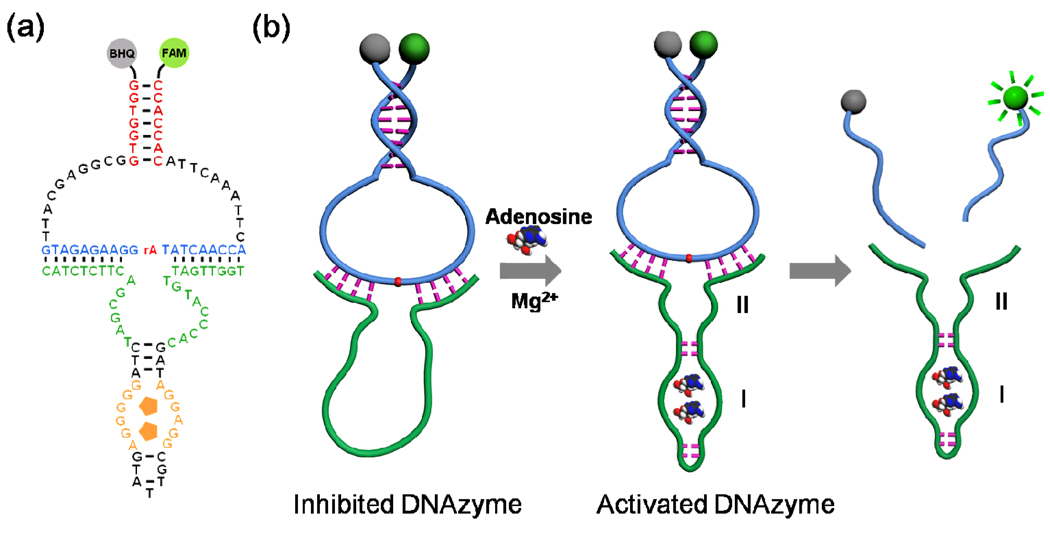
a) Secondary structure of the activated CAMB sensing system for adenosine. (b) Schematic of a fluorescence sensing CAMB system for adenosine by using CAMB as a signal amplifying label through an inhibiting strategy.
Figure 6
Figure 6
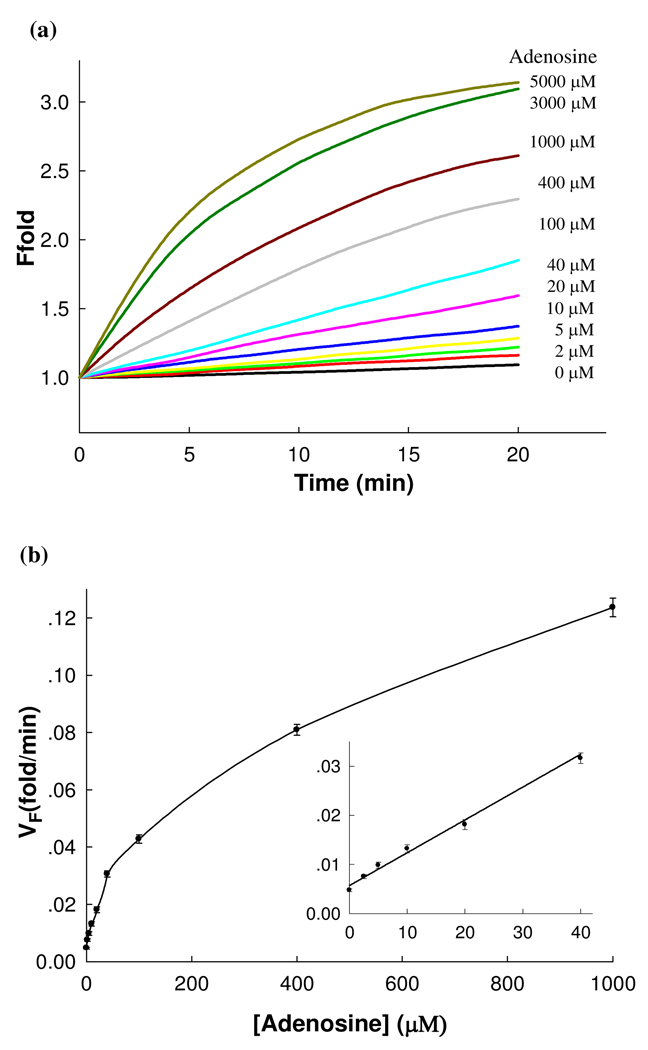
Sensitivity of the fluorescent CAMB system for adenosine detection. (a) Time-dependent fluorescence enhancement of the sensing system in the presence of different concentrations of adenosine with 10 mM Mg2+ as a cofactor. The concentration of substrate and the aptamer-appended DNAzyme was 300 nM and 200 nM, respectively, and the buffer solution contained 25 mM HEPES (pH 7.2) and 100 mM NaCl. (b) Calibration curve of the fluorescent CAMB sensor for adenosine. Inset shows the linear responses of sensing system to adenosine at low concentration.
Scheme 1
Scheme 1
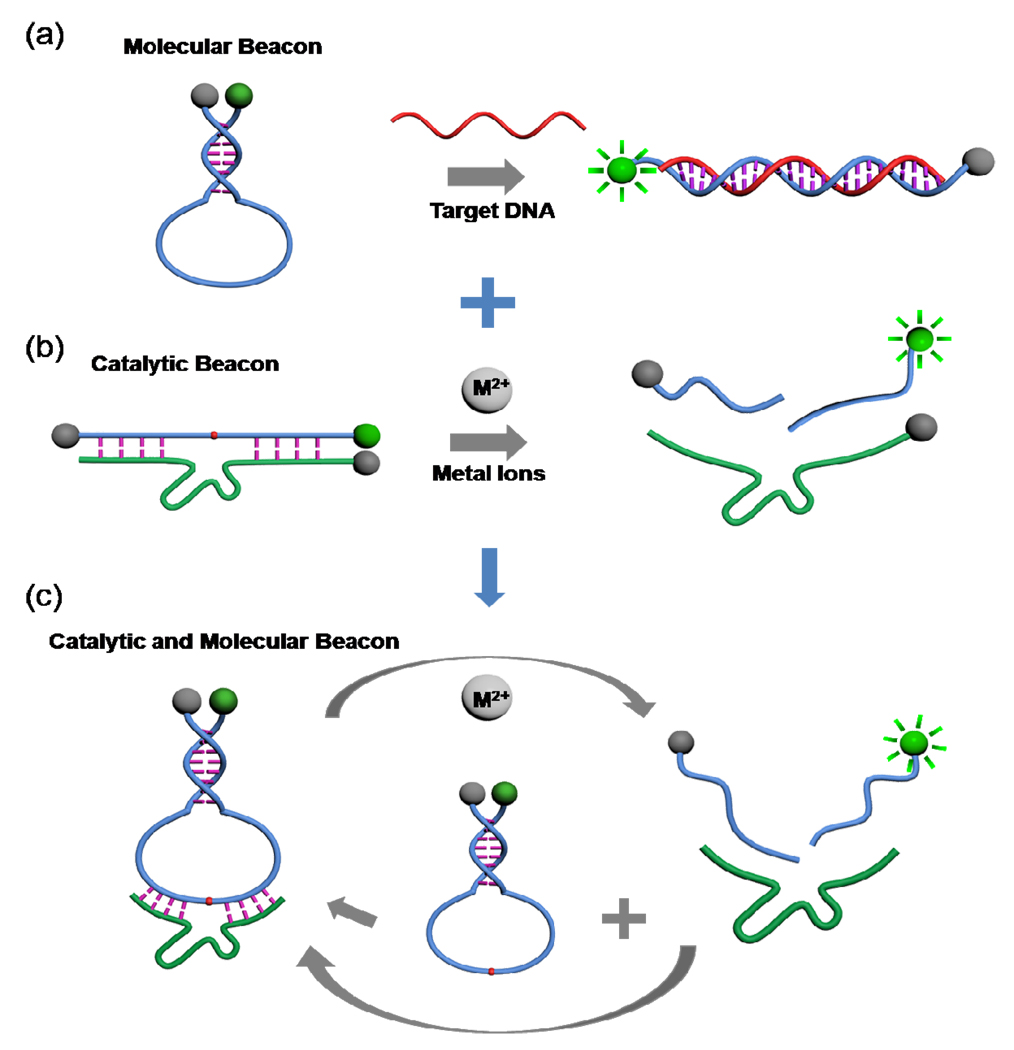
Design strategy of the catalytic and molecular beacon (CAMB). (a) Schematic of the molecular beacon (MB) design. (b) Schematic of the catalytic beacon design. (c) Schematic of the CAMB. The DNAzyme substrate strand is incorporated in the loop of the MB, which binds to the enzyme strand to form a complex structure. Addition of metal ions cleaves the substrate and cuts the molecular beacon into two pieces, resulting in stem dehybridization and enhanced fluorescence signal. In the presence of excess MB substrate, one DNAzyme can catalyze the cleavage of multiple MB substrates and achieve an amplified fluorescence signal.

References

    1. Nolan EM, Lippard SJ. Chem. Rev. 2008;108:3443–3480. - PubMed
    1. Chen PR, He C. Curr. Opin. Chem. Biol. 2008;12:214–221. - PubMed
    1. Xue X, Wang F, Liu X. J. Am. Chem. Soc. 2008;130:3244–3245. - PubMed
    1. Qian F, Zhang C, Zhang Y, He W, Gao X, Hu P, Guo Z. J. Am. Chem. Soc. 2009;131:1460–1468. - PubMed
    1. McRae R, Bagchi P, Sumalekshmy S, Fahrni CJ. Chem. Rev. 2009;109:4780–4827. - PMC - PubMed

Publication types