


Molecular bases of proliferation of Francisella tularensis in arthropod vectors
- PMID: 20482589
- PMCID: PMC2957557
- DOI: 10.1111/j.1462-2920.2010.02230.x
Molecular bases of proliferation of Francisella tularensis in arthropod vectors
Erratum in
- Environ Microbiol. 2011 Dec;13(12):3311
Abstract
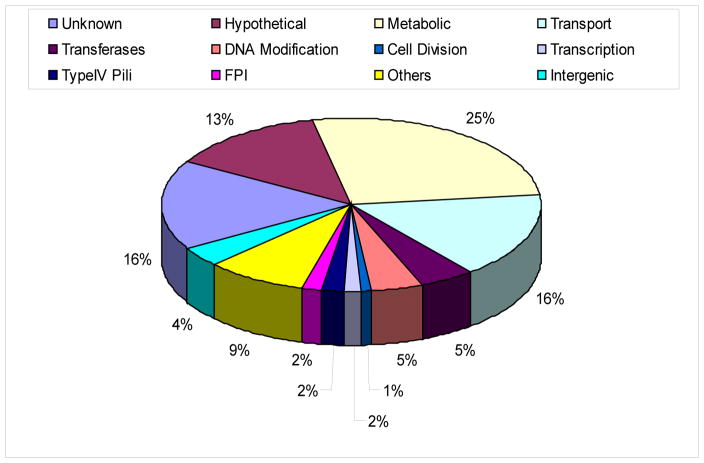
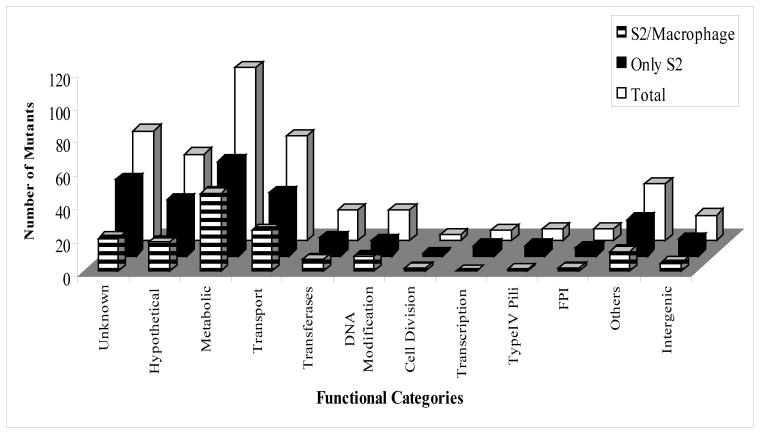
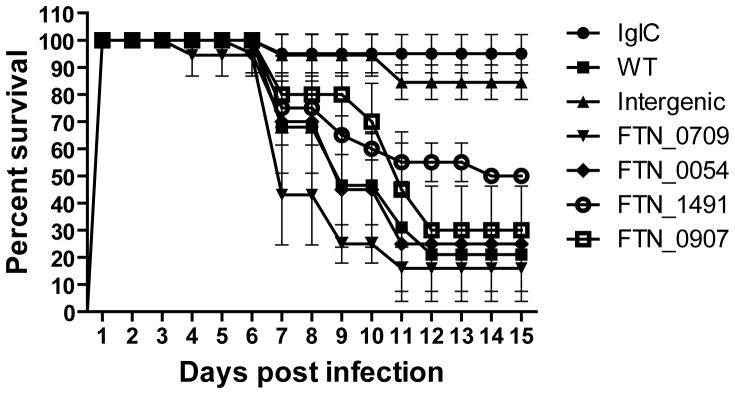
Arthropod vectors are important vehicles for transmission of Francisella tularensis between mammals, but very little is known about the F. tularensis-arthropod vector interaction. Drosophila melanogaster has been recently developed as an arthropod vector model for F. tularensis. We have shown that intracellular trafficking of F. tularensis within human monocytes-derived macrophages and D. melanogaster-derived S2 cells is very similar. Within both evolutionarily distant host cells, the Francisella-containing phagosome matures to a late endosome-like phagosome with limited fusion to lysosomes followed by rapid bacterial escape into the cytosol where the bacterial proliferate. To decipher the molecular bases of intracellular proliferation of F. tularensis within arthropod-derived cells, we screened a comprehensive library of mutants of F. tularensis ssp. novicida for their defect in intracellular proliferation within D. melanogaster-derived S2 cells. Our data show that 394 genes, representing 22% of the genome, are required for intracellular proliferation within D. melanogaster-derived S2 cells, including many of the Francisella Pathogenicity Island (FPI) genes that are also required for proliferation within mammalian macrophages. Functional gene classes that exhibit growth defect include metabolic (25%), FPI (2%), type IV pili (1%), transport (16%) and DNA modification (5%). Among 168 most defective mutants in intracellular proliferation in S2 cells, 80 are defective in lethality and proliferation within adult D. melanogaster. The observation that only 135 of the 394 mutants that are defective in S2 cells are also defective in human macrophages indicates that F. tularensis utilize common as well as distinct mechanisms to proliferate within mammalian and arthropod cells. Our studies will facilitate deciphering the molecular aspects of F. tularensis-arthropod vector interaction and its patho-adaptation to infect mammals.
© 2010 Society for Applied Microbiology and Blackwell Publishing Ltd.
Figures
References
-
- Tularemia--United States, 1990–2000. MMWR Morb Mortal Wkly Rep. 2002;51:181–184. - PubMed
-
- Anderson KV. Toll signaling pathways in the innate immune response. Curr Opin Immunol. 2000;12:13–19. - PubMed
-
- Apidianakis Y, Rahme LG. Drosophila melanogaster as a model host for studying Pseudomonas aeruginosa infection. Nat Protoc. 2009;4:1285–1294. - PubMed
-
- Baron GS, Nano FE. MglA and MglB are required for the intramacrophage growth of Francisella novicida. Mol Microbiol. 1998;29:247–259. - PubMed
Publication types
MeSH terms
Grants and funding
LinkOut - more resources
Full Text Sources
Molecular Biology Databases
