. 2010 May 18:11:23.
doi: 10.1186/1471-2172-11-23.

Significantly reduced CCR5-tropic HIV-1 replication in vitro in cells from subjects previously immunized with Vaccinia Virus

Affiliations

Significantly reduced CCR5-tropic HIV-1 replication in vitro in cells from subjects previously immunized with Vaccinia Virus

Raymond S Weinstein et al. BMC Immunol. .

Abstract

Background: At present, the relatively sudden appearance and explosive spread of HIV throughout Africa and around the world beginning in the 1950s has never been adequately explained. Theorizing that this phenomenon may be somehow related to the eradication of smallpox followed by the cessation of vaccinia immunization, we undertook a comparison of HIV-1 susceptibility in the peripheral blood mononuclear cells from subjects immunized with the vaccinia virus to those from vaccinia naive donors.

Results: Vaccinia immunization in the preceding 3-6 months resulted in an up to 5-fold reduction in CCR5-tropic but not in CXCR4-tropic HIV-1 replication in the cells from vaccinated subjects. The addition of autologous serum to the cell cultures resulted in enhanced R5 HIV-1 replication in the cells from unvaccinated, but not vaccinated subjects. There were no significant differences in the concentrations of MIP-1alpha, MIP-1beta and RANTES between the cell cultures derived from vaccinated and unvaccinated subjects when measured in culture medium on days 2 and 5 following R5 HIV-1 challenge.

Discussion: Since primary HIV-1 infections are caused almost exclusively by the CCR5-tropic HIV-1 strains, our results suggest that prior immunization with vaccinia virus might provide an individual with some degree of protection to subsequent HIV infection and/or progression. The duration of such protection remains to be determined. A differential elaboration of MIP-1alpha, MIP-1beta and RANTES between vaccinated and unvaccinated subjects, following infection, does not appear to be a mechanism in the noted protection.


Figures
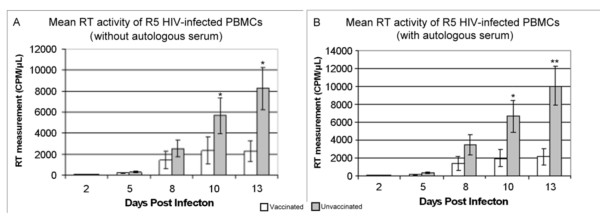
Figure 1
Figure 1
Comparison of R5 HIV-1ADA replication in PBMC cultures from vaccinia naïve (N-10) and vaccinia vaccinated (N = 9) subjects. Figure 1a shows cultures without and figure 1b shows cultures with pretreatment with autologous serum. A reduction in HIV replication can be seen on days 10 and 13. *p < 0.05 **p < 0.01.
Figure 2
Figure 2
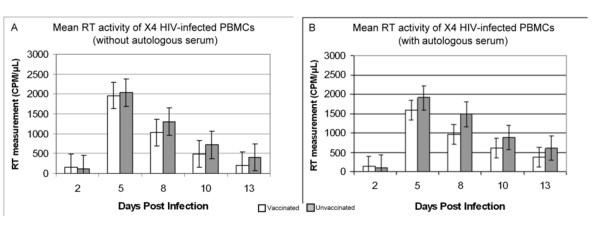
Comparison of X4 HIV-1NL4-3 in PBMC cultures from vaccinia naïve (N = 10) and vaccinia vaccinated (N = 9) subjects. Figure 2a shows cultures without and figure 2b shows cultures with pretreatment with autologous serum. No statistically significant difference between the vaccinated and unvaccinated subjects is found, however there is a trend toward reduced viral replication in the vaccinated subjects.
Figure 3
Figure 3
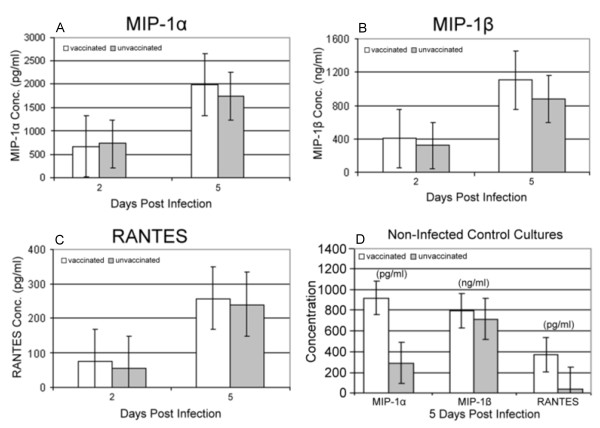
Chemokine analysis in culture supernatants. Comparison of MIP-1α (a), MIP-1β (b) and RANTES (c) release between the PBMCs from vaccinated (N = 9) and unvaccinated (N = 10) subjects on days 2 and 5 post culture inoculation with HIV-1ADA. No significant difference between the vaccinated and unvaccinated subjects is apparent. Figure 3d shows chemokine levels from non-infected control cultures (N = 2 for each group) on culture day 5. There is a trend toward a higher baseline chemokine production in the vaccinated subjects, though it is not statistically significant.

References

    1. Gao F, Bailes E, Robertson DL, Chen Y, Rodenburg CM, Michael SF, Cummins LB, Arthur LO, Peeters M, Shaw GM, Sharp PM, Hahn BH. Origin of HIV-1 in the chimpanzee Pan troglodytes troglodytes. Nature. 1999;397:436–41. doi: 10.1038/17130. - DOI - PubMed
    1. Zhu T, Korber BT, Nahmias AJ, Hooper E, Sharp PM, Ho DD. An African HIV-1 sequence from 1959 and implications for the origin of the epidemic. Nature. 1998;391:594–97. doi: 10.1038/35400. - DOI - PubMed
    1. Korber B, Muldoon M, Theiler J, Gao F, Gupta R, Lapedes A, Hahn BH, Wolinsky S, Bhattacharya T. Timing the Ancestor of the HIV-1 Pandemic Strains. Science. 2000;288:1789–96. doi: 10.1126/science.288.5472.1789. - DOI - PubMed
    1. Lemey P, Pybus OG, Wang B, Saksena NK, Salemi M, Vandamme AM. Tracing the origin and history of the HIV-2 epidemic. PNAS. 2003;100(11):6588–6592. doi: 10.1073/pnas.0936469100. - DOI - PMC - PubMed
    1. Rizzo P. No evidence of HIV and SIV sequences in two separate lots of polio vaccines used in the first U.S. polio vaccine campaign. Virology. 2001;287(1):13–17. doi: 10.1006/viro.2001.0955. - DOI - PubMed

Publication types

MeSH terms