


Characterisation of sugar beet (Beta vulgaris L. ssp. vulgaris) varieties using microsatellite markers
- PMID: 20482800
- PMCID: PMC2890681
- DOI: 10.1186/1471-2156-11-41
Characterisation of sugar beet (Beta vulgaris L. ssp. vulgaris) varieties using microsatellite markers
Abstract
Background: Sugar beet is an obligate outcrossing species. Varieties consist of mixtures of plants from various parental combinations. As the number of informative morphological characteristics is limited, this leads to some problems in variety registration research.
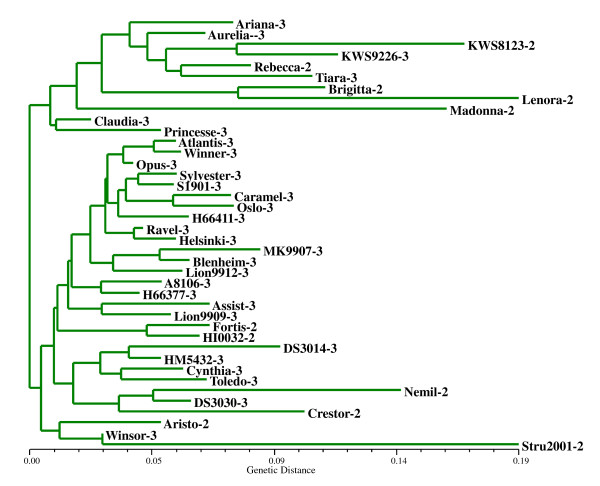
Results: We have developed 25 new microsatellite markers for sugar beet. A selection of 12 markers with high quality patterns was used to characterise 40 diploid and triploid varieties. For each variety 30 individual plants were genotyped. The markers amplified 3-21 different alleles. Varieties had up to 7 different alleles at one marker locus. All varieties could be distinguished. For the diploid varieties, the expected heterozygosity ranged from 0.458 to 0.744. The average inbreeding coefficient F(is) was 0.282 +/- 0.124, but it varied widely among marker loci, from F(is) = +0.876 (heterozygote deficiency) to F(is) = -0.350 (excess of heterozygotes). The genetic differentiation among diploid varieties was relatively constant among markers (F(st) = 0.232 +/- 0.027). Among triploid varieties the genetic differentiation was much lower (F(st) = 0.100 +/- 0.010). The overall genetic differentiation between diploid and triploid varieties was F(st) = 0.133 across all loci. Part of this differentiation may coincide with the differentiation among breeders' gene pools, which was Fst = 0.063.
Conclusions: Based on a combination of scores for individual plants all varieties can be distinguished using the 12 markers developed here. The markers may also be used for mapping and in molecular breeding. In addition, they may be employed in studying gene flow from crop to wild populations.
Figures
References
-
- Fénart S, Arnaud J-F, De Cauwer I, Cuguen J. Nuclear and cytoplasmic genetic diversity in weed beet and sugar beet accessions compared to wild relatives: New insights into the genetic relationships within the Beta vulgaris complex species. Theor Appl Genet. 2008;116:1063–1077. doi: 10.1007/s00122-008-0735-1. - DOI - PubMed
-
- Fischer HE. Origin of the 'Weisse Schlesische Rübe' (white Silesian beet) and resynthesis of sugar beet. Euphytica. 1989;41:75–80. doi: 10.1007/BF00022414. - DOI
-
- Van Geyt JPC, Lange W, Oleo M, De Bock ThSM. Natural variation within the genus Beta and its possible use for breeding sugar beet: A review. Euphytica. 1990;49:57–76. doi: 10.1007/BF00024131. - DOI
-
- McGrath JM, Saccomani M, Stevanato P, Biancardi E. In: Genome Mapping and Molecular Breeding in Plants. Vegetables. Kole C, editor. Vol. 5. Berlin: Springer; 2007. Beet; pp. 191–207. full_text.
-
- Bredemeijer GMM, Cooke RJ, Ganal MW, Peeters R, Isaac P, Noordijk Y, Rendell S, Jackson J, Röder MS, Wendehake K, Dijcks M, Amelaine M, Wickaert R, Bertrand L, Vosman B. Construction and testing of a microsatellite database containing more than 500 tomato varieties. Theor Appl Genet. 2002;105:1019–1026. doi: 10.1007/s00122-002-1038-6. - DOI - PubMed
Publication types
MeSH terms
LinkOut - more resources
Full Text Sources
Research Materials
Miscellaneous
