


Epigenetic marking of the BDNF gene by early-life adverse experiences
- PMID: 20483357
- PMCID: PMC2948595
- DOI: 10.1016/j.yhbeh.2010.05.005
Epigenetic marking of the BDNF gene by early-life adverse experiences
Abstract
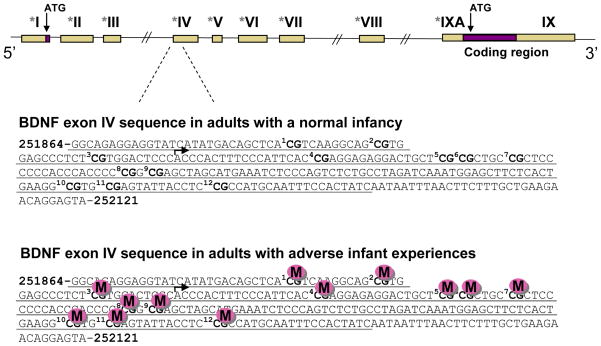
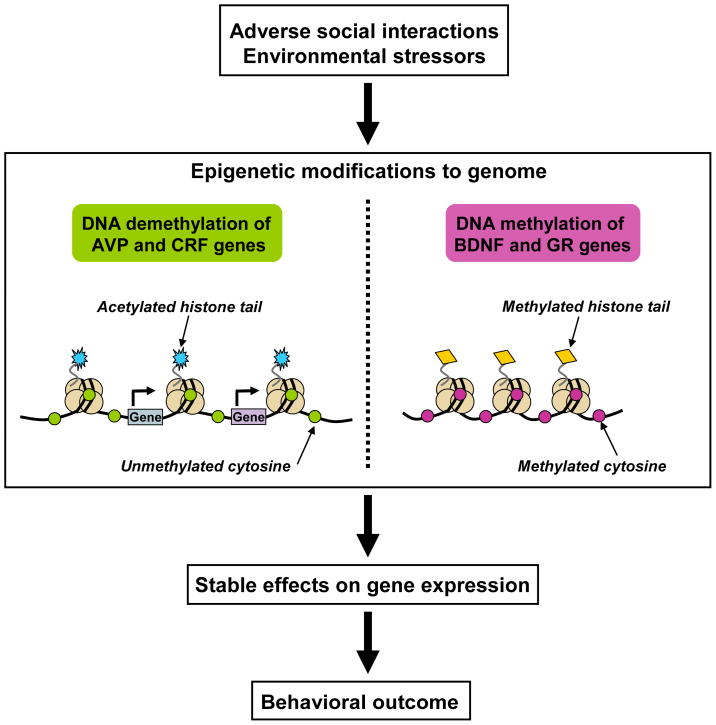
Studies over the past half-century have made it clear that environmental influences in development, particularly stress and traumatic experiences, can remain pervasive across the lifespan. Though it has been hypothesized for some time that the long-term consequences of early-life adversity represent epigenetic influences, it has not been until recently that studies have begun to provide empirical support of experience-driven epigenetic modifications to the genome. Here we focus on this theme, and review current knowledge pertaining to the epigenetics of behavioral development. At the center of our discussion is the brain-derived neurotrophic factor (BDNF) gene, as abnormal BDNF gene activity is a leading etiological hypothesis by which early-life adverse experiences persistently modify brain and behavioral plasticity.
Copyright © 2010 Elsevier Inc. All rights reserved.
Figures
References
-
- Abdolmaleky HM, Cheng KH, Russo A, Smith CL, Faraone SV, Wilcox M, Shafa R, Glatt SJ, Nguyen G, Ponte JF, Thiagalingam S, Tsuang MT. Hypermethylation of the reelin (RELN) promoter in the brain of schizophrenic patients: a preliminary report. Am J Med Genet. 2005;134:60–6. - PubMed
-
- Aisa B, Elizalde N, Tordera R, Lasheras B, Río JD, Ramírez MJ. Effects of neonatal stress on markers of synaptic plasticity in the hippocampus: Implications for spatial memory. Hippocampus. 2009;19:1222–1231. - PubMed
-
- Alleva E, Branchi I. NGF: A social molecule. Psychoneuroendocrinol. 2006;31:295–296. - PubMed
-
- Alleva E, Francia N. Psychiatric vulnerability: Suggestions from animal models and role of neurotrophins. Neurosci Biobehav Rev. 2009;33:525–536. - PubMed
Publication types
MeSH terms
Substances
Grants and funding
LinkOut - more resources
Full Text Sources
Medical
Miscellaneous
