


One year of alendronate treatment lowers microstructural stresses associated with trabecular microdamage initiation
- PMID: 20483387
- PMCID: PMC2918636
- DOI: 10.1016/j.bone.2010.05.016
One year of alendronate treatment lowers microstructural stresses associated with trabecular microdamage initiation
Abstract
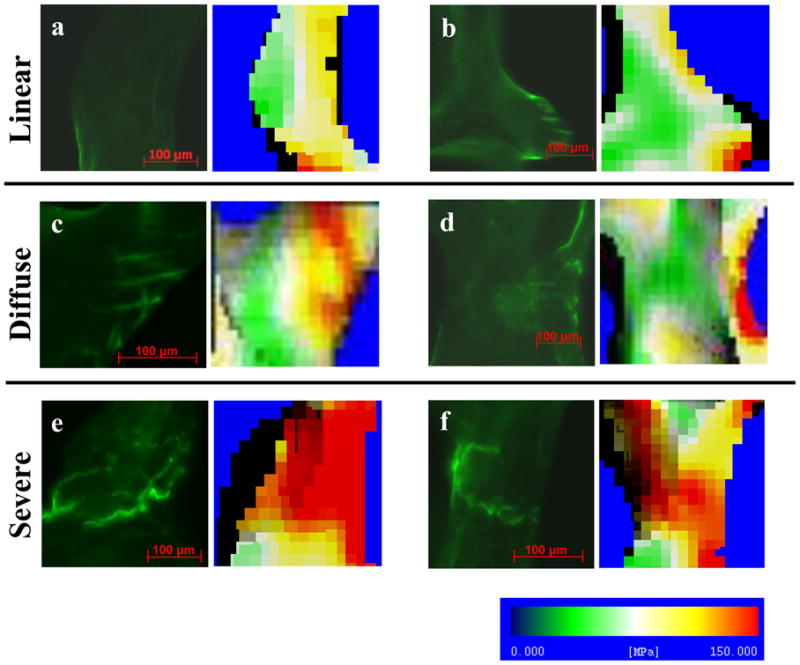
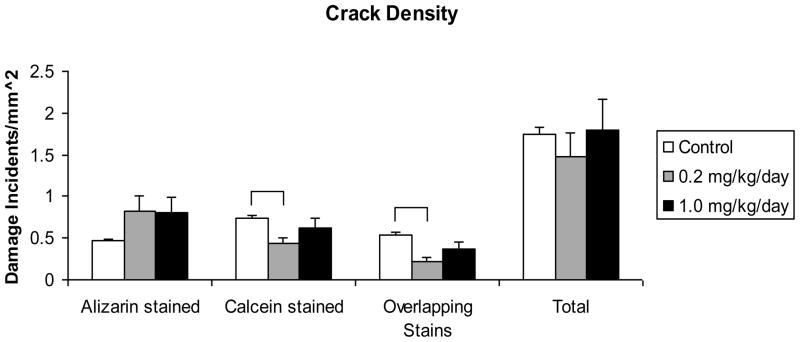
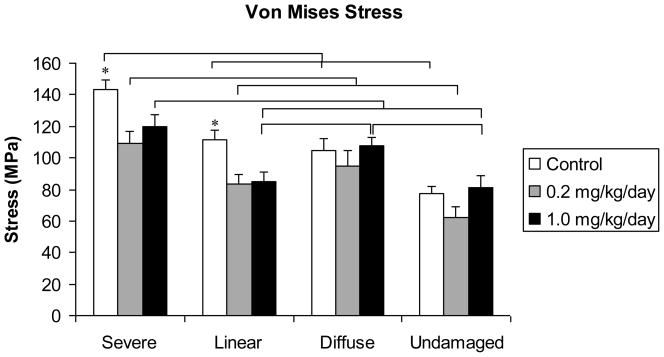
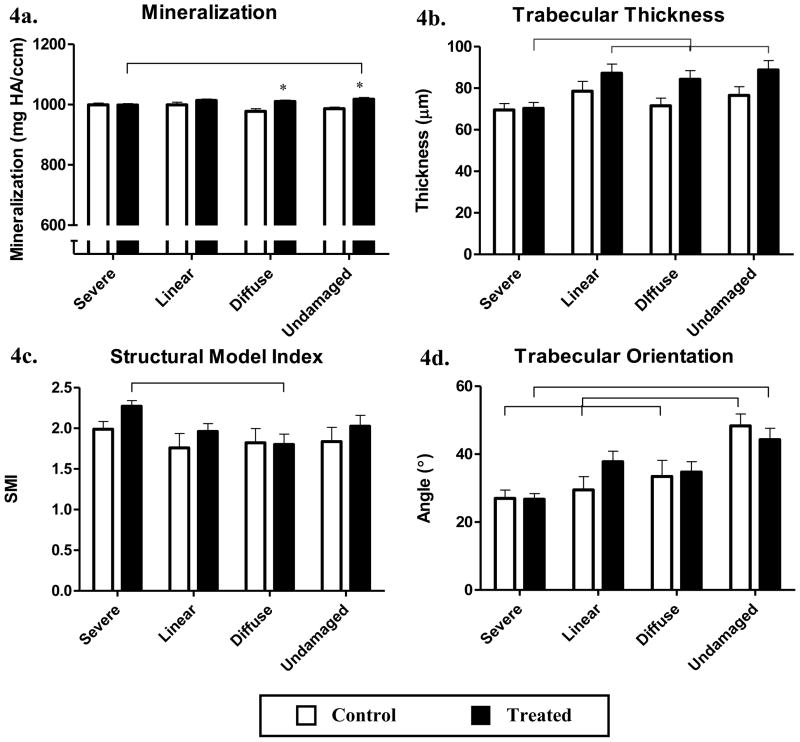
Alendronate, an anti-remodeling agent, is commonly used to treat patients suffering from osteoporosis by increasing bone mineral density. Though fracture risk is lowered, an increase in microdamage accumulation has been documented in patients receiving alendronate, leading to questions about the potentially detrimental effects of remodeling suppression on the local tissue (material) properties. In this study, trabecular bone cores from the distal femur of beagle dogs treated for one year with alendronate, at doses scaled by weight to approximate osteoporotic and Paget's disease treatment doses in humans, were subjected to uniaxial compression to induce microdamage. Tissue level von Mises stresses were computed for alendronate-treated and non-treated controls using finite element analysis and correlated to microdamage morphology. Using a modified version of the Moore and Gibson classification for damage morphology, we determined that the von Mises stress for trabeculae exhibiting severe and linear microcrack patterns was decreased by approximately 25% in samples treated with alendronate compared with non-treated controls (p<0.01), whereas there was no reduction in the von Mises stress state for diffuse microdamage formation. Furthermore, an examination of the architectural and structural characteristics of damaged trabeculae demonstrated that severely damaged trabeculae were thinner, more aligned with the loading axis, and less mineralized than undamaged trabeculae in alendronate-treated samples (p<0.01). Similar relationships with damage morphology were found only with trabecular orientation in vehicle-treated control dogs. These results indicate that changes in bone's architecture and matrix properties associated with one year of alendronate administration reduce trabecular bone's ability to resist the formation of loading-induced severe and linear microcracks, both of which dissipate less energy prior to fracture than does diffuse damage.
Copyright 2010 Elsevier Inc. All rights reserved.
Figures
References
-
- Seeman E. The antifracture efficacy of alendronate. Int J Clin Pract Suppl. 1999;101:40–5. - PubMed
-
- Liberman UA, Weiss SR, Broll J, Minne HW, Quan H, Bell NH, Rodriguez-Portales J, Downs RW, Jr, Dequeker J, Favus M. Effect of oral alendronate on bone mineral density and the incidence of fractures in postmenopausal osteoporosis. The Alendronate Phase III Osteoporosis Treatment Study Group. N Engl J Med. 1995;333(22):1437–43. - PubMed
-
- Seeman E. Is a change in bone mineral density a sensitive and specific surrogate of anti-fracture efficacy? Bone. 2007;41(3):308–17. - PubMed
-
- Allen MR, Iwata K, Phipps R, Burr DB. Alterations in canine vertebral bone turnover, microdamage accumulation, and biomechanical properties following 1-year treatment with clinical treatment doses of risedronate or alendronate. Bone. 2006;39(4):872–9. - PubMed
Publication types
MeSH terms
Substances
Grants and funding
LinkOut - more resources
Full Text Sources
Medical
