


Human tumor antigen-specific helper and regulatory T cells share common epitope specificity but exhibit distinct T cell repertoire
- PMID: 20483736
- PMCID: PMC7382897
- DOI: 10.4049/jimmunol.0903612
Human tumor antigen-specific helper and regulatory T cells share common epitope specificity but exhibit distinct T cell repertoire
Abstract
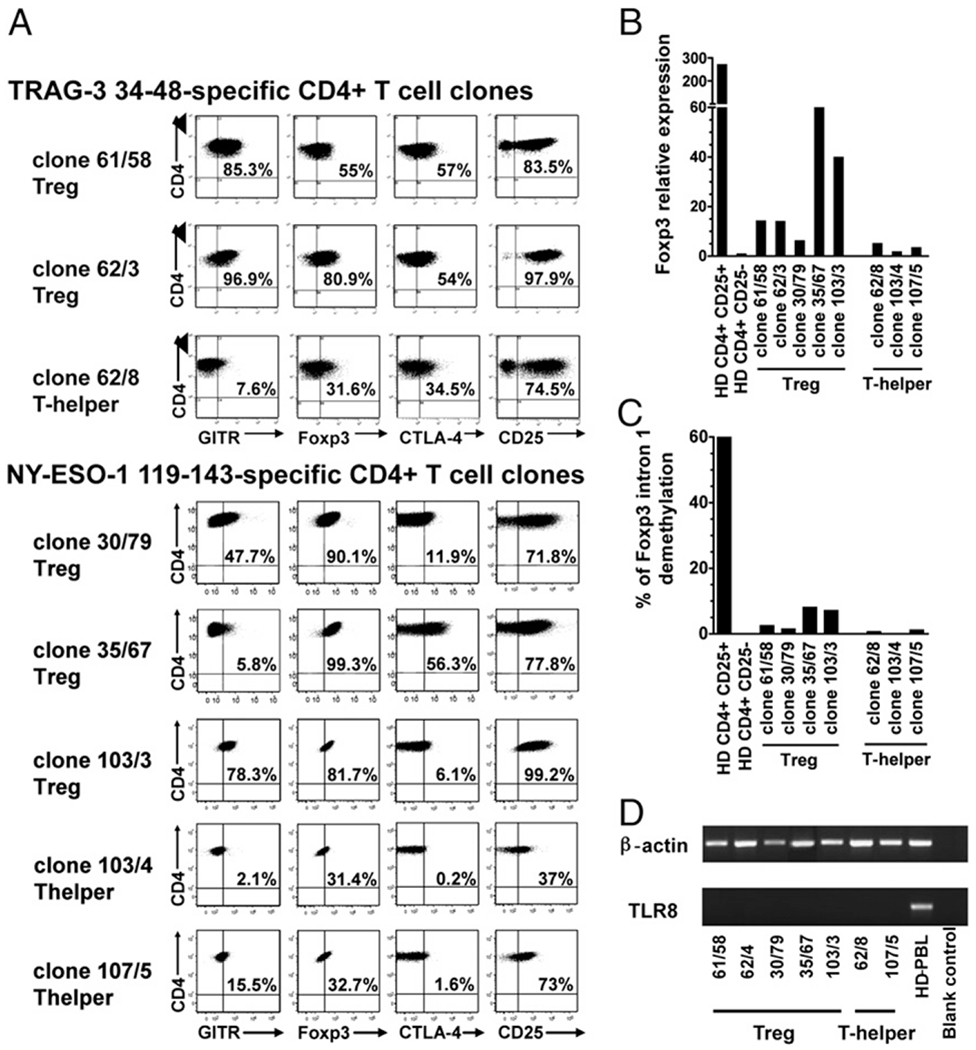
CD4(+) regulatory T cells (Tregs) accumulate at tumor sites and play a critical role in the suppression of immune responses against tumor cells. In this study, we show that two immunodominant epitopes derived from the tumor Ags (TAs) NY-ESO-1 and TRAG-3 stimulate both CD4+ Th cells and Tregs. TA-specific Tregs inhibit the proliferation of allogenic T cells, act in a cell-to-cell contact dependent fashion and require activation to suppress IL-2 secretion by T cells. TRAG-3 and NY-ESO-1-specific Tregs exhibit either a Th1-, a Th2-, or a Th0-type cytokine profile and dot not produce IL-10 or TGF-beta. The Foxp3 levels vary from one Treg clone to another and are significantly lower than those of CD4+CD25high Tregs. In contrast to NY-ESO-1-specific Th cells, the NY-ESO-1-specific and TRAG-3-specific Treg clonotypes share a common TCR CDR3 Vbeta usage with Foxp3+CD4+CD25high and CD4+CD25- T cells and were not detectable in PBLs of other melanoma patients and of healthy donors, suggesting that their recruitment occurs through the peripheral conversion of CD4+CD25- T cells upon chronic Ag exposure. Collectively, our findings demonstrate that the same epitopes spontaneously stimulate both Th cells and Tregs in patients with advanced melanoma. They also suggest that TA-specific Treg expansion may be better impaired by therapies aimed at depleting CD4+CD25high Tregs and preventing the peripheral conversion of CD4+CD25- T cells.
Conflict of interest statement
Disclosures
The authors have no financial conflicts of interest.
Figures




References
-
- Boon T, Cerottini JC, Van den Eynde B, van der Bruggen P, and Van Pel A. 1994. Tumor antigens recognized by T lymphocytes. Annu. Rev. Immunol 12: 337–365. - PubMed
-
- Rosenberg SA, Sherry RM, Morton KE, Scharfman WJ, Yang JC, Topalian SL, Royal RE, Kammula U, Restifo NP, Hughes MS, et al. 2005. Tumor progression can occur despite the induction of very high levels of self/tumor antigen-specific CD8+ T cells in patients with melanoma. J. Immunol 175: 6169–6176. - PubMed
-
- Marincola FM, Jaffee EM, Hicklin DJ, and Ferrone S. 2000. Escape of human solid tumors from T-cell recognition: molecular mechanisms and functional significance. Adv. Immunol 74: 181–273. - PubMed
-
- Sakaguchi S 2004. Naturally arising CD4+ regulatory t cells for immunologic self-tolerance and negative control of immune responses. Annu. Rev. Immunol 22: 531–562. - PubMed
-
- Shevach EM 2002. CD4+ CD25+ suppressor T cells: more questions than answers. Nat. Rev. Immunol 2: 389–400. - PubMed
Publication types
MeSH terms
Substances
Grants and funding
LinkOut - more resources
Full Text Sources
Other Literature Sources
Research Materials
